

Minister: Harapan Kita Hospital Achieves Financial Independence and BPJS Patient Subsidies
-
News
-
2 hours ago
This article was translated by AI. Read the original article on Kompas.com. See Original

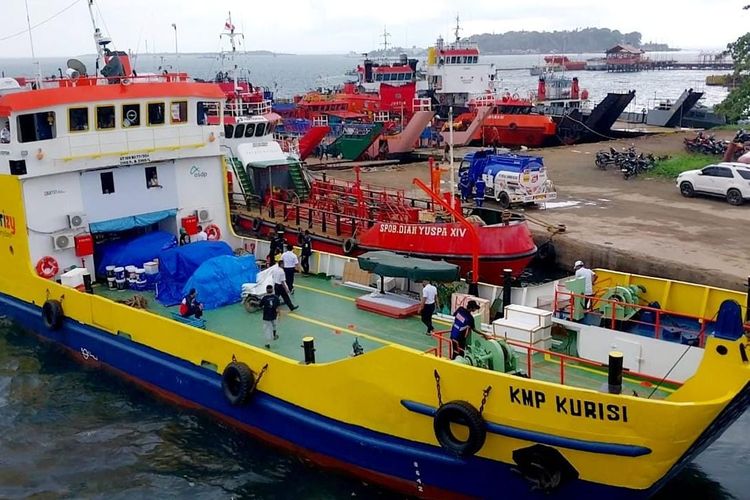
THE GOVERNMENT operates 41 sea highway routes and 107 pioneer passenger ship routes in 2026.
However, the success of these two programs cannot be measured merely by the number of ships sailing or the ports visited.
The fundamental question is whether subsidies are genuinely enhancing services, reducing logistics costs, and making goods more affordable for the public.
The sea highway focuses on distributing goods, especially essential and critical items, to backward, remote, outermost, and border areas.
Meanwhile, pioneer passenger shipping connects regions that are inadequately served by commercial transport, including access to education, healthcare, markets, and government services.
Both have distinct functions and do not necessarily overlap.
However, this functional difference does not negate the need to evaluate the effectiveness of their budgets.
The sea highway started in 2015 with three ships and three routes.
By 2023, the program serviced 39 routes with 38 ships. In 2024, the Ministry of Transportation recorded 39 ships and 39 routes.
A report by the Center for Budget Analysis and State Financial Accountability at the Indonesian House of Representatives noted that the realization of sea highway subsidies reached IDR 1.551 trillion and pioneer shipping subsidies amounted to IDR 4.508 trillion from 2020 to 2023.
Thus, the total subsidy realization for both programs reached approximately IDR 6.06 trillion over four years.
During the same period, the total realization of the maritime transport budget amounted to IDR 15.90 trillion.
This figure also includes subsidies for livestock ships, inter-island feeder ships, and mandated public services for Pelni passenger transportation.
Therefore, IDR 15.90 trillion cannot be solely referred to as the cost of the sea highway and pioneer ships.
The substantial budget indicates the government's commitment to improving connectivity in areas that are not commercially viable to serve.
Nevertheless, this expenditure needs to be balanced with measurements of the benefits received by the community.
The Ministry of Trade reported that the price variation coefficient between regions decreased from 14.2 percent in 2015 to 10.25 percent in 2024.
Additionally, a study by the Trade Policy Agency for the period from 2024 to May 2025 found that the median prices of several staple food commodities and essential goods in regions utilizing the sea highway tended to be 5-14 percent lower than in non-sea highway routes.
These findings indicate that benefits exist, but do not prove that all reductions in price disparities are due to the sea highway.
Prices are also influenced by production, demand, weather, ground transportation costs, and local market conditions.
Pioneer passenger shipping offers different benefits. This service aids residents of remote islands in accessing healthcare, education, markets, and government centers. Its success should be measured by fare affordability, schedule regularity, passenger numbers, and accessibility of basic services.
Debate arises when commercial ships that have already been operating are utilized in the sea highway subsidy scheme. The use of private ships is not inherently wrong.
This method can save costs on ship procurement and utilize available capacity.
However, the additional benefits must be evaluated. Imagine an island already served by three commercial ships.
If one of those ships then receives a subsidy, but its schedule, frequency, and capacity do not increase, the community may not receive any additional service.
Conversely, if the subsidy increases frequency, opens port access, provides cargo space for essential goods, or lowers fares, the scheme could indeed be beneficial.
Thus, the government needs to compare conditions before and after subsidies for each route.
Metrics should include sailing frequency, additional capacity, vessel occupancy rates, transportation fares, and price changes for goods in the destination area. The designation of operators should also be transparent and allow for healthy competition.
The budget study by the Indonesian House of Representatives noted that from 2020 to 2023, the sea highway transported 102,877 TEUs and 3,178 tons of goods via 29 routes with 37 ships.
Meanwhile, a report from Ocean Week on October 13, 2026, stated that by the first half of 2026, the sea highway had completed 557 sailings and served 100 ports.
Outbound cargo was recorded at 21,762 TEUs and 1,682.42 tons, while return cargo reached 6,660 TEUs.
According to the TEU figures in that report, the return load is equivalent to approximately 30.6 percent of the outbound load.
This aggregate figure is not sufficient to conclude that all routes are inefficient.
However, the government needs to examine which routes have low return loads and seek the causes.
Local governments should map the potential agricultural, fishery, plantation, and local business products and connect producers with buyers.
Without cargo consolidation and market access, ships risk returning with suboptimal load space.
Logistics costs do not stop at shipping rates. Transportation costs from warehouses to ports, loading and unloading, storage, and distribution to consumers also determine final prices.
Lower maritime tariffs do not necessarily reduce prices if costs along the distribution chain remain high.
The government must evaluate the effectiveness of budgets for each route, additional capacity and frequency, optimization of return loads, logistics costs from upstream to downstream, port readiness and land access, as well as changes in prices paid by the community.
Subsidies remain necessary for regions that cannot yet be served commercially.
The state cannot simply stop services that serve as crucial links to other regions.
However, subsidies should not be granted without clear performance metrics.
Routes that can already be served commercially should be evaluated to reduce dependency on subsidies.
Conversely, areas that still require basic services must continue to be served.
Decisions need to consider community needs and the availability of alternative transport, not just the operator's profit and loss.
The success of pioneer shipping should not be measured by the number of continually subsidized ships but rather by the growing number of routes that can eventually operate without subsidies due to the economic development of the regions they serve.
Ultimately, the goal of subsidies is not just to have ships sailing. The aim is to ensure that the community gains access to transportation, essential goods at more affordable prices, and broader economic opportunities.
Every rupiah from the State Revenue and Expenditure Budget should yield measurable benefits for the public.