
The Fate of IKN After Being Excluded from the Government Work Plan
-
News
-
36 minutes ago
This article was translated by AI. Read the original article on Kompas.com. See Original
WHY is the two-year mark of the administration considered crucial? It represents the point where hopes and disappointments become visibly apparent.
Promises, once driven by faith, now confront reality.
At the two-year juncture, success can no longer be merely announced, and failures are increasingly difficult to conceal.
The public begins to compare what was promised with their actual experiences.
The two-year mark of governance is an appropriate moment for a clear evaluation.
This time frame is sufficient to assess policy directions, understand initial outcomes, and identify issues needing correction.
At this stage, there is still time to remedy situations, but apologies are starting to lose their persuasion and appeal.
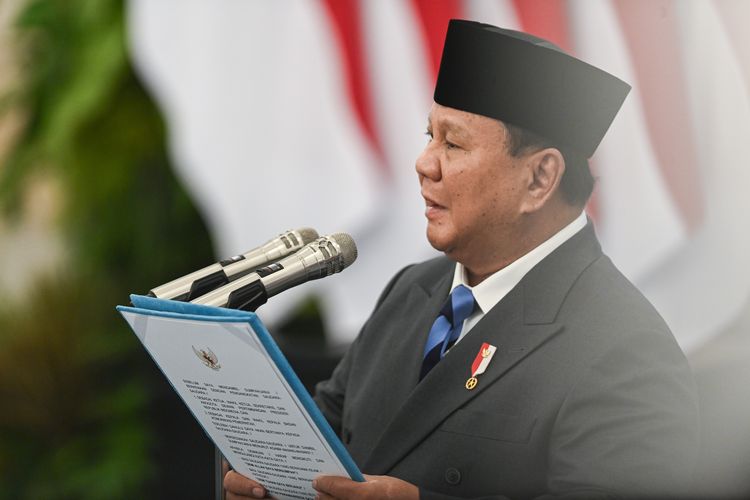
Assessing the administration of Prabowo Subianto and Gibran Rakabuming Raka requires a dual stance: recognizing verifiable achievements while also critiquing areas that have not yielded promised changes.
Of course, the Asta Cita of Prabowo-Gibran presents a broad and ambitious development agenda. Food and energy self-sufficiency, human development, industrialization, fortification of defense, the eradication of corruption, and reforms in law and bureaucracy are all goals relevant to national interests.
It is not an exaggeration to commend the Prabowo administration for situating these agendas within an interconnected development framework.
Food relates to welfare and national resilience. Education and health determine the quality of human resources.
Industrialization connects to value creation and job opportunities.
Meanwhile, legal certainty and bureaucratic quality are prerequisites for investment and public service.
However, it should be noted that the broader the development agenda, the greater the demands for coordination, budgeting capacity, bureaucratic quality, and policy consistency.
The eight major missions cannot receive equal attention at every stage of governance.
The Prabowo government needs to set the most critical objectives, allocate resources effectively, and ensure that each program has a clear relationship to its ultimate goals.
Ambition serves as political capital, but the ability to prioritize determines whether that ambition can be realized.
In terms of human development, the Free Nutritious Meal program (MBG), health screenings, and educational strengthening demonstrate the government's efforts to expand state interventions into the basic needs of society.
These programs deserve commendation because they address real issues.
Children need proper nutrition to grow and learn. Communities require easier access to healthcare. Education needs adequate facilities and qualified teaching staff.
The state should not merely wait for society to resolve these issues using its own resources.
However, appreciation for the objectives does not imply that all implementations should be accepted without scrutiny.
The success of the MBG program cannot solely be measured by the quantity of food distributed but also by nutritional quality, targeting accuracy, and overall impact.
Improvements in schools need to lead to better reading, math, and critical thinking skills among students.
Health screening expansions must be accompanied by adequate medical follow-up.
Therefore, success must extend beyond administrative reach to enhance the quality of life.
In the agricultural sector, the orientation towards self-sufficiency deserves positive attention. Food self-sufficiency can reduce vulnerability to international market volatility and strengthen national resilience.
If production improvements can be sustained, distribution improved, and import dependency reduced over time, this agenda might become one of the significant legacies of the Prabowo administration.
However, agricultural success cannot be measured solely by national production figures. Affordable prices, farmers' income, land productivity, water availability, and climate change resilience must also be part of the evaluation.
Self-sufficiency that boosts production but does not improve farmers' welfare undoubtedly poses significant problems.
In terms of the economy, growth remains an important indicator but is not the only measure of success.
The government deserves credit for maintaining stability and boosting economic activity amid global uncertainties.
Nevertheless, that success must translate into household realities.
People experience the economy through the prices of basic necessities, income, job opportunities, education costs, and their ability to meet daily needs.
Thus, growth must be accompanied by the creation of productive jobs, real wage increases, expanded business opportunities, and a more equitable distribution of development benefits.
As long as people face cost-of-living pressures, the government should not adopt a defensive posture towards criticism.
Such criticism can serve as an indication that economic growth has not been fully felt by all segments of society.
Conversely, economic pressures should not lead to the dismissal of all macroeconomic achievements.
A fair assessment must acknowledge measurable progress while also identifying groups that have not benefitted adequately.
Similar challenges arise in legal reform and governance.
The eradication of corruption, bureaucratic simplification, and increased policy effectiveness certainly require strong leadership, but not merely performative assertiveness—rather, assertiveness that aligns with legal certainty, transparency, and accountability.
The effectiveness of law enforcement is not solely determined by the number of cases handled but also by the consistency of law application and equitable treatment.
The Prabowo government will gain stronger trust if the public perceives that position, political proximity, and economic power do not dictate who receives special treatment.
Another issue that warrants attention is the quality of institutional oversight.
Broad political support from coalition parties can indeed assist the Prabowo administration in executing its development agenda.
However, such support should not undermine the legislative oversight function.
Strengthening the state does not mean expanding executive authority without bounds.
A strong state features institutions capable of executing their duties professionally, overseeing one another, and correcting presidential errors.
Additionally, the civil-military relationship needs careful consideration. Strengthening defense is a national necessity, but military professionalism must continue within the framework of civil supremacy and clear power division.
The Prabowo administration should not need to choose between security and democracy. Both must be simultaneously reinforced.
Evaluating the Prabowo-Gibran administration need not be framed as a conflict between appreciation and criticism.
Appreciation without critique risks turning the evaluation into a justification. Criticism without appreciation risks overlooking the progress that has indeed been made.
A healthy administration requires both: recognition of successes and the courage to rectify shortcomings.