

Malang Student Dies, Legislator Calls for Fundamental Reforms in Child Protection
-
News
-
8 minutes ago
This article was translated by AI. Read the original article on Kompas.com. See Original
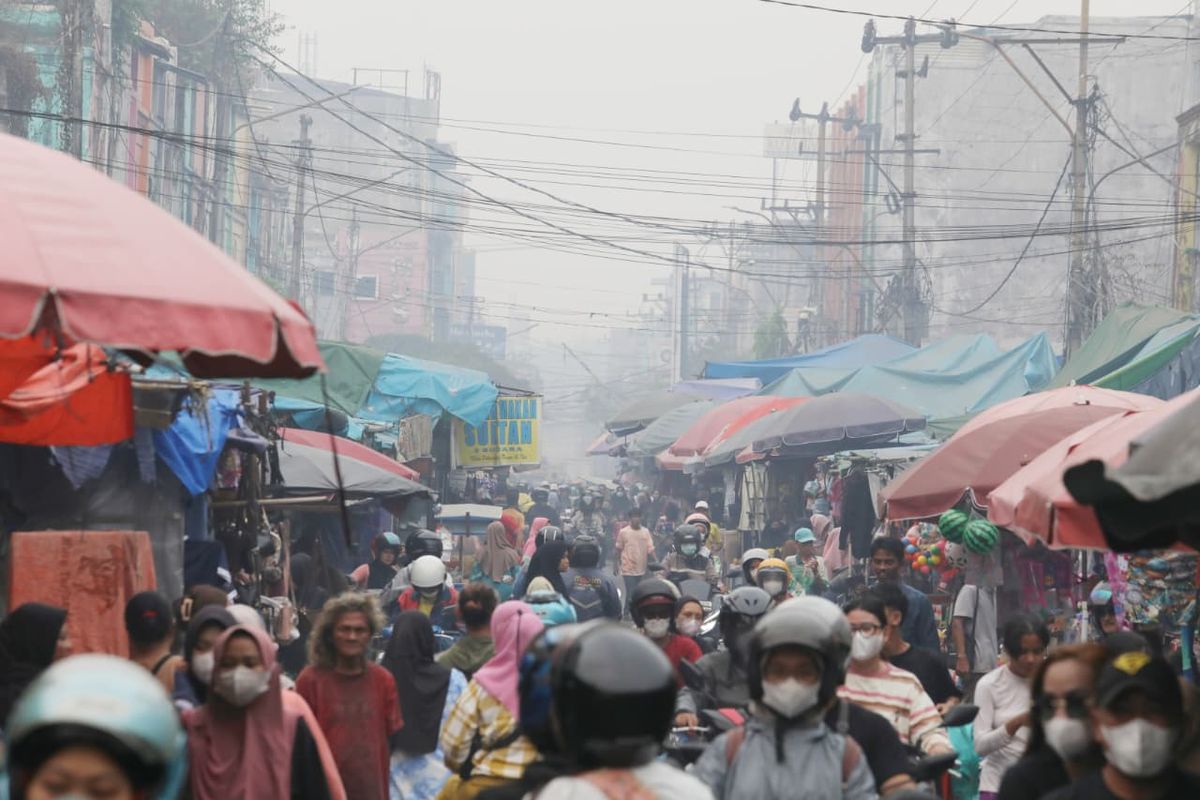
SATURDAY (10/10/2026) at 10:00 AM WIB, the air quality index (AQI) in Palembang registered 1,203, categorized as "Hazardous" (IQAir, 2026).
We, living in areas affected by forest and land fires, breathe in numbers that were never designed for human comprehension.
Imagine a figure above 301 is already deemed hazardous, and we are inhaling polluted air at 1,203. What does this mean?
The standard AQI used by IQAir spans from 0 to 500.
Beyond 300, the official alert system is already at the highest level: Hazardous.
This means that, from a health perspective, the entire population will be seriously affected. Not just humans, but also animals and plants.
IQAir only displays measurements up to 500 on its official map. The figure of 1,203 appears when local sensors measure extremely high concentrations of PM2.5 particles.
The AQI formula continues to function, causing the numbers to swell far beyond 500.
For me, the number 1,203 is not just data. It's the government's "Performance Index" announced to us.
The government conveys, with a tone of emotional weight, that everyone is working tirelessly to extinguish the fires from air-conditioned offices in Jakarta, Palembang, Jambi, Pekanbaru, Palangka Raya, Pontianak, Banjarmasin, and other major affected cities.
Yet here, on our own soil, the state has failed to provide us with one of the most basic necessities: breathable air.
We are no longer fully living. We're merely surviving amidst choking, coughing, dry throats, and burning eyes, surrounded by toxic smoke.
Two days earlier, the ASEAN Special Meteorological Centre (ASMC) reported that numerous air quality monitoring stations in Peninsular Malaysia, Singapore, Borneo, and Sumatra were at unhealthy to dangerous levels (ASMC, 2026).
Amidst those numbers, on September 29, the government announced the sealing of 57 corporate entities whose concession areas have burned a total of 34,636 hectares (KLH, 2026).
The figure of 57 was presented as proof of the state's presence. However, WALHI stated that at least 372 companies are suspected of being involved in forest and land fires this year, based on the distribution of hot spots and tracing of group affiliations (WALHI, 2026).
This means that only about 15 percent of those indicated have been sealed. Hot spots are not criminal evidence, and companies have the right to contest.
The Deputy Minister of Environment himself reminded that hot spot data does not automatically prove a company's culpability (KLH, 2026).
Environment Minister Jumhur Hidayat stated on one occasion that the sealing is based on the principle of strict liability.
If that principle is genuinely applied, the question of who struck the match becomes irrelevant. The only question is who holds the land permit.
A second question could continue: Why was the peat left dry, becoming a warehouse for fuel?
While authorities are busy searching for the firestarter, landowners or permit holders breathe easy in their air-conditioned offices and are never asked to explain.
The scale of the fires is significant. The monitoring system of Sipongi from the Ministry of Forestry reported 202,004.30 hectares burned from January to July 2026 (Kemenhut, 2026), and for six priority provinces, about 72,088.61 hectares had been recorded by September (Kemenko PMK, 2026).
At that time, the Coordinating Minister for Political, Legal, and Security Affairs, Djamari Chaniago, even acknowledged that the peak of El Niño had yet to be reached. This means these numbers are not the peak but rather the slope of rising figures.
The regional data is even more alarming. WALHI West Kalimantan reported 6,910 hot spots throughout August, with distribution across 115 oil palm plantation permits and 51 forest utilization permits, as well as 14 forest utilization areas that burned (WALHI Kalbar, 2026).
In Central Kalimantan, WALHI found 32,796 hot spots and around 38 impacted concessions; in Riau, 34 corporate areas recorded a total fire area of 16,277.5 hectares (WALHI, 2026).
In South Sumatra, the region that nurtured and raised me, WALHI South Sumatra counted 22,690 hot spots within concessions from September 1 to October 2, almost 17,000 of which were in peat ecosystems (WALHI Sumsel, 2026).
On October 7, Deputy Minister of Environment Diaz Hendropriyono inspected peat fire sites in Talang Kelapa District, which included plantations and residential areas, and then chaired a meeting with 43 concession-holding companies in the area where the fires occurred.
Data from KLH for the 57 sealed entities points in a similar direction: 19 are in West Kalimantan, 12 in South Sumatra, with 88.9 percent of the burned area in Kalimantan (KLH, 2026).
Actually, in 2025, the then Minister of Environment Hanif Faisol Nurofiq referred to Presidential Instruction Number 3 of 2020 as a basis for acting against concession holders allowing fires. Now there is Presidential Instruction Number 11 of 2026 addressing the strengthening of the ban on land clearing by burning.
Every new regulation made hastily is a quiet acknowledgment that the old ones lack power, because they have no enforcement strength.
A government that has to repeat orders annually to the same parties signifies a government that lacks authority. The public cannot place hope in them.
The state issues HGU and forestry utilization permits, then sits as a judge over those permits.
The absurdity peaks when the reported parties include state-owned enterprises, which WALHI has recorded as having repeatedly burned land (WALHI, 2026). Investigators, permit issuers, and landowners converge within one entity.
There is also the discrepancy in figures: KLH mentions 34,636 hectares in the 57 corporate concessions, while Sipongi records about 72,088.61 hectares in six provinces as of September (Kemenko PMK, 2026).
The coverage and dates differ, but that rough comparison suggests that the 57 corporate concessions contribute approximately 48 percent or less. Who controls the remainder has not been explained.
Data from the National Police adds another layer. As of September 28, the Criminal Investigation Department (Bareskrim) is handling 341 police reports covering an area of 30,566.55 hectares: 245 individual reports for 5,181.61 hectares, and 96 corporate reports for 25,384.94 hectares (Bareskrim Polri, 2026).
This means approximately 83 percent of the issues lie with corporate filings.
However, all 196 suspects identified are individuals, with only four suspects related to corporations recorded by September 30.
Eight out of ten hectares are pursued through corporate filings, but 196 out of 200 suspects are individuals. This is the direction of our legal system: always focused downwards.
The impacts are now evident across borders. On Friday, October 9, Malaysia closed schools in its capital and several states.
The closures are expected to affect around two million students, as the Air Pollution Index in Kuala Lumpur was about 170 (Malaysian Ministry of Education, 2026).
On the morning of that day, 37 areas were reported as unhealthy according to Malaysian government data. Sultan Ibrahim stated that schools would close when the "Air Pollution Index" (API) reaches 150 or higher.
Prime Minister Anwar Ibrahim admitted to directly contacting President Prabowo and requested his foreign minister to arrange an emergency ASEAN environmental ministers meeting (Anwar Ibrahim, 2026), while Malaysia added artificial rain operations (Malaysian Government, 2026).
Singapore is not faring any better. The "National Environmental Agency" (NEA) noted a 24-hour "Pollutant Standard Index" (PSI) of 192 in the central region on October 9, the highest since smoke returned in September 2026.
In an advisory issued on October 8, the NEA described moderate to thick haze from southern and central Sumatra and West Kalimantan moving towards Singapore (NEA, 2026).
The ASEAN Agreement on Transboundary Haze Pollution (AATHP) establishes obligations for prevention and monitoring.
Two decades later, the results still consist of diplomatic notes and emergency meetings, not enforceable accountability. Diplomacy is always cheaper for permit holders than going to court.
The smoke does not stop at national borders. According to WALHI, among the 372 suspected companies, about 26 are affiliated with Malaysia and 26 with Singapore (WALHI, 2026).
Those who are most vocal about the smoke are often the capital owners behind the flames. But Jakarta cannot hide behind the passports of shareholders; permits are issued and monitored here.
KLH states that repeated fires will be a black mark in PROPER assessments, but the results, it says, are still being processed (KLH, 2026). This is legally cautious but insufficient for public scrutiny.
The President has already requested that these names reach him. The public has not been granted the same access.
Presumption of innocence does not require secrecy, only requires the right to respond.
Announce the names, seal dates, burned area, legal status, and corporate responses in an open document, so buyers, banks, and the stock exchange can punish based on data, not whispers.
Calls to impoverish corporations sound appealing, but can easily be countered in court. What is far more lethal for these businesses is not their bank accounts but their permits.
Revoking HGU and forest utilization permits automatically upon the second occurrence. Shifting the burden of proof to permit holders to demonstrate their prevention systems are effective.
Opening up the ultimate beneficial owners to ensure that controllers, not shell companies, are accountable.
Doctrinally, the term ecocide has yet to be codified as a positive legal norm within the national criminal law system.
Therefore, its strategic use is better positioned as a framework for moral and ethical-political demands to create urgency, rather than as a basis for formal legal prosecution that would be easily dismissed in court.
The greatest pressure may come from abroad. WALHI demands that Malaysia and Singapore hold their affiliated corporations accountable, including revoking sustainability certifications (WALHI, 2026).
Verbal commitments among heads of state will evaporate if not tied to figures: how many permits revoked, how many names announced, how many suspects among the controllers.
Thus, we propose a simple ninety-day test. Within two weeks, publish the list of 57 entities along with their legal status. Within sixty days, complete the verification of hundreds of other entities that Minister Jumhur states are still ongoing.
In ninety days, revoke the permits of repeat offenders. If the deadline passes without results, the public has the right to conclude that the seal was the goal, not the means.
Article 28H, paragraph (1) of the 1945 Constitution guarantees the right to a good and healthy environment. The seals can be reopened, but our lungs cannot.
The number 1,203 on this Saturday morning is not an instrumental anomaly. It is not an error of measurement.
Rather, it is an empirical manifestation of regulatory failure: a cost externality imposed on the public when the state prefers symbolic administrative instruments in the form of sealing over corrective legal instruments in the form of permit revocation.
At this point, the pollution phenomenon has experienced a paradigm shift: it can no longer be read merely as a bio-physical environmental crisis, but has transformed into a crisis of ecological justice and a violation of citizens' constitutional rights to a good and healthy environment.