

Request for Thorough Investigation into Bullying that Killed SMAN 7 Malang Student, KPAI: Do Not Let It Happen Again
-
News
-
4 minutes ago
This article was translated by AI. Read the original article on Kompas.com. See Original
JAKARTA, KOMPAS.com - A total of 639 death row inmates in Indonesia are still awaiting legal certainty regarding the mechanism for changing the death penalty to life imprisonment or commutation.
In the meantime, they also face the risk of mental and physical strain due to uncertainty surrounding execution timelines.
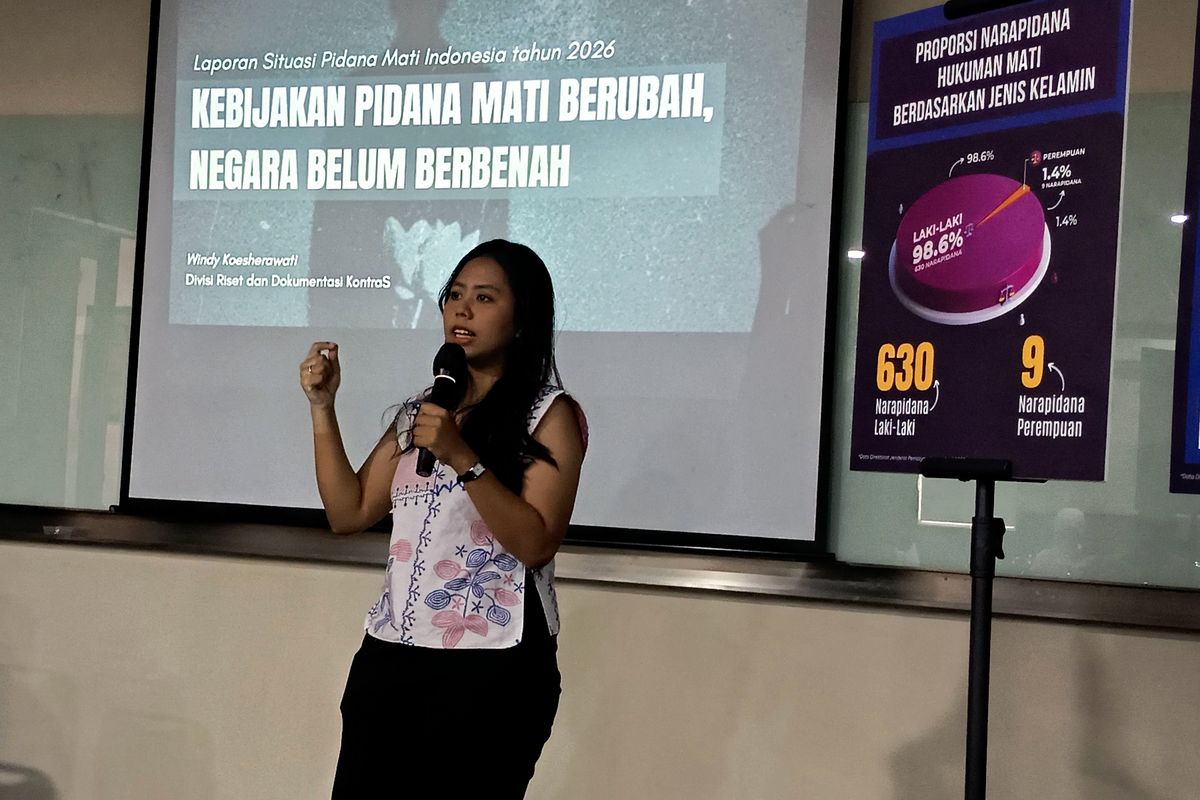
The Commission for Missing Persons and Victims of Violence (KontraS) highlighted these conditions in its 2026 Indonesia Death Penalty Situation Report launched at Atma Jaya University on Friday (9/10/2026).
Windy Koesherawati, a member of KontraS's Research and Documentation Division, stated that as of April 2026, out of 639 death row inmates, 630 are men and nine are women.
The crimes they are convicted of vary widely, ranging from violence against women and children, narcotics, psychotropics, murder, robbery, violations of child protection laws, to terrorism.
"Out of 639 individuals (as of April 2026), 630 are men, while the remaining nine are women. The crimes varied, including violence against women and children, narcotics, psychotropics, murder, robbery, child protection violations, and terrorism," said Windy during the launch of the Indonesia Death Penalty Situation Report at Atma Jaya University on Friday (9/10/2026).
According to Windy, the issues faced by death row inmates extend beyond the certainty of punishment execution; it also includes their living conditions while waiting in correctional facilities.
They risk experiencing the death row phenomenon, a psychological and physical pressure stemming from prolonged uncertainty about when they will be executed.
This condition can worsen due to isolation, discrimination, poor prison conditions, and limited access to education and recreation.
"Death row inmates experience this phenomenon because they must live with long-term mental and physical trauma from not knowing when they will be executed," she explained.
In addition to legal uncertainties, KontraS has highlighted the shortage of social counselors, which could potentially hinder the assessment process for prisoners, including death row inmates who have the opportunity to change their sentences to life imprisonment.
Windy stated that the current number of available social counselors is far from the ideal requirement.
"Currently, there are only 2,623 social counselors available on the ground. According to research from the Directorate General of Corrections, the ideal number of social counselors should be 16,422," Windy said.
"Ultimately, this situation affects the length of the assessment process and the uncertainty of assessments for death row inmates, further increasing the death row phenomenon they experience," she added.
The gap in the number of counselors is viewed as a factor that prolongs the assessment process, leaving death row inmates in extended uncertainty.
The presence of social counselors becomes vital in line with the updates to the death penalty policy in the new Criminal Code (KUHP).
Through the commutation mechanism, the death penalty can be converted to life imprisonment in accordance with existing regulations.
In this process, assessments are required to evaluate the changes in the attitude of prisoners and to see how the rehabilitative process affects their behavior.
However, Windy noted that there are still issues regarding death row inmates' understanding of the rights they can exercise to seek sentence reductions.
"This is problematic because they are unaware of the rights they have to reduce their sentences, such as the right to seek counseling regarding the commutation process," Windy explained.
"They do not know that there is a commutation mechanism that could save them from execution. Unfortunately, such matters are overlooked by the state," she added.
Erasmus, Director of the Institute for Criminal Justice Reform (ICJR), stated that defendants from economically vulnerable backgrounds are more likely to be sentenced to death due to limited access to effective legal defense.
Erasmus argued that economic conditions can affect a defendant's ability to secure adequate legal representation during the judicial process.
"If you are poor, your chances of receiving the death penalty are higher," Erasmus said.
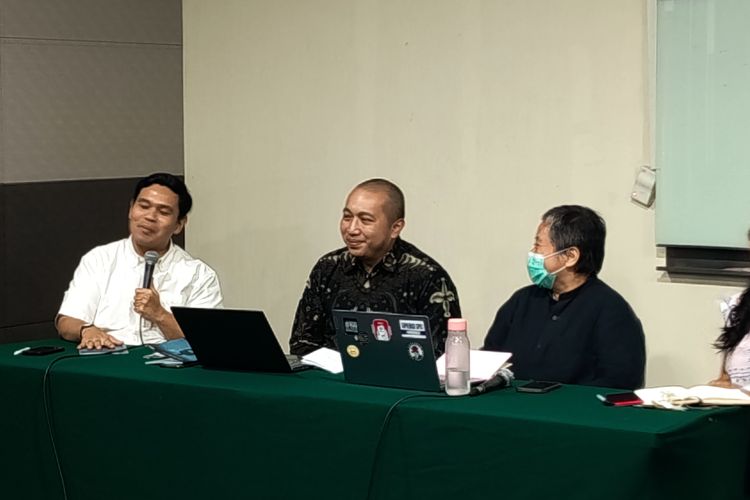 Erasmus, Director of ICJR, responding to KontraS's study on the death penalty policy in Indonesia, Friday (9/10/2026).
He contended that death penalty cases should not merely be viewed through the lens of the crime committed by the defendant. The quality of the judicial process and access to legal assistance must also be considered.
Erasmus questioned whether every defendant facing a death sentence had received adequate defense, especially if they came from economically weaker groups.
He stressed that a defendant's ability to secure a lawyer with sufficient resources and experience can greatly influence their defense in court.
"If your lawyer is top-tier and can attract media attention, like in the Jessica - Mirna case where the charge was premeditated murder, you might escape the death penalty. So in Indonesia, being poor can lead you to a death sentence," he explained.
He asserted that public attention towards a case and the ability to present a robust defense must be considered when discussing equality before the law.
Erasmus also referenced the case of Yusman, a client of KontraS, emphasizing the importance of legal assistance in cases that could lead to a death sentence.
"Why am I mentioning this? Because this is actually one of KontraS' clients, Yusman. If it weren't for KontraS, Yusman would have been executed by now. Yusman's lawyer was the same one who had Yusman sentenced to death. The prosecutor sought life imprisonment," he revealed.