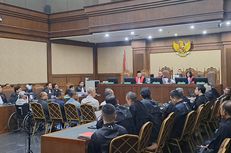
Six Defendants in Crude Oil Corruption Case File Exception After Alleged State Losses of Rp 6.1 Trillion
-
News
-
1 minute ago
This article was translated by AI. Read the original article on Kompas.com. See Original

JAKARTA, KOMPAS.com - Bambang Soesatyo, a member of the Presidential Advisory Council of the Republic of Indonesia (Wantimpres RI), explained the rationale behind the expansion of the working commissions.
“The plan to form six commissions must be viewed as an effort to align the work of Wantimpres RI with the complexity of current challenges facing Indonesia,” Bamsoet stated, as quoted from his remarks on Friday (9/10/2026).
In the previous term, Wantimpres operated with only four commissions: Politics, Law and Human Rights; Defense and Security; People's Welfare; and Economics and Finance.
In contrast, the Wantimpres for the 2026-2029 term will have six commissions: Geopolitics, Law, Human Rights, Defense and Security; Economics and Finance; Human Development and Community Empowerment; Food; Infrastructure; and Downstreaming and Energy Transition.
This change is deemed crucial for providing more focused and incisive advisory functions to President Prabowo Subianto, enabling better responsiveness to national and global issues.
According to Bamsoet, the world is rapidly changing, with geopolitical issues increasingly impacting the economy, food security, and energy.
On the other hand, he continued, national development also requires more specific attention to human resources, infrastructure, downstreaming, and energy transition.
“Therefore, the expansion of commissions will enable Wantimpres RI to provide data-driven, cross-sectoral, and forward-looking recommendations,” he said.
The Deputy Chairman of the Golkar Party emphasized that separating the areas of food, infrastructure, and downstreaming and energy transition is strategically important.
He asserted that these three sectors are increasingly vital for Indonesia's resilience and competitiveness.
Bamsoet pointed out that food security is directly related to price stability and community welfare.
“Food is now a strategic issue that pertains to national resilience,” he noted.
Infrastructure forms the foundation of connectivity and productivity.
Additionally, downstreaming and energy transition determine Indonesia's ability to convert its natural resource wealth into added value while addressing changes in the global energy structure.
He mentioned that the government also positions food and energy resilience, green economy, and strengthening infrastructure as crucial components of national economic transformation.
“We can observe how geopolitical conflicts, climate change, supply chain disruptions, and fluctuations in global commodity prices can affect our communities' dining tables. Likewise, infrastructure—roads, ports, airports, irrigation, clean water, energy, and digital infrastructure—constitutes the lifeblood of economic growth,” Bamsoet said.
The Deputy Chairman of KADIN Indonesia further elaborated that the commission on Geopolitics, Law, Human Rights, Defense, and Security holds significant importance.
Given the rapid shifts in global power dynamics, this sector's attention is critical.
Moreover, there is competition among great powers, regional conflicts, trade protectionism, cybersecurity, artificial intelligence advancements, and changes in global supply chains that could impact Indonesia’s interests.
Consequently, Wantimpres RI must provide insights that uphold an active and independent foreign policy while ensuring the legal framework, defense, security, and human rights protections are maintained.
“We need to promote an independent and active foreign policy, strengthen Indonesia's position within ASEAN, leverage our membership in BRICS, and foster constructive relations with the United States, China, Europe, Japan, India, and other countries,” he stated.
“Advisory roles to the President in this domain must take a comprehensive view of issues because today’s geopolitical decisions can influence investments, trade, defense, energy, and community welfare,” Bamsoet added.
He also explained that the commission managing downstreaming and energy transition is essential as Indonesia focuses on utilizing natural resources, industrialization, and the demand for a low-carbon economy.
He emphasized that downstreaming should lead to more sophisticated industries, create quality jobs, strengthen domestic supply chains, and increase state revenue.
“We must not limit downstreaming to just building factories and exporting semi-finished products. We need to consider technological mastery, research, human resources, financing, markets, and the ability to build downstream industries,” he stressed.
At the same time, energy transition should maintain a balance between emission reduction targets and the energy requirements of industries, transportation, households, and economic growth.
Moreover, from an economic standpoint, a more specific focus is necessary as national growth targets face a challenging global environment.
Bamsoet argued that Indonesia's growth engine increasingly requires policies that interconnect food, energy, industry, infrastructure, investment, and consumer spending.
“A growth rate of around 5 percent should serve as a foundation to achieve an 8 percent economic growth target,” he said.
“The challenge is how to ensure this growth becomes increasingly high-quality, creates jobs, enhances productivity, strengthens purchasing power, reduces regional disparities, and provides greater added value domestically,” Bamsoet elaborated.