

Prabowo Instructs Renovation of All Community Health Centers and Every District to Have a Good Hospital
-
News
-
17 minutes ago
This article was translated by AI. Read the original article on Kompas.com. See Original
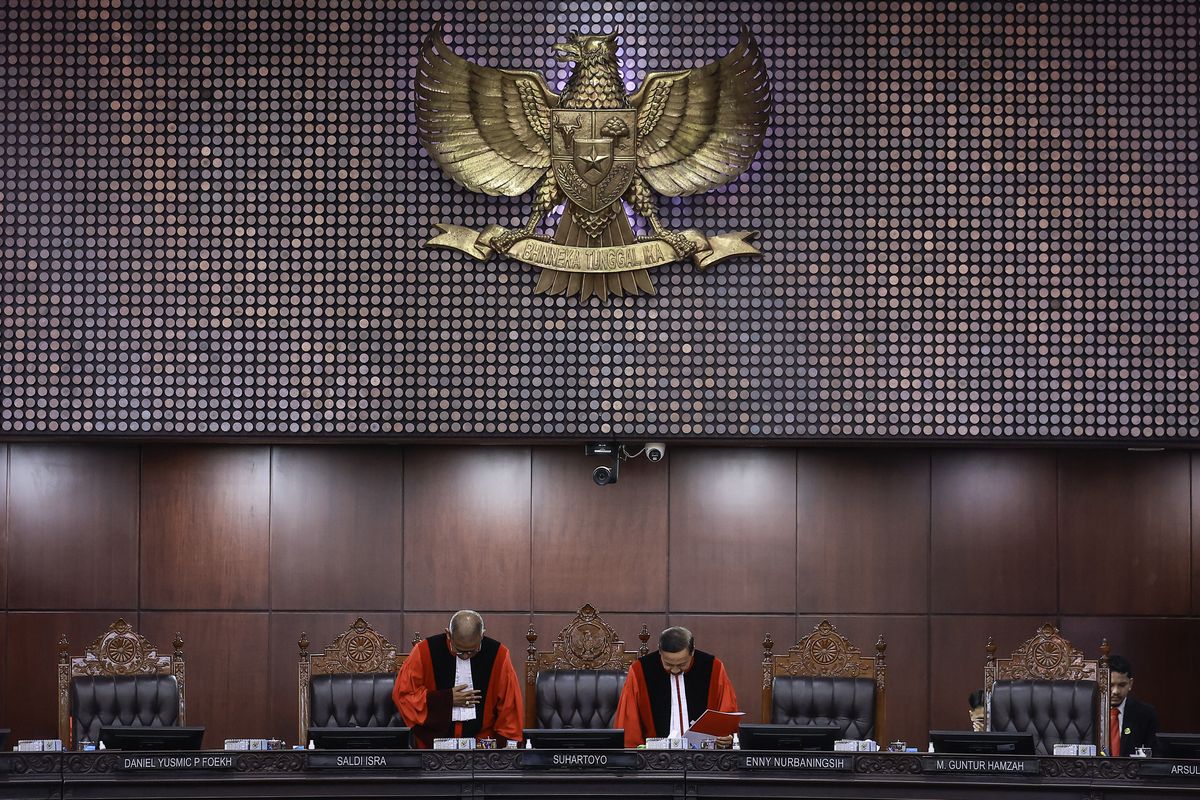
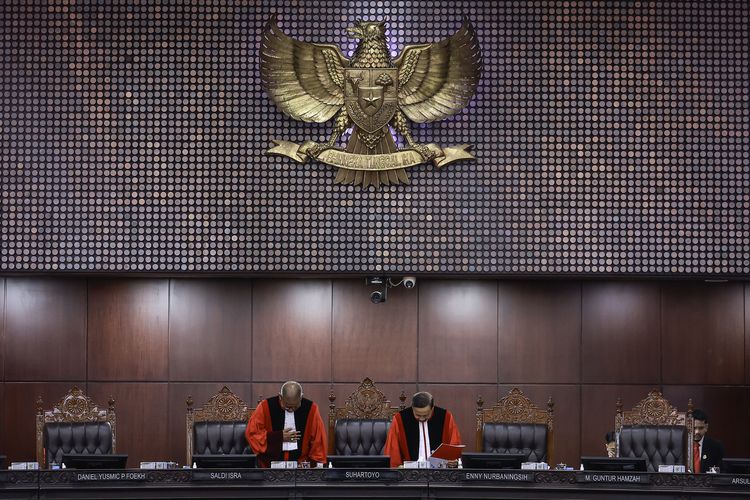
CONCLUSION The Constitutional Court's ruling Number 01/PHPU.PRES-XXIV/2026 concerning the educational requirements of Vice President Gibran Rakabuming Raka raises broader constitutional issues beyond the existence of a diploma.
The Court indicated in its assessment that it found no convincing evidence showing that Gibran possesses a diploma, certificate, or foreign degree that could be equated with at least a high school education as required by the Election Law.
However, the petition was ultimately deemed unacceptable because the petitioners were assessed to have no legal standing.
In my view, the reason for the rejection of the petition should not solely rest on the issue of legal standing of the petitioners.
This is because the petitioners can assert that there exists a tangible constitutional grievance due to alleged defects in the nomination requirements for the 2024 Presidential Election.
The elections encompass more than merely the legal relationship between the candidates and the General Election Commission (KPU); it is a constitutional process involving the candidates, supporting political parties, and the voting public as holders of sovereignty.
Should there be a suspicion that a candidate fails to meet the legally-required qualifications, and yet that candidate continues to compete and receives votes from the public, then the issue transcends merely the individual interests of the candidate.
This matter pertains to the rights of election participants to engage in a legitimate and fair competition and the voters' rights to cast their votes in a democratic process that meets constitutional requirements.
Hence, it is essential to differentiate between statutory standing and constitutional standing. It is true that positive law confines the Presidential and Vice Presidential PHPU petitioners to specific parties.
However, that limitation does not eliminate the reality that other parties involved in the electoral process may experience constitutional harm when the integrity of the nomination requirements is challenged.
In such cases, the constitutional interests of the participants and voters should not be perceived merely as abstract interests.
The constitutional issue that requires deliberation is whether the limitation of statutory standing precludes all access to addressing matters concerning the fundamental validity of a candidate.
If the answer is affirmative, there exists the risk of a constitutional gap, where serious allegations regarding candidate qualifications arise, but no party has the capacity to bring the issue to the appropriate forum.
Nonetheless, I do not believe the Constitutional Court should disqualify the Vice President appointed through this PHPU matter.
It is crucial to differentiate here between determining legal facts and concluding legal consequences for the incumbent officials.
The Court has stated that during the hearings, no convincing evidence was found regarding a diploma, certificate, or foreign degree that could serve as the basis for equating education with at least the high school level.
Simultaneously, the Court affirmed it could not cancel or disqualify Gibran in his capacity as Vice President.
After his inauguration, the matter is no longer akin to a dispute over candidate status, but rather concerns a constitutional officeholder's status.
This raises a critical constitutional question: If the Court states it did not find the required evidence of a diploma but also asserts it lacks the authority to disqualify the Vice President, then who ought to follow up on these findings, and through what mechanism?
According to the constitutional framework of the 1945 Constitution, the answer to that question can be directed towards Articles 7A and 7B.
Article 7A stipulates that the President and/or Vice President may be dismissed during their term if found to no longer meet the qualifications as President and/or Vice President.
Article 7B then provides a special mechanism: the DPR submits a request to the Court to examine, adjudicate, and decide on the DPR's opinion regarding those allegations.
Consequently, the more accurate construction is that the Court in the PHPU matter need not disqualify the appointed Vice President.
However, if the examination reveals relevant legal facts indicating unmet requirements, those facts should be considered in the decision's reasoning as legal findings.
Furthermore, should there be a party authorized to act on those findings, the mechanism must be placed within the framework of Articles 7A and 7B of the 1945 Constitution.
This is also consistent with the principle that disqualification applies to candidates, while dismissal applies to officials who have held office.
After the inauguration, an individual's legal status shifts. They are no longer merely an election participant but a holder of a constitutional office. Thus, the legal mechanisms must follow the constitutional office regime.
In this context, the ruling of niet ontvankelijk verklaard should not conclude with the determination that the petitioners lack legal standing.
The ruling ought to provide a more comprehensive constitutional explanation regarding the forums and legal mechanisms available should findings related to candidate qualifications have consequences on the continuation of the Vice President's office.
In other words, the issue is not merely whether petitioners may enter through the PHPU doorway, but also where the matter should be directed if the PHPU door has been closed while relevant legal findings are acknowledged by the Court itself.
This underscores the importance of ensuring that the Court's ruling not only provides legal certainty but also prevents constitutional mechanisms from experiencing any potential void.
The finality of the Court's decision should not be construed as an end to all possibilities of constitutional accountability.
Rather, when an individual's legal status transforms from candidate to official, the resolution mechanism must also transition from an electoral dispute to a mechanism of accountability structured by the 1945 Constitution.
Ultimately, this case serves as a crucial lesson for Indonesia's constitutional law: legal standing should not be viewed solely as a formal issue of who may submit a case but should also be assessed concerning the protection of constitutional rights and the availability of effective legal remedies.
If indeed no evidence of the required qualifications is found, then the issue cannot merely stop at the question of “who is entitled to file a suit”.
The more fundamental inquiry is: does the constitution provide a pathway to follow up on the findings?
According to the design of the 1945 Constitution, there are mechanisms in Articles 7A and 7B. The DPR can serve as the entry point of the process, while the Court resumes its constitutional function to examine and decide on the DPR's opinion.
With such a framework, a constitutional vacuum does not occur: the Court does not usurp the authority of the DPR/MPR, yet it does not allow constitutional findings to lose their possibility for follow-up action.

























