Prabowo Gathers Gerindra Cadres in Hambalang, Dasco and KDM Attend
-
News
-
1 hour ago
This article was translated by AI. Read the original article on Kompas.com. See Original

JAKARTA, KOMPAS.com - The Indonesian House of Representatives (DPR RI) has approved the draft law on Employment Protection, officially enacting it.
The approval took place during a plenary session led by DPR RI Chair Puan Maharani at the Indonesian Parliament Complex in Jakarta on Tuesday (6/10/2026).
“We will ask each faction whether the draft law on Employment Protection can be approved and enacted into law?” said Puan while leading the session on Tuesday.
All eight factions in the DPR expressed their agreement, resulting in the draft being officially enacted into law.
This decision followed a report on the deliberations of the Employment Protection draft law presented by Deputy Chair of Commission IX, Putih Sari.
According to Putih, the formation of this new employment law is expected to provide greater certainty for workers, employers, and the government.
The draft law is also designed to establish a national employment system that offers stronger protection for workers.
Additionally, the draft aims to ensure legal certainty for both workers and employers, encourage job creation and expansion, and enhance the competence and productivity of the workforce.
The Employment Protection draft law also addresses efforts to realize a fair and decent wage system and to strengthen harmonious and equitable industrial relations.
It is known that the revision of Law Number 13 of 2013 on Employment was one of the pressing tasks for the DPR and the government before it was passed on Tuesday (6/10/2026).
This is because the Constitutional Court (MK), through Decision Number 168/PUU-XXI/2023, requested the lawmakers to promptly establish a new employment law and to separate or remove it from Law Number 6 of 2023 on Job Creation.
The MK further granted the lawmakers a two-year deadline to separate the employment cluster into its own legislation starting from the reading of this decision on 31 October 2024.
This means that the employment cluster within the Job Creation Law must be excised and become its own Employment Law before 31 October 2026.
“With this new employment law, issues concerning potential disharmony and inconsistencies in the materials/substance of employment law can be unraveled, reorganized, and promptly resolved,” said MK Justice Enny Nurbaningsih while reading the legal considerations of Decision Number 168/PUU-XXI/2023 on Thursday (31/10/2024).
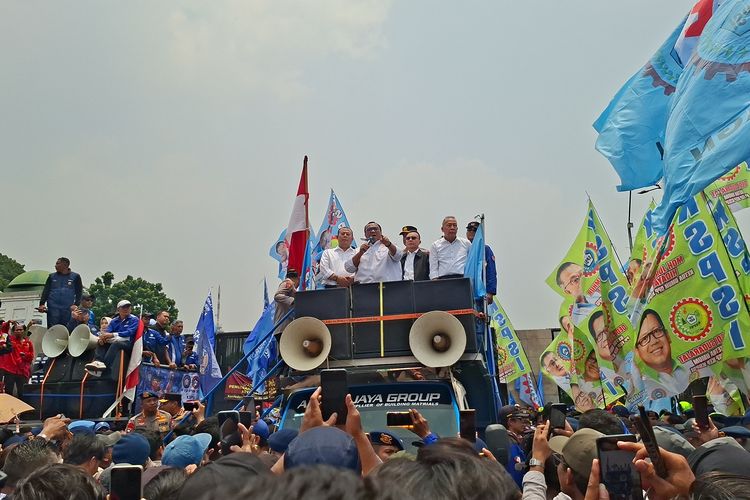 KSPSI President AGN, Andi Gani Nena Wea, alongside DPR RI Deputy Chair Sufmi Dasco Ahmad, Saan Mustopa, and Cucun Ahmad Syamsurijal, meeting with labor activists demonstrating in front of the DPR RI building in Central Jakarta on Tuesday (6/10/2026) afternoon.
At that time, the MK assessed the possibility of conflicting norms between the Employment Law and the Job Creation Law.
Specifically, regarding the norms in the Employment Law which were modified, making them difficult to comprehend by the general public, including workers/employees.
If these issues persist without resolution, the governance and legal landscape of employment will easily fall prey to uncertainty and prolonged injustice.
“Moreover, several materials/substantial substances of regulations that are hierarchically subordinate to the law, including several government regulations, were included as material in the employment law,” clarified Enny.
For information, the request numbered 168/PUU-XXI/2023 was submitted by the Labour Party, the Indonesian Metal Workers Federation (FSPMI), the All-Indonesian Workers Confederation (KSPSI), the Indonesian Labour Unity Confederation (KPBI), the Indonesian Workers Confederation (KSPI), and two individuals, Mamun and Ade Triwanto, who are both workers.