

Prabowo Gathers Gerindra Cadres in Hambalang, Dasco and KDM Attend
-
News
-
1 hour ago
This article was translated by AI. Read the original article on Kompas.com. See Original
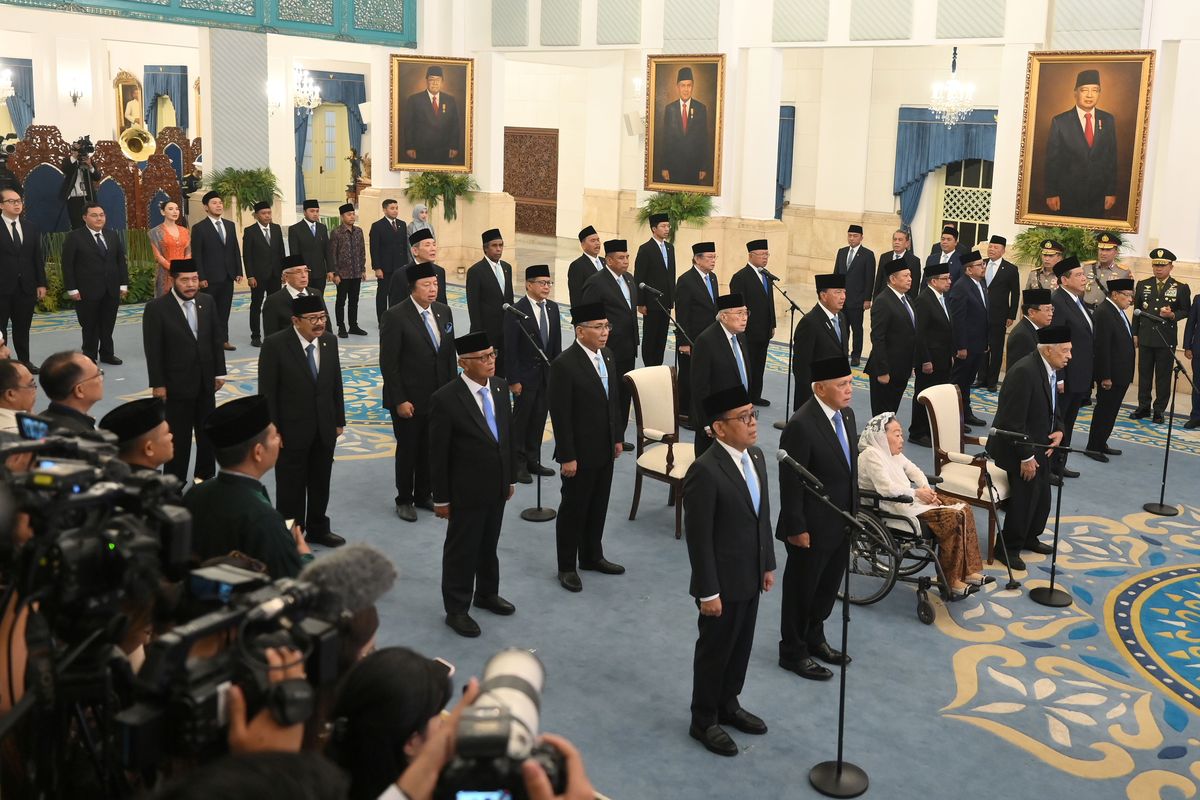
JAKARTA, KOMPAS.com - A total of 26 figures have joined the advisory circle of President Prabowo Subianto.
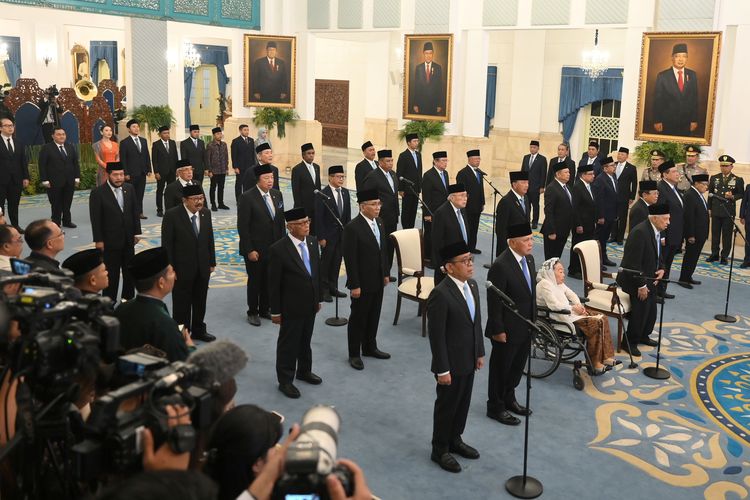
They were inaugurated to serve on the Presidential Advisory Council (Wantimpres) on Friday (2/10/2026).
Among those appointed are several individuals with prior government experience, such as former Coordinating Minister for Human Development and Cultural Affairs Pratikno.
Also included is activist and academic Rocky Gerung, known for his critical stance toward the government.
They were gathered in a single institution and took their oath of office in front of Prabowo.
Pratikno was appointed Chair of Wantimpres, Hatta Rajasa as Vice Chair, and Muhammad Qodari as Secretary of Wantimpres.
The inauguration of the 26 Wantimpres members was based on Presidential Decree Number 107/P 2026 regarding the Appointment of Members of the Presidential Advisory Council, as read by Nanik Purwanti, Deputy for Administrative Affairs of the Ministry of State Secretariat.
With their official appointment, the work of the Wantimpres members is now awaited.
This includes not only clarifying their authority but also how they will fulfill their roles as Presidential advisors.
Will they communicate the realities of governance and society to Prabowo, especially when encountering problematic policies?
Or will they only share information that pleases the President?
Sidarto Danusubroto, a member of Wantimpres from 2014-2019 and 2019-2024, urged the newly appointed Wantimpres members to bravely convey genuine inputs to Prabowo.
According to Sidarto, the advice given to the President should not solely consist of praise or positive remarks.
"In essence, both negative and positive aspects should be reported as they are. It’s unacceptable for senior figures to provide only pleasing information. That cannot be allowed," Sidarto told Kompas.com on Sunday (4/10/2026).
Sidarto has served two terms on Wantimpres.
He stated that throughout his tenure, he consistently communicated the situation honestly to President Joko Widodo.
"I have served two terms on Wantimpres. I am the only one who has served two terms. I conveyed the truth to Mr. Jokowi. Since most members are older than Mr. Jokowi, it has an impact," he said.
Thus, Sidarto hopes that the new Wantimpres members possess the experience and courage to provide input as well.
He even considers experience to be one of the critical factors in effectively serving as presidential advisors.
According to Sidarto, the ideal members of Wantimpres should be senior figures with adequate experience.
"If they are young and have limited experience, then that is useless," he remarked.
Political communication observer from Esa Unggul University, M Jamiluddin Ritonga, believes that the public should expect the 26 Wantimpres members to actively provide advice and considerations to the President.
The advice, he states, should be critical, objective, and comprehensive.
Not only when requested, but Wantimpres should also offer input on their own initiative.
"The public certainly hopes that the 26 newly appointed members of the Presidential Advisory Council (Wantimpres) actively provide critical, objective, and comprehensive advice and considerations to the President, both when requested and on their own initiative," said Jamiluddin to Kompas.com on Monday (5/10/2026).
He noted that the considerations provided should not be based solely on personal opinions but backed by thorough studies.
Wantimpres needs to examine the impact and risks of every policy, then provide the President with various alternatives.
"Therefore, Wantimpres should ideally offer considerations based on scientific research with in-depth impact risk analysis," he said.
From these studies, Wantimpres can compile various alternative solutions along with their consequences.
"The advice given should not merely justify the President's plans but must also present alternative policy options and their logical consequences," Jamiluddin added.
With this approach, Wantimpres can perform its function as a second opinion for the President.
"Thus, Wantimpres should ideally serve as a second opinion. This way, Wantimpres can provide an independent alternative perspective to evaluate the government’s priority programs," he stated.
In addition to providing considerations, Jamiluddin notes that Wantimpres must be able to serve as the "ears" of the President to listen to the voices of the public.
"The Presidential Advisory Council (Wantimpres) plays a strategic role as the 'ears' of the president," said Jamiluddin.
To fulfill this function, Wantimpres cannot simply wait for reports behind a desk.
They need to actively open communication with various segments of society.
"Wantimpres should open multi-channel communication. They need to provide a platform that is easily accessible to all community layers, both conventionally and digitally," Jamiluddin stated.
He suggested that Wantimpres members regularly meet with academics, community leaders, labor organizations, and youth communities.
Technology can also be utilized to capture emerging issues in society.
According to Jamiluddin, Wantimpres could engage in social media listening to identify public concerns.
Furthermore, they should also go directly to the regions.
"Wantimpres should also conduct field visits. Going directly to various regions, especially in 3T areas (underdeveloped, frontier, and outermost areas), to see the objective realities without bureaucratic barriers," Jamiluddin added.
However, absorbing public aspirations does not mean that every complaint should be immediately conveyed to the President.
Jamiluddin opines that Wantimpres must filter and process the aspirations objectively.
"Hence, Wantimpres must function as an intelligent filter," he said.
Aspirations received should be prioritized based on urgency and impact.
Systemic and urgent issues, such as economic, political, legal justice, or food sovereignty concerns should be prioritized to be communicated to the President.
The advisory function also demands courage to express differing opinions from the President.
Jamiluddin asserts that Wantimpres would not be effective if it merely follows the President's views.
"Wantimpres needs to maintain a critical stance and present an objective viewpoint to the President so that government policy directions progress smoothly," Jamiluddin stated.
He outlined several reasons why Wantimpres must be brave enough to differ in opinions.
First, Wantimpres can function as an "intellectual brake."
This means the advisors can balance the decision-making process so that the President’s decisions are based on a wider perspective.
Second, Wantimpres must evaluate issues from ethical and strategic standpoints.
Third, members of Wantimpres can assist the President in identifying risks before policies are implemented.
Fourth, the diversity of experience among members should enrich the President's decision-making processes.
"Therefore, Wantimpres must indeed be brave enough to convey differing views to the President. To achieve this, Wantimpres must think objectively, forming inputs based on professional expertise and national interests, not merely following the President's will," Jamiluddin concluded.
Another challenge for Wantimpres is ensuring they do not merely become an institution that legitimizes government policies.
Jamiluddin mentioned several measures that can be taken to keep Wantimpres substantive and independent.
One such step is to enhance the transparency of recommendations.
According to him, some considerations from Wantimpres that do not involve state secrets can be made public.
This approach can increase the accountability of the advisory body to the President.
Moreover, Jamiluddin suggested establishing a mechanism requiring the President or relevant ministries to respond to formal recommendations made by Wantimpres.
"Thus, a legal mandate is necessary to obligate the President or relevant ministries to provide a written response to the formal considerations submitted by Wantimpres, even though the recommendations remain non-binding," he said.
Jamiluddin also believes recruitment policies should be scrutinized to prevent political interests from dominating Wantimpres.
According to him, the composition of Wantimpres should ideally also involve cross-disciplinary experts, community leaders, academics, and civil society elements.
Additionally, Wantimpres should be supported by a strong team of experts and rigorous studies.
"By doing so, the advice provided will be based on scientific research and objective policy impact analysis, not merely political opinions," he stated.