

Prabowo Gathers Gerindra Cadres in Hambalang, Dasco and KDM Attend
-
News
-
2 hours ago
This article was translated by AI. Read the original article on Kompas.com. See Original
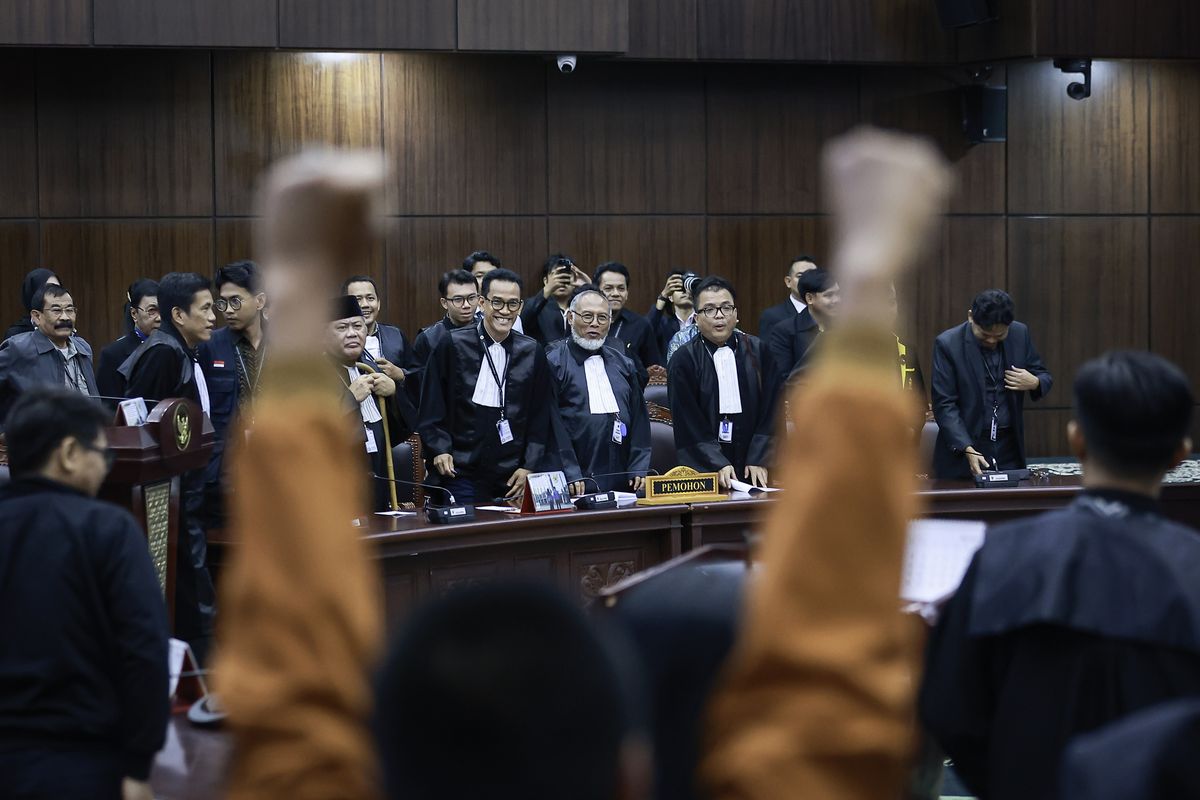
THERE IS something peculiar about the Constitutional Court's ruling regarding the educational qualifications of Vice President Gibran Rakabuming Raka.
It is not because the Court declared Gibran invalid as Vice President, nor because it stated that his diploma is counterfeit.
Rather, it is the ruling that presents two seemingly contradictory points: it declared the petition inadmissible, yet in its considerations, the Court stated it found no convincing evidence that Gibran possesses a diploma, certificate, or foreign degree that could validate his qualifications as having completed a minimum of high school education or equivalent.
This raises a more significant question than the diploma controversy itself.
If educational qualifications are among the requirements to hold a public office, who is truly responsible for ensuring that these qualifications are met before someone is sworn in?
This question is crucial because the issue only became a debate after Gibran was inaugurated as Vice President on October 20, 2024.
In its ruling, the Court explained that the petitioners lacked legal standing to bring the case.
The Court also assessed that the matter presented was no longer appropriately categorized as a dispute over presidential election results, as the nomination stages had ended and the elected pair had already been inaugurated.
Therefore, the Court did not use this case as grounds to annul or disqualify Gibran as Vice President.
This is where the public should not stop at asking, “So does Gibran have a diploma or not?”
While that question is indeed intriguing, there is a far more pressing issue of governance: how can the state ensure that all qualifications for a public official are thoroughly verified before the position is conferred?
Qualifications are not mere bureaucratic formalities. When someone is deemed qualified, the state confers upon them legitimacy, authority, access to public resources, and public trust.
If subsequently, those qualifications are called into question after the inauguration, the issue transcends a mere piece of documentation.
There are much larger institutional and public trust implications at play.
We are already accustomed to verification principles in bureaucracy. When someone applies as a state civil servant, their diploma is scrutinized.
When someone undergoes a position selection, their qualifications and competencies are assessed.
When an employee applies for a promotion, supporting documents must be accountable.
The state understands that one cannot simply claim to meet the requirements; they must be able to prove it.
So why does verification become more complicated when it involves a public office with greater authority at stake?
Certainly, political positions and state civil servant roles occur within different legal regimes.
The mechanisms for their nominations are also not the same. However, their governance principles converge: Before the state confers authority, it must ensure that the individual receiving it genuinely meets the stipulated requirements.
This is where we need to reconsider the meaning of meritocracy. The merit system is often understood as a principle of placing the right person in the right position based on qualifications, competencies, and performance.
However, the right person cannot be determined solely by observing who successfully passes.
There must be processes in place to ensure that all qualifications forming the basis of that success are genuinely valid.
In other words, we need more than just merit-based selection. We need merit-based verification.
Verification is not a trivial task. It serves as the first barrier before public authority is conferred.
In this case, the Court stated that after reviewing evidence and facts presented during the trial, it did not find convincing evidence in the form of diplomas, certificates, or foreign degrees to substantiate equivalency to a minimum high school education or its equivalent.
The Court also noted the educational documents submitted in this matter and statements from relevant parties regarding those documents.
However, these findings do not automatically imply that the Court can impose consequences such as annulment of office.
The boundaries of legal authority remain in effect. The Court expressed it could not annul or disqualify Gibran as Vice President through this petition.
Here lies an important lesson for public administration.
A legal system can consist of many institutions, but if the division of verification authority and corrections is unclear, accountability gaps can still emerge.
Imagine a recruitment process. In the initial stages, the committee declares someone to meet the qualifications.
This person is then appointed and performs their duties. Years later, questions arise concerning one of the documents that formed the basis of their qualification.
When the matter is brought to another institution, it turns out this institution has no authority to annul the results of the prior process.
Who then is responsible?
This question shouldn’t be directed at a single individual. Rather, what needs examination is the design of the system.
Who verifies documents? Who conducts validation? Who determines that the requirements have been fulfilled? What standards of proof apply?
Is there cross-examination? And most importantly, what happens if a new error is discovered after someone has assumed office?
Such questions are highly relevant in the agenda of civil service reform. We are moving towards a more data-driven, competency-based, talent management system, and a meritocratic framework.
However, digitization and the abundance of selection instruments do not automatically guarantee quality if verification just becomes a checkmark exercise.
A good system is not one that simply has the most requirements. A good system is one capable of demonstrating that those requirements are genuinely fulfilled.
This matter could serve as a moment to reinforce a simple principle in filling public positions: verification must occur as early as possible, the responsible institutions must be clearly designated, and every decision must leave a accountable trail.
The cheapest corrections happen before the inauguration. Before someone assumes office, the state can still examine documents, seek clarifications, and rectify decisions.
But once someone is inaugurated, has authority, makes decisions, and performs public functions, the issue becomes far more complex.
What’s at stake is no longer merely administrative completeness, but also the legitimacy of the office and public trust.
We often become angry upon discovering officials deemed incompetent after they’ve assumed their positions.
However, perhaps our outrage comes too late. The real issues should have been resolved while the individual was still at the verification desk, when their documents were reviewed, qualifications assessed, and before any authority was granted to them.
Consequently, this matter should not merely spark a debate about Gibran.
It can serve as a question for the entire governmental system: how robust are our mechanisms to ensure that an individual genuinely meets the criteria before the state grants a position and authority to them?
Meritocracy is not just about selecting the most qualified individual. It also means ensuring that the basis for declaring someone qualified is genuinely provable.
For once a position is conferred, verification errors are no longer simply administrative mistakes. They can evolve into matters of public trust.
And ultimately, perhaps the most important question is no longer, Who is at fault in this case?
But rather: Who should have been responsible from the start to ensure that issues like this do not require court rulings to be called into question?