

Prabowo Gathers Gerindra Cadres in Hambalang, Dasco and KDM Attend
-
News
-
2 hours ago
This article was translated by AI. Read the original article on Kompas.com. See Original
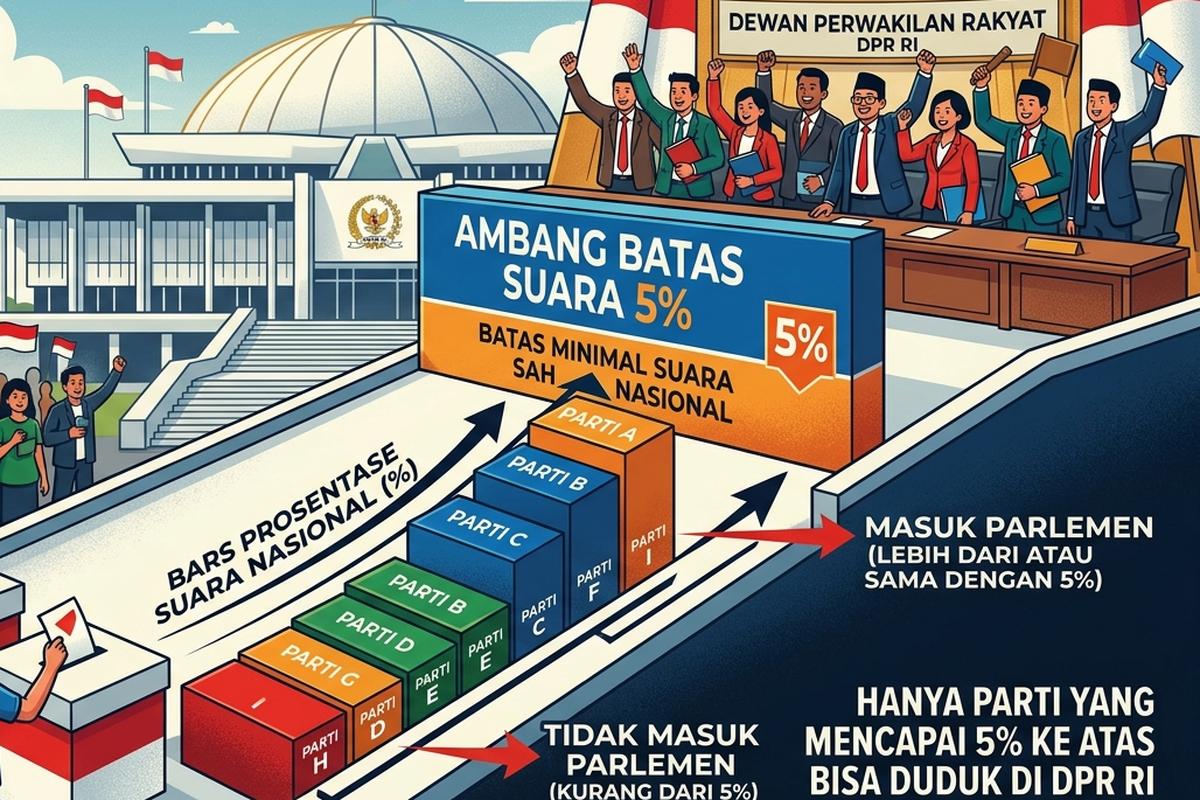
JAKARTA, KOMPAS.com - A proposal suggesting that political parties failing to meet the parliamentary threshold (PT) should be allowed to form a joint faction reignites the debate over unconverted voter ballots into seats in the House of Representatives (DPR).
Constitutional law expert Mahfud MD highlighted this issue in the context of the 2024 elections, estimating that the accumulated votes from parties that did not qualify for the DPR could reach around 17.3 percent.
“For instance, yesterday, PPP received 3.9 percent, just missing one seat. PSI got around 2 percent. Perindo received a similar amount. If we sum this up, it’s 17.3 percent,” Mahfud stated on his YouTube channel on Wednesday (30/9/2026).
Mahfud proposed that parties failing to meet the PT should be able to form a collective faction.
He also mentioned a mechanism called stembus accoord, which allows the pooling of leftover votes from various political parties.
“For parties that did not meet the PT, they could enter an agreement to form a joint faction. This has been done before, and if implemented, there would be no lost votes and they would equally have the right to propose a presidential candidate,” Mahfud added.
This proposal arises as the proportion of votes from political parties that do not reach the PT in the 2024 elections has been recorded as greater than in the two previous elections.
Data presented by Neni Nur Hayati, Director of the Democracy and Electoral Empowerment Partnership (DEEP) Indonesia, indicates that the proportion of votes from parties below the threshold has been steadily increasing over the last three elections.
In the 2014 elections, with the PT set at 3.5 percent, around 2.97 million votes or 2.37 percent of the national vote came from two parties that did not cross the threshold.
This number rose in the 2019 elections. With a PT of 4 percent, approximately 13.59 million votes or 9.7 percent of the national vote came from parties that did not meet the threshold.
In the 2024 elections, the proportion increased again. Based on data from Neni, there were about 26.3 million votes or 17.3 percent of the national vote from parties that did not meet the threshold.
These parties include PPP with 3.87 percent of the votes, PSI with 2.81 percent, Perindo with 1.29 percent, Gelora with 0.84 percent, Hanura with 0.72 percent, Labor Party with 0.64 percent, Ummat with 0.42 percent, PBB with 0.32 percent, Garuda with 0.27 percent, and PKN with 0.22 percent.
“Thus, there is a tendency for the proportion of votes for parties below the threshold to increase from 2014 to 2019 and then 2024,” Neni told Kompas.com on Thursday (1/10/2026).
The larger the votes collected by parties below the PT, the greater the number of votes that cannot be converted into seats in the DPR through the prevailing electoral mechanism.
However, according to Neni, the magnitude of unconverted votes should not solely be viewed through the lens of the parliamentary threshold.
“We cannot consider the threshold separately from the number of participating parties, the geographical distribution of votes, and the system for converting votes into seats,” she explained.
She pointed out that the issue of unconverted votes is indeed related to the design of the electoral system.
Lawmakers must balance the representation of voters with the effectiveness of the parliament.
“If we talk about the impact, it is significantly substantial if the measure used is voter representation through DPR seats,” Neni stated.
“Therefore, the focus is on how to create a balance between representation and parliamentary effectiveness,” she added.
Perludem researcher Haykal observes that the impact of unconverted votes is significant when measured in terms of voter representation in the DPR.
“It’s considerable. In 2024, because three parties that secured seats did not meet the PT, around 17 million votes cannot be converted into seats,” Haykal told Kompas.com on Thursday.
According to him, this situation indicates that there are voters who cast their ballots for certain political parties but do not achieve representation in the DPR.
“Thus, there are 17 million people who cast their votes, but it essentially means nothing,” Haykal said.
For Perludem, this issue is not just about how many parties enter the DPR, but how votes are converted into political representation.
When a party’s votes are below the PT at the national level, those votes cannot be used to secure DPR seats, even though cumulatively they number in the millions.
This situation also leads to an ongoing debate regarding PT that goes beyond merely simplifying the number of parties in parliament.
On the other hand, there are questions about how far this simplification can be implemented without increasing the gap between voter choices and the available seats in the DPR.
Neni considers joint factions and the evaluation of the parliamentary threshold are at different levels.
Joint factions are a solution at the institutional level of the parliament, whereas threshold evaluation touches on the design of the electoral system from the outset.
The discussion surrounding the threshold has also been part of Constitutional Court Decision Number 116/PUU-XXI/2023.
In that decision, the court upheld the PT requirement of 4 percent for the 2024 elections but stated that this provision needs to be evaluated for the 2029 elections and future elections.
She noted that if a joint faction were to be applied, its design must be clear so that it does not merely serve as a workaround after votes fail to be converted into seats.
Neni emphasizes that there needs to be regulation on who can form a joint faction, what the minimum accumulated vote requirement is, how positions and rights are shared within the faction, decision-making mechanisms, and transparency in funding and accountability.
Additionally, there must be clarity on the differences in rights between joint factions and factions formed by political parties that secure seats through the electoral process.
“We want to avoid situations where a joint faction merely becomes a ‘backdoor’ to obtain all the privileges of a faction without going through the same representation mechanisms as parties that successfully secure seats,” Neni stressed.