

Prabowo Gathers Gerindra Cadres in Hambalang, Dasco and KDM Attend
-
News
-
1 hour ago
This article was translated by AI. Read the original article on Kompas.com. See Original
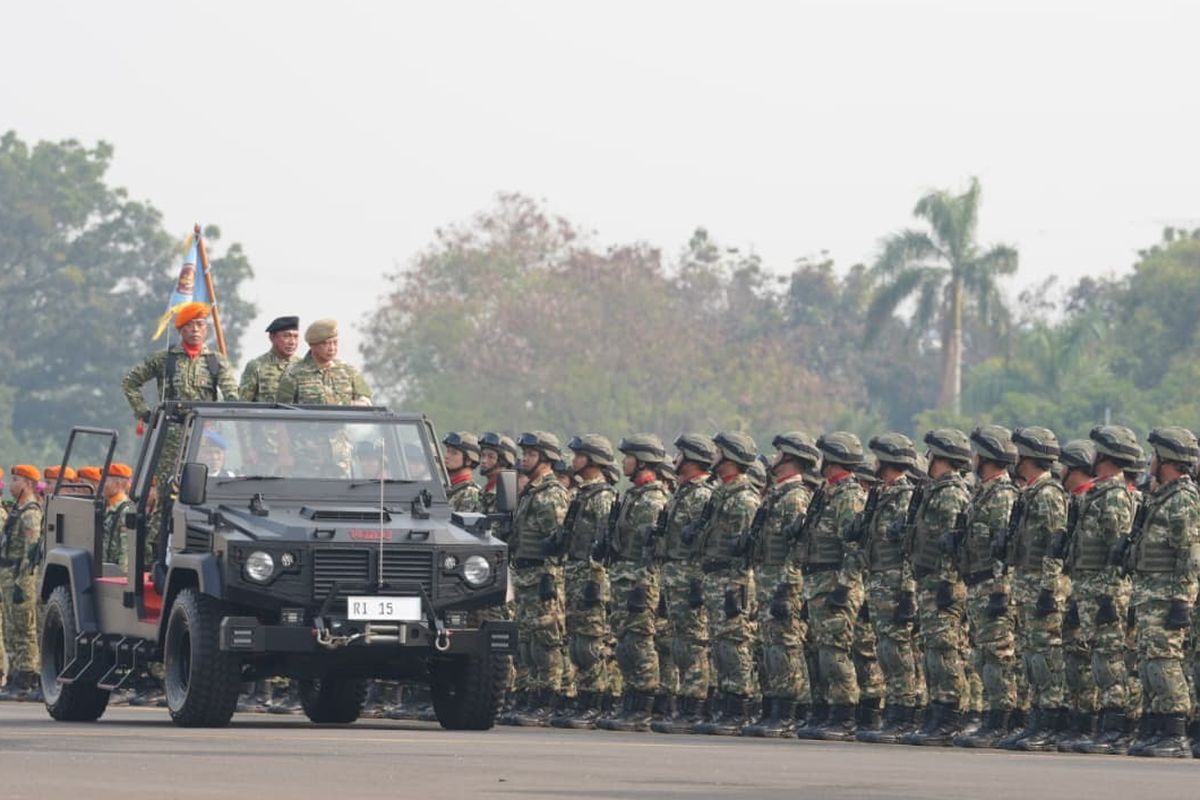
JAKARTA, KOMPAS.com - The second wave of Basic Military Training for Civil Servants' Reserve Components (Latsarmil Komcad ASN) has officially concluded, with 2,241 civil servants now recognized as reserve components after participating in the training for 37 days.
This session of Latsarmil Komcad ASN has drawn attention following the death of a participant, Vanreko Varkas Bagaskara, an employee of the Ministry of Creative Economy, who passed away during the training process.
Lieutenant General Gabriel Lema, Head of the National Reserve Body at the Ministry of Defense, promised an evaluation of the program in the wake of Vanreko's death.
“Every program activity will be evaluated,” Gabriel stated after the closing ceremony of Latsarmil at Halim Perdanakusuma Air Base in East Jakarta on Tuesday (29/9/2026).
He did not provide specific details regarding the evaluation but emphasized that it would be comprehensive.
“Everything. All mechanisms are subject to selection and the existing stages,” Gabriel added.
Vanreko passed away after receiving medical treatment due to losing consciousness during the Latsarmil series on Friday (25/9/2026).
Colonel Iman Fathurrohman, Head of the RSAU dr. Esnawan Antariksa, reported that Vanreko lost consciousness after complaining of blurred vision and dizziness around 09:30 WIB.
At that time, Vanreko had just completed the first session of the Latsarmil closing ceremony and was about to participate in the second training session.
“The health team from Pusdikkes, under the leadership of Dr. Iriane Dewi, promptly provided first aid on-site,” Iman said in a written statement on Sunday (27/9/2026).
According to Iman, initial examinations indicated that Vanreko suffered from hypotension and an elevated body temperature suggesting heatstroke as a physical response to weather exposure and fatigue.
First aid included cooling measures with cold compresses, administering intravenous fluids, and oxygen therapy.
Subsequently, Vanreko was taken to the emergency department of RSAU dr. Esnawan Antariksa Halim Perdanakusuma.
Upon arrival at the hospital, Vanreko received treatment from specialist doctors.
The medical team monitored his hemodynamic status and organ function and provided respiratory stabilization.
“Continuous observation until Friday night at 19:00 WIB showed very positive developments; the patient had regained consciousness and exhibited spontaneous reflexes, as well as stable vital signs,” he explained.
However, Vanreko's condition deteriorated again early Saturday (26/9/2026).
Around 04:30 WIB, he experienced repeated seizures accompanied by decreased consciousness.
Iman stated that this condition was a systemic complication arising from heatstroke that affected vital organ functions.
“The RSAU dr. Esnawan medical team quickly coordinated with RSPAD Gatot Soebroto for advanced care referral (neuro-intensive care),” he added.
Vanreko was then referred to RSPAD Gatot Soebroto via an ICU-standard ambulance, accompanied by medical personnel and AU POM staff.
He arrived at the RSPAD Gatot Soebroto emergency room around 11:30 WIB.
He subsequently underwent a head CT scan and received intensive treatment in the ICU.
“Despite the combined medical team from Pusdikkes, RSAU dr. Esnawan Antariksa, and RSPAD Gatot Soebroto deploying their best medical resources and providing intensive care, God had other plans. Mr. Vanreko Varkas Bagaskara, S.Pd. has been declared deceased,” he stated.
Despite Vanreko's death, the government has reiterated that the implementation of the ASN reserve component program is a constitutional mandate.
Home Minister Tito Karnavian referred to Article 27, paragraph (3), and Article 30, paragraphs (1) and (2) of the 1945 Indonesian Constitution, which broadly regulates citizen participation in defending the country within the defense and security sector.
“Therefore, we should not hesitate in light of the mandate of the 1945 Constitution. It’s about actualizing and realizing that mandate,” Tito said.
“Today's activities are a tangible realization of that constitutional mandate,” he added.
For this reason, Tito stated that the ASN reserve component is not a sudden initiative without a legal basis.
The former National Police Chief clarified that the ASN reserve component program is not meant to militarize government employees.
“We are not stating that ASN will be militarized, no,” Tito emphasized.
Tito believes the ASN reserve component program adds value for both the institution and the employees.
He is convinced that a strong government relies partly on ASNs capable of executing administration effectively and efficiently.
“To be effective and efficient requires not only the system but also the people in that organization,” Tito said.
“Integrity, cleanliness, discipline, punctuality, resilience, and loyalty to the nation—these qualities are often found in the military,” he added.
Thus, civil servants are included in this program to glean positive values from the military world to support good governance.
Tito also plans to mobilize 552 local governments across Indonesia to encourage civil servants in the regions to participate in the reserve component program.