

Prabowo Gathers Gerindra Cadres in Hambalang, Dasco and KDM Attend
-
News
-
1 hour ago
This article was translated by AI. Read the original article on Kompas.com. See Original
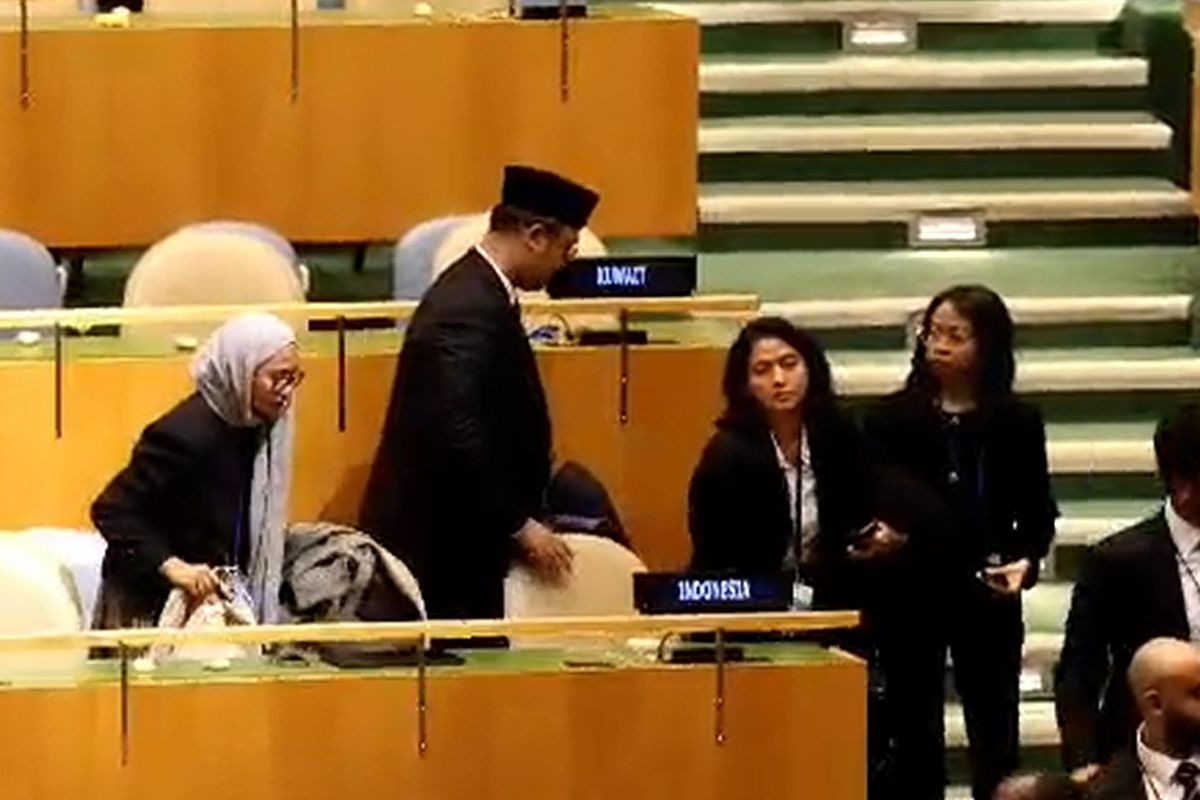
JAKARTA, KOMPAS.com - Indonesia showcased its diplomatic stance amid the dynamics of the United Nations General Assembly (UNGA) taking place in New York, USA, on Saturday (26/9/2026) local time.
On several agendas, Indonesia took a firm position on international issues, including the conflict in the Middle East.
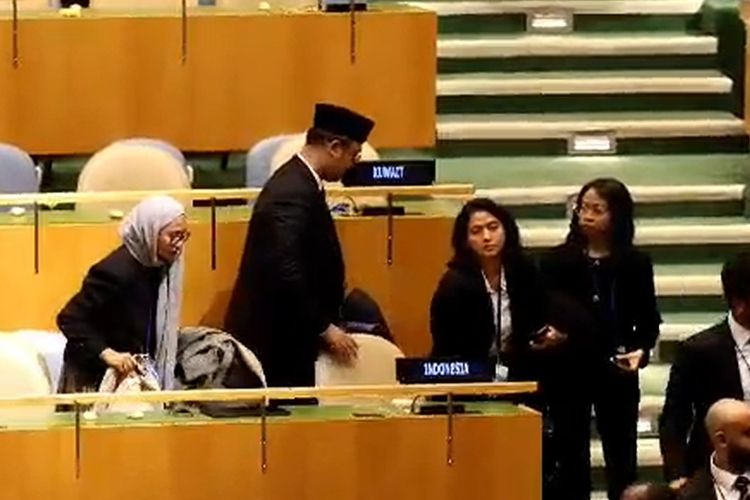
One significant action was the Indonesian delegation's walkout during the speech by Israeli Prime Minister Benjamin Netanyahu at the UN General Assembly.
In addition to Indonesia, diplomats from various other countries also rushed out of their seats to protest the Israeli regime leader.
The atmosphere in the UN General Assembly hall became lively as delegations left their seats and exited the room.
Indonesian Foreign Ministry Spokesperson Yvonne Mawengkang stated that the delegation's walkout was a show of solidarity with Palestine and a condemnation of the humanitarian crimes committed by Israel.
"This action was taken as a demonstration of solidarity with the Palestinian people, as well as a protest and condemnation of the humanitarian crimes and violations of international law that Israel has committed against the Palestinian people in Gaza and the occupied Palestinian territories," Yvonne told Kompas.com via a text message on Friday (25/9/2026).
She mentioned that the walkout reflects Indonesia's consistent position supporting Palestinian independence.
This action can also be interpreted as Indonesia's rejection of all forms of violence and violations of international law committed by Israel.
Indonesia aimed to send a message that violations of international law cannot be normalized and must be stopped immediately.
At the international forum, Indonesia emphasized several points, including its support for Palestinian independence.
Foreign Minister (Menlu) Sugiono stated that the situation in Palestine is a real test for the consciences of nations around the world.
Sugiono initially expressed that a relevant multilateral system for the 21st century must be more representative, agile, and capable of delivering tangible results.
To achieve this, UN member states must start by strengthening collective capacities to address crises, respond effectively to global crises and humanitarian situations, and promote peace, development, and cooperation simultaneously.
He noted that merely having stronger institutions will not save multilateralism.
"International law must be upheld consistently. Sovereignty must be respected, and colonialism must be ended. Here, Palestine stands as one of the most tangible tests for these principles, as well as a test for our consciences," Sugiono stated in his speech at the 81st UN General Assembly in New York, USA, on Saturday (26/9/2026) local time.
Sugiono emphasized that the glaring violations of international law in Gaza and the West Bank remind him of the world before 1945, when a race was nearly exterminated.
At that time, there was no UN Charter.
Similarly, there was no Universal Declaration of Human Rights or four Geneva Conventions of 1949.
During those times, Indonesia understood the meaning of fighting against colonialism and the world struggle when international law was still weak.
According to him, this understanding is what makes Indonesia consistently support Palestine.
"Our nation's journey toward independence has shaped our consistent stance in supporting the Palestinian people and their right to determine their future," said Sugiono.
He stated that Indonesia will continue to stand with the Palestinian people until their right to self-determination is fulfilled.
Sugiono also called for the realization of an independent and sovereign Palestinian state based on a two-state solution, in accordance with international law and internationally agreed parameters.
"The Palestinian issue is not merely a concern for one region; it is a test of whether the multilateral system can uphold the principles that justify its establishment and whether that system can deliver tangible results during the most critical times," he added.
Furthermore, Indonesia also contributed $1.2 million or approximately IDR 21 billion to the UN for Palestinian Refugees (UNRWA) this year.
Sugiono asserted that UNRWA must be able to fully and effectively carry out its mandate because millions of Palestinian refugees depend on the assistance provided by the agency.
"UNRWA must be able to fully and effectively implement its mandate as millions of Palestinian refugees rely on its aid," Sugiono stated during a ministerial meeting to support UNRWA at UN Headquarters in New York on Thursday (24/9/2026), as quoted by Antara.
Sugiono highlighted that UNRWA currently faces significant political and financial pressures, and its personnel and facilities must receive protection.
Indonesia will continue to support UNRWA and encourage other countries to enhance their support for the agency to ensure its operational continuity.
Sugiono also criticized the seizure of the UNRWA training center in Qalandia, East Jerusalem, which is under occupation.
He stated that this action has hampered UNRWA's operations and violated the principle of inviolability regarding UN facilities based on international law.
"Such actions impede the operations of the agency and violate the principle of inviolability of UN facilities under international law. This must not continue," he asserted.
Another diplomatic stance of Indonesia that garnered attention is its candidacy for a non-permanent member of the United Nations Security Council (UNSC) for the 2029-2030 term.
Minister Sugiono revealed that the candidacy is based on Indonesia's experience, sacrifices, and dedication to maintaining world peace.
"We aim to advance our diplomacy through humanitarian assistance, peacebuilding, and engagement across regions and institutions. With this spirit, Indonesia puts forward its candidacy for a non-permanent seat on the UN Security Council for the 2029-2030 term," Sugiono stated during his speech at the 18th UN General Assembly in New York, USA, as quoted from the Ministry of Foreign Affairs’ YouTube broadcast on Sunday (27/9/2026).
He noted that Indonesia has contributed to conflict resolution through diplomacy and mediation, both regionally and beyond.
Indonesia is also one of the main contributors to UN peacekeeping missions, deploying personnel to various missions worldwide since 1957.
Sugiono went on to say that for nearly two decades, Indonesian peacekeeping forces have served under the UN flag in Lebanon.
"While UNIFIL may be entering its final phase, Indonesia's commitment does not end with the conclusion of this mission," he emphasized.
Sugiono reiterated that Indonesia's commitment is clear: to strengthen unity and promote peace.
Strengthening unity means rebuilding trust in the multilateral system and keeping channels of dialogue open.
Advancing peace means urging all parties to respect international law and effectively utilize available means.
Consequently, Indonesia will strive to keep dialogue open, build mutual understanding, and turn shared responsibilities into tangible cooperation.
"We will consistently uphold the UN Charter in maintaining international peace and security," he affirmed.
Indonesia will also apply the same principles in its interactions with all parties and maintain open space for cooperation.
This aligns with Indonesia's foreign policy guidelines and is also in accordance with principles articulated by President Prabowo Subianto during his speech at last year's UN meeting.
"This same approach serves as a guideline for Indonesia's interaction with all partners through ASEAN, G20, D8, BRICS, MICTA, and the UN; Indonesia will continue to cultivate friendships to realize tangible cooperation," he stated.
At this occasion, Sugiono urged the UN to transform to become more representative and deliver tangible outcomes amid various global dynamics.
According to Sugiono, resilience at the domestic and regional levels must be complemented by a multilateral system capable of supporting and underpinning it.
"Here, the role of the United Nations remains irreplaceable," Sugiono stated.
He elaborated that the UN must provide room for various countries to resolve differences without resorting to conflict.
He mentioned that UN institutions provide common rules when interests clash and allow countries to pool capabilities when no single country can act effectively alone.
Therefore, Indonesia continues to place its trust in the UN.
"However, believing in the UN also means believing that the institution must evolve along with the world it serves," Sugiono remarked.
According to Sugiono, the answer to an imperfect multilateralism is not to reduce multilateralism but to realize a stronger and better multilateralism.
"The multilateral system suited for the 21st century must be more representative, more agile, and more capable of delivering tangible results," he concluded.