
The Price of the Vice Presidential Seat for the Future of the Young Generation
-
News
-
Just now
This article was translated by AI. Read the original article on Kompas.com. See Original
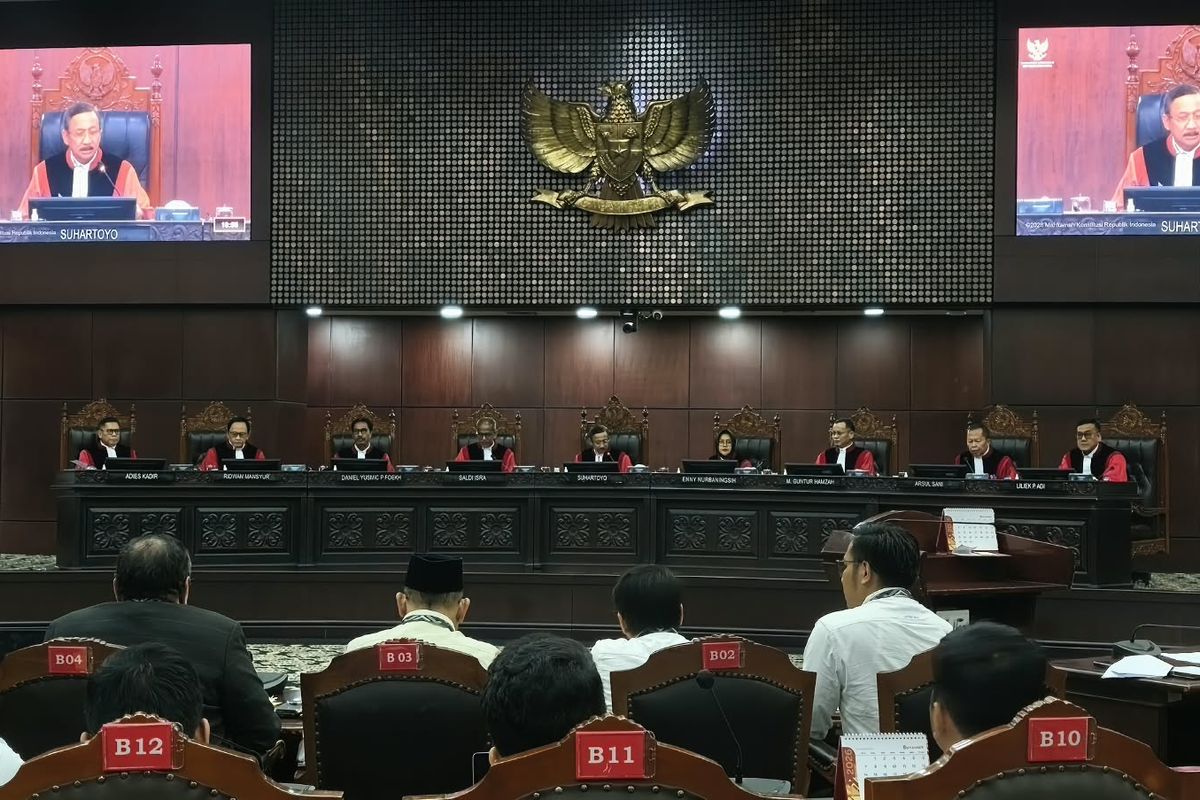
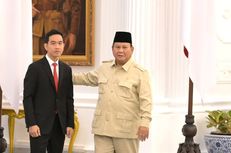
JAKARTA, KOMPAS.com - The dispute over the educational qualifications of Gibran Rakabuming Raka in the 2024 presidential election continues to unfold at the Constitutional Court (MK).
During the inaugural hearing and subsequent examinations, the petitioners raised several concerns regarding irregularities in Gibran’s educational qualification fulfillment.
These include the introduction of a new norm in the KPU regulations that exempts proof of high school graduation for candidates who studied abroad, the reportedly expedited process for issuing equivalency certificates, and allegations of concealed information.
On the other hand, the KPU asserts that all of Gibran’s qualification documents have been verified and deemed sufficient.
During the initial hearing on Monday (September 21, 2026), the petitioners presented findings that suggest a structured, systematic, and planned (TST) action in meeting these qualifications.
One of the key points raised was the change in the norm outlined in Article 18, paragraph (3) of the KPU Regulation No. 19 of 2023, which suddenly exempts proof of high school graduation for candidates educated abroad.
Petitioner Denny Indrayana stated that this norm had not existed in previous elections.
The article reads:
“Proof of graduation as referred to in paragraph (1) letter n is exempted for presidential candidates and for presidential or vice-presidential candidates who do not possess proof of high school graduation from foreign schools but have proof of graduation from higher education.”
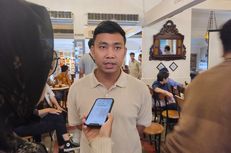
“We present evidence here showing that in the 2009, 2014, and 2019 elections, no such norm existed. This norm suddenly appeared for the 2024 election,” Denny said.
Denny further noted that the alleged 'stealth clause' is supported by public testing conducted by independent election monitoring leader Hadar Nafis Gumay.
During public testing on this regulation, it was confirmed that Article 18 paragraph (3) did not exist.
“It was mentioned that this is a stealth or loophole article,” he added.
The petitioners also questioned the rapid issuance of Gibran's equivalency certificate, which was processed in just one day.
This is notably quicker than the usual five-day processing time.
“There was an Equivalency Certificate that was indicated to have been issued by the Ministry of Education and Culture's Directorate General of Primary and Secondary Education very quickly, in less than 24 hours, on August 26, 2019, which has not yet been demonstrated to have the supporting documents proving graduation,” said the petitioners' attorney, Bambang Widjajanto.
Bambang considered that the flaws surrounding the candidacy process cannot simply be remedied by an inauguration.
He asserted that the inauguration is a subsequent stage reliant on the validity of the candidacy, not an instrument to remedy defects inherent in that candidacy process.
“Therefore, the inauguration does not have the healing power regarding defects in qualifications that have not been met from the outset, especially if it is alleged that there is potential manipulation in the fulfillment process,” he emphasized.
On this basis, the petitioners request that the Constitutional Court allow for an open and transparent examination of the veracity of the educational qualifications.
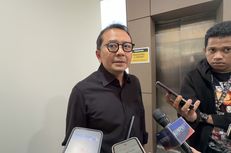
Denny Indrayana revealed that information regarding Gibran Rakabuming Raka’s failure to meet the educational qualifications for the vice-presidential candidacy in the 2024 presidential election has been concealed.
“The information regarding Gibran’s educational qualifications has been withheld and not provided, even until now,” Denny stated.
Denny noted that they only recently learned that Gibran’s qualifications at the high school level do not meet the requirements for a vice-presidential candidate.
He explained that in PHPU Case Number 01/PHPU.PRES-XXIV/2026, they had previously questioned Gibran's educational qualifications in the general court, the State Administrative Court (PTUN), the Central Information Commission (KIP), and even sent letters to the DPR.
The former Deputy Minister of Law and Human Rights expressed that these efforts resulted in no clarity, leaving the MK as the last hope.
“In this case, the Court is the last hope, court of last resort. So that we do not face a process of justice that is denied, denial of justice,” he stated.
Responding to the petitioners’ arguments, the General Election Commission (KPU) emphasized that Gibran Rakabuming Raka has met the educational qualifications as a vice-presidential candidate in the 2024 presidential election.
“The qualification documents submitted by Gibran Rakabuming Raka as a vice-presidential candidate have been verified by the Respondent and deemed sufficient,” said the attorney.
The KPU received and verified the qualification documents for the candidate pair Prabowo Subianto-Gibran Rakabuming Raka on October 28, 2023.
Concerning Gibran, they clarified Article 1 paragraph (7) of the Minister of Education and Culture Regulation No. 29 of 2014, which states that an equivalency certificate is a document that certifies that the diploma/certificate obtained by the learner from abroad is equivalent to that of a domestic diploma.
Thus, it can be concluded that Gibran's high school equivalency certificate is equivalent to a diploma.
In addition, there is Article 18 paragraph (1) of KPU Regulation No. 19 of 2023.
In KPU Regulation 19/2023, the KPU exempts proof of high school graduation for candidates who studied abroad and possess proof of higher education graduation.
“Thus, the petitioners’ claims questioning the fulfillment of educational qualifications cannot simply be the basis for declaring that the candidacy in question does not meet the applicable legal provisions,” said the KPU’s attorney.
The KPU also noted that the complaint regarding Gibran's educational qualifications in the 2024 election is categorized as an impeachment.
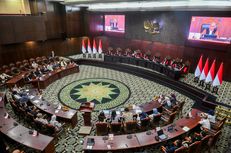
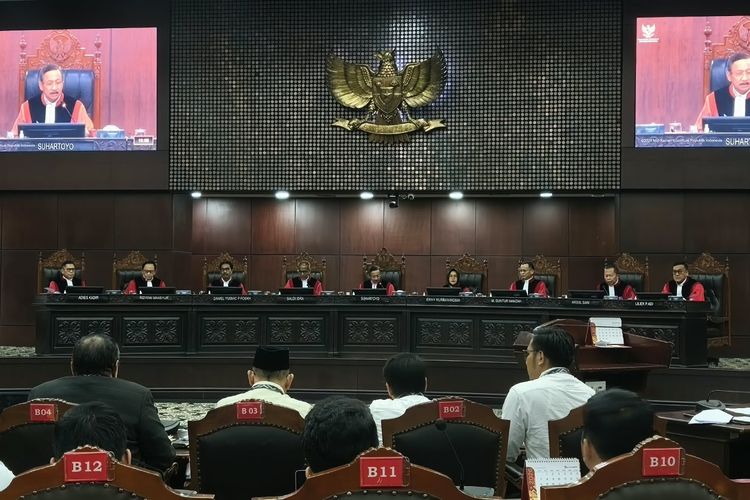
“In essence, the petitioners’ request falls under the impeachment category,” stated KPU attorney Jufaldi in the MK hearing room in Jakarta on Wednesday (September 23, 2026).
Meanwhile, the KPU acknowledged that Article 18 Paragraph (3) of KPU Regulation No. 19 of 2023 regarding the exemption from proof of high school graduation was created for the 2024 presidential election.
“Yes (it was made for the 2024 presidential election),” said KPU Chairman Afifuddin during the hearing on the petition concerning Gibran's candidacy in the 2024 presidential election at the Constitutional Court on Wednesday night (September 23, 2026).
Initially, Constitutional Judge Enny Nurbanigsih highlighted the issue of the high school graduation exemption rule as outlined in KPU Regulation No. 19 of 2023, Article 18, Paragraph (3), which was also challenged by the petitioners.
“Is that norm indeed created for every presidential candidate requirement, or is it specifically designed only for the 2024 presidential election?” Judge Enny inquired.
Afifuddin stated that the norm is also used in local elections before and after the 2024 presidential election.
Meanwhile, KPU Commissioner Idham Kholid noted that the KPU's regulations are based on Minister of Education and Culture Regulation No. 29 of 2014 on the legalization of foreign diplomas and Minister of Education and Culture Regulation No. 6 of 2022 regarding special equivalency in higher education.
“Regarding Minister of Education and Culture Regulation No. 29 of 2014 on the legalization of foreign diplomas, it has been referred to in KPU decisions regarding the technical guidelines for the verification of registration of candidate pairs for regional elections in the 2020 simultaneous elections,” he explained.
Constitutional Judge Saldi Isra then sought to clarify what Judge Enny had inquired earlier.
Saldi emphasized the significant time gap between Minister of Education and Culture Regulation 29 of 2014 and the 2024 election.
He then questioned whether there had been any rules on equivalency of foreign diplomas in the five previous elections.
“It’s not about whether the Minister of Education and Culture regulation is to be used as a consideration, but whether the material stating that presidential or vice-presidential candidates from abroad has ever existed in previous KPU regulations during the five-year elections before 2024?” Saldi pressed.
Afifuddin then affirmed that such rules had not been established in previous presidential elections prior to 2024.
Enny briefly responded to Afifuddin's statement.
“That's actually the answer I was looking for,” Enny said.