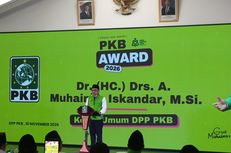


Cak Imin Encourages Pesantren-Based Vocational Schools to Elevate Standards to International Levels
-
News
-
3 hours ago
This article was translated by AI. Read the original article on Kompas.com. See Original

Instead, the mentality that emerges is: “As long as I am not a suspect, I must hold on.” However, public officials’ ethical standards should not stop at the suspect question.
If an official’s moral yardstick is merely “I’m not a suspect,” then governance ethics have been reduced to criminal law. And that is dangerous.
The president needs to view this as a governance issue. In a presidential system, ministers ultimately assist the president and are responsible for carrying out government duties according to their position.
Therefore, when a ministry faces a serious corruption case, the president has a direct interest in ensuring the legal process proceeds without obstacles and public trust in the government is maintained.
Policy choices can vary. A minister may continue to perform duties under tightened supervision. A comprehensive evaluation of ministry structures and officials may also be conducted.
Or, if deemed necessary to safeguard the independence of the legal process and institutional credibility, temporary suspension can be considered until the core issues become clearer.
Most importantly, decisions must be based on institutional and national interests, not momentary political pressure.
There is a tendency in our state administration practice to demand officials’ accountability only after their legal status changes to suspect. However, a mature state should not operate on such logic.
The rule of law requires proof processes. Yet, an ethical state demands leadership capable of preventive action before the criminal process concludes.
If future investigations prove that a minister was unaware of, uninvolved in, and unrelated to the suspects’ actions, then their personal honor must certainly be restored.
But during this process, the concern should not solely be the minister’s fate. Far more important is the institution’s fate.
Because a ministry does not belong to a minister. The minister’s office is not private property. And government is not a stage to defend individual dignity. It is a public trust.
The issue afflicting the Ministry of ATR/BPN should not stop at the question: who received money? The more fundamental question is: why did the system allow the money to circulate?
Why were those identified as trusted aides able to be so close to the decision-making process?
Where is internal oversight? How do conflict-of-interest prevention mechanisms function?
And finally: what form of accountability should a leader take when the system under their leadership fails?
This is the moment to shift paradigms from “I am not involved” to “I am responsible for ensuring the institution I lead remains clean.”
From “I’m not a suspect” to “I must uphold the honor of the office.” And from “press on and never retreat” to a new culture: public officials must know when to hold on, when to distance themselves, and when, with moral awareness, to step down for the honor of the institution.
Ultimately, an official’s success is measured not only by how long they remain in office.
Sometimes, history will honor more an official who dares to say: “I do not have to be found guilty to realize that the institution I lead needs my accountability.”
Because in a democratic state, the law determines right and wrong. But ethics determines whether an office is still worth holding when public trust is at stake. Ethics truly stands above the law.