
The Change of Vice President and the Cohesiveness Test of Prabowo’s Coalition
-
News
-
4 minutes ago
This article was translated by AI. Read the original article on Kompas.com. See Original
THE CHANGE in Vice President amidst the term is not merely a matter of filling a vacant constitutional seat.
In Indonesia's political configuration, this event has the potential to test the balance of power, coalition cohesiveness, and the relationship between the President and the political forces that brought him to power.
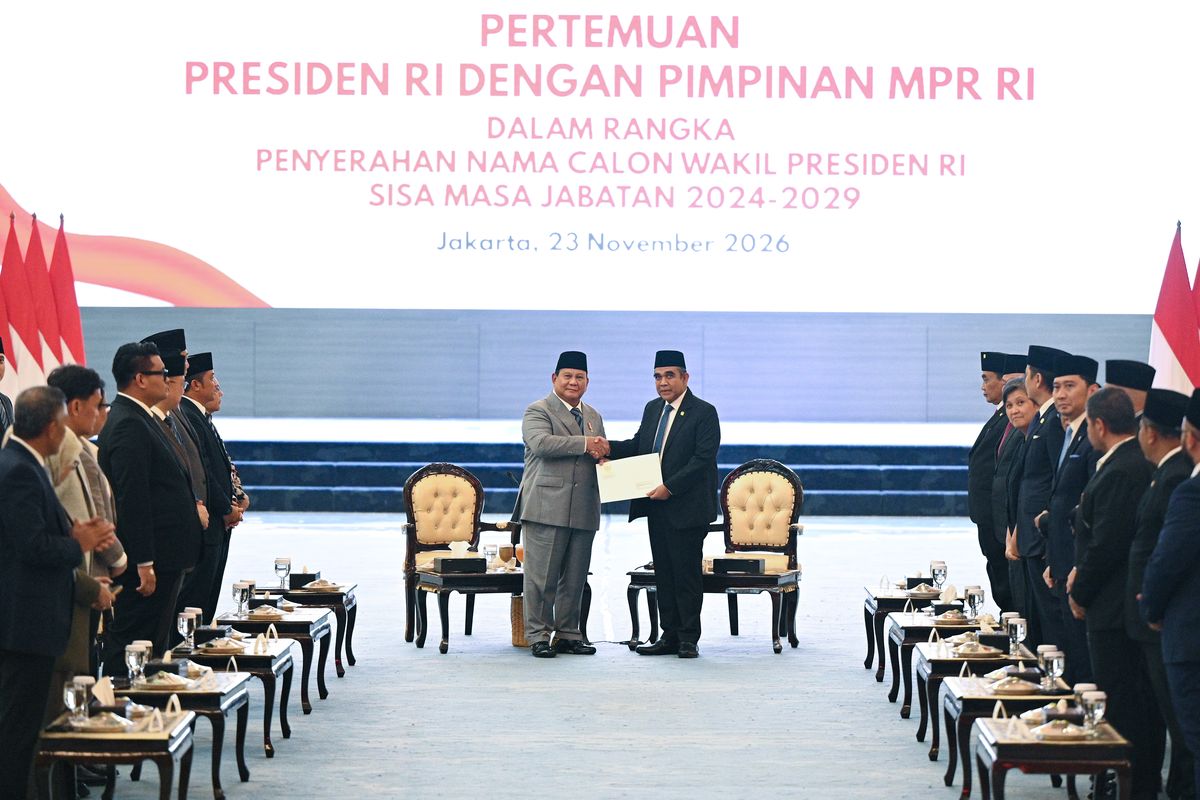
President Prabowo Subianto has proposed two names to the MPR for selection as vice president replacement: Andi Amran Sulaiman and Sugiono.
Both have different backgrounds.
Amran is known through his professional experience and leadership in the agriculture sector, while Sugiono is a key cadre of Gerindra who previously served as Minister of Foreign Affairs and currently holds the position of the party's Secretary-General.
Constitutionally, this process falls within the MPR’s authority as stipulated in Article 8, paragraph (2) of the 1945 Constitution.
The President proposes two candidates, and then the MPR chooses one. However, behind this procedure lies a much broader political issue.
Whoever is elected will not only fill the vice presidential seat but also help determine the political balance within Prabowo's administration.
The fundamental question is not merely who is most qualified to accompany the President, but how this transition will impact the relationships among the powers that have supported the government.
In understanding this dynamic, Gibran Rakabuming Raka’s position must not be overlooked.
In the 2024 election, Gibran is not just a candidate who complements Prabowo electorally.
His presence holds strategic significance as a political bridge between Prabowo and the networks associated with President Joko Widodo.
Gibran symbolizes continuity with the previous administration.
He also acts as a connector between Prabowo's political base, Jokowi's volunteer network, and the voter groups seeking governmental continuity.
In this sense, Gibran can be characterized as a coalition magnet that helps broaden Prabowo’s political reach.
However, to label Gibran as the ace that secures Prabowo’s victory needs to be placed in a proportional context.
Prabowo's victory cannot be explained solely by Gibran’s influence. Prabowo’s popularity, the strength of the Gerindra machinery, support from coalition parties, volunteer networks, and various other social and electoral factors also contribute to the 2024 election outcome.
Nonetheless, Gibran’s role as a political connector remains vital. Therefore, when Gibran is no longer vice president, the change involves not just the national leadership composition, but also a vital communication channel and a symbol of connectivity between Prabowo’s administration and Jokowi’s political network.
Does Gibran’s absence automatically mean the loss of Jokowi’s political support and his base in Solo? Certainly not.
Support for Jokowi, support for Gibran, and support for Prabowo's administration are interconnected but not identical.
There is no reason to assume that all of Jokowi's supporters will shift their stance simply because Gibran is no longer vice president.
However, the political relationship that previously had institutional channels through Gibran must now find new forms.
This is where Prabowo's ability to manage relations with Jokowi and his supporter networks will be tested.
The change in Vice President also raises questions about the actual foundation of Prabowo’s government coalition.
Is the coalition built on shared vision and development agendas, or is it largely supported by elite agreements, role-sharing, and electoral calculations?
If the coalition's foundation is primarily transactional, changing figures who function as political connectors could lead to tensions.
Conversely, if the coalition relationships are supported by more structural government interests, Gibran’s departure need not result in a fissure.