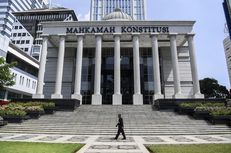
Constitutional Court Declares New Police Law Formally Defective, Must Be Amended Within One Year
-
News
-
2 minutes ago
Writer
This article was translated by AI. Read the original article on Kompas.com. See Original

JAKARTA, KOMPAS.com - The Constitutional Court (MK) has stated that Law Number 5 of 2026 concerning the Third Amendment to Law Number 2 of 2002 on the Indonesian National Police (Police Law) is formally flawed.
This was announced by the MK while partially granting petition number 251/PUU-XXIV/2026, which challenged the formal aspects of the new Police Law.
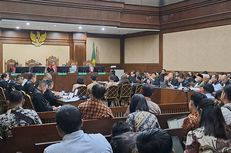
“We grant part of the petition from Applicant I,” said MK Chief Justice Suhartoyo during the reading of the decision in case number 251/PUU-XXIV/2026 at the MK building in Jakarta on Monday (23/11/2026).
The court declared that the latest Police Law is formally flawed and must be amended within a maximum of one year from the reading of the decision.
The new Police Law will remain in effect until amendments are made by the lawmakers within the deadline specified by the court decision.
If the government and the House of Representatives fail to amend within one year, the previously applicable regulation would revert to Law Number 2 of 2002 on the Police.
“We state that the establishment of Law Number 5 of 2026 concerning the Third Amendment to Law Number 2 of 2002 on the Indonesian National Police is not contrary to the 1945 Constitution of the Republic of Indonesia and continues to have legally binding power conditionally as long as amendments are made within one year from this decision being pronounced,” Suhartoyo said.
In its legal considerations, the MK pointed out that one issue in the process of enacting the Police Law was related to the decision of the House of Representatives for the 2024-2029 period, which took over the police draft law (RUU) from the previous 2019-2024 period to establish it as a House initiative proposal.
This takeover process has come under scrutiny as it bypassed the harmonization stage conducted by the House Legislative Body (Baleg).
Indeed, harmonization is one of the stages in the legislative process outlined in the relevant regulations.
The MK emphasized that the authority of the plenary meeting as the highest decision-making forum in the House cannot be used as a justification to overlook the legislative stages prescribed by the Law on the Formation of Legislation (UU P3).
MK Justice Enny Nurbaningsih explained that the plenary meeting does have the authority to designate a draft law (RUU) as a House initiative proposal.
However, this authority must still be exercised in accordance with the established legislative procedures.
“The authority of the plenary meeting to designate a draft law as a House initiative proposal is a legitimate authority. However, this authority does not inherently provide a basis to disregard the specific stages set out by the UU P3,” Enny stated during the reading of the legal considerations.
Enny added that the House, as the law-making body, must comply with the provisions in the UU P3 since that law serves as a guideline for every stage of the legislative process.
Additionally, the MK rejected arguments suggesting that the harmonization function had been substantively fulfilled through various discussion stages, such as compiling the Problem Inventory List (DIM), working meetings, working committees, drafting teams, and synchronization teams.
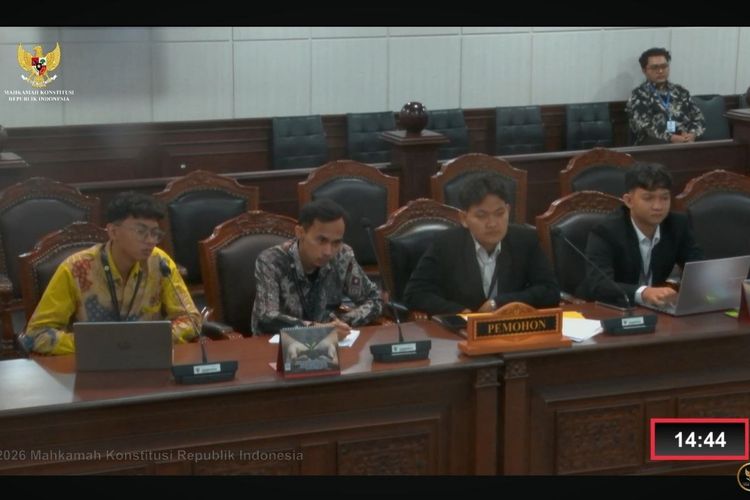 Applicants outlined the main points of their petition during the preliminary hearing of case number 251/PUU-XXIV/2026 at the Constitutional Court on Tuesday (7/7/2026).
It is known that Zulfikar Putra Utama (Applicant I) and Muhammad Ezra Suhaeri (Applicant II) believe the Police Law contradicts Law Number 13 of 2022 on the Formation of Legislation (P3).
In their formal challenge of the Police Law to the MK, they noted allegations that the revision of the Police Law was conducted while ignoring various principles and procedures for good legislative practices.
This includes principles of transparency, effectiveness, and meaningful public participation.
In their petition, Zulfikar and Ezra requested that the MK state that the formation of Law Number 5 of 2026 concerning the Third Amendment to Law Number 2 of 2002 on the Indonesian National Police does not fulfill the requirements for law formation according to the 1945 Constitution of the Republic of Indonesia, and that the Police Law lacks legally binding force. They also requested the MK to declare that Law Number 2 of 2002 on the Indonesian National Police, as amended by Law Number 6 of 2023 on the Establishment of Government Regulations in Lieu of Law Number 2 of 2022 on Job Creation, is reinstated.