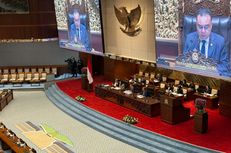
At the Constitutional Court, DPR Acknowledges Challenges for Small Business Operators in Obtaining Halal Certification
-
News
-
Just now
Writer
This article was translated by AI. Read the original article on Kompas.com. See Original

JAKARTA, KOMPAS.com - Abdullah, a member of Commission III of the House of Representatives (DPR) representing parliament at the Constitutional Court (MK), revealed the challenges faced by micro and small business operators in obtaining halal certification.
Some of these challenges include the requirement to have a business identification number for halal declarations, the mechanism for paying incentives for halal product process facilitators, and infrastructure limitations.
"One major issue hindering micro and small business operators is the ineffectiveness of the halal declaration process. This problem is not just a simple technical challenge faced on the ground, but rather a structural issue stemming from the lengthy and complicated certification process," Abdullah stated during a DPR briefing in the case Number 354/PUU-XXIV/2026 on Monday (November 16, 2026), as quoted from a MKRI YouTube broadcast on Tuesday (November 17, 2026).
The DPR also acknowledged various obstacles faced by the Halal Product Assurance Agency (BPJPH) as outlined in the monitoring report concerning Law Number 33 of 2014 on Halal Product Assurance (UU JPH) in 2025.
The report highlighted several substantial institutional dynamics and operational hurdles, including the significantly low rate of halal certifications compared to the population of micro and small businesses, the suboptimal use of the SiHalal application developed by BPJPH, and limitations in the infrastructure of halal inspectors and human resources supporting halal product processes.
Additionally, there are challenges related to digital literacy and proof of raw materials, along with limited budget facilities for free halal certification programs.
"These issues are rooted in the procedures for implementing halal declarations as stipulated in the a quo Law and its implementing regulations, which prove to be burdensome. In reality, these procedures were intended by the lawmakers to ease access to business opportunities for micro and small entrepreneurs," Abdullah added.
 The Constitutional Court building. The Constitutional Court (MK) has proposed an additional budget of Rp 67 billion for the 2027 budget year.
For your information, the petition Number 354/PUU-XXIV/2026 was filed by a culinary vendor named Wahyu Triana Sari along with two others.
They are challenging Article 48 numbers 1, 2, and 20 of the Appendix of Law 6/2023, which contains amendments to Article 1 number 1, Article 4A paragraph (1) and Article 33A paragraphs (1), (2), (3), (4), and (5) of the Halal Product Assurance Law.
The provision of Article 67 of the Halal Product Assurance Law essentially regulates the deadline for mandatory halal certification for products circulating and trading in the Territory of Indonesia, gradually, and is to be stipulated in Government regulations.
The derivative of Article 67 of Law 33/2014 is then regulated in Article 160 of Government Regulation Number 42 of 2024 on Halal Product Assurance Organization (PP 42/2024).
Essentially, this norm sets the deadline for halal certification compliance until October 17, 2026, for micro and small businesses.
Wahyu and others state that each business actor operating in the home culinary field lacks written parameters to determine how far raw materials, packaging, production tools, and supporting services are included in the scope of certification obligations.
Therefore, legal compliance depends on the interpretation of the implementing authority, which can change over time.
According to them, the broad formulation without clear limitations regarding the type, scope, and characteristics of the intended objects creates norm confusion.
As a result, it is potentially subject to subjective interpretation by policy makers and field implementers.
This could also create space for law enforcement to reach objects that were not meant by the lawmakers to be targets of the halal product assurance regime.
In their petition, they request that the MK issue an interim ruling to delay the enforcement of Article 67 paragraph (2) and (3) of Law 33/2014 as it relates to the obligation for halal certification for micro and small business products and the imposition of administrative sanctions until a final decision by the Constitutional Court on the substance of the a quo request.
They also ask the Court to declare Article 48 number 1 of Appendix Law 6/2023, which amends the norm of Article 1 number 1 of Law 33/2014, conditionally unconstitutional and lacking binding legal force unless it is interpreted as: "A product is food, beverages, medicine, or cosmetics consumed and/or used by Muslims."