

The Gibran Nomination Hearing: Uncovering the Background and Origin of the "Educational Exemption Clause"
-
News
-
3 minutes ago
This article was translated by AI. Read the original article on Kompas.com. See Original
TWO years is not a long time for a government. However, two years are sufficient to observe the direction of power.
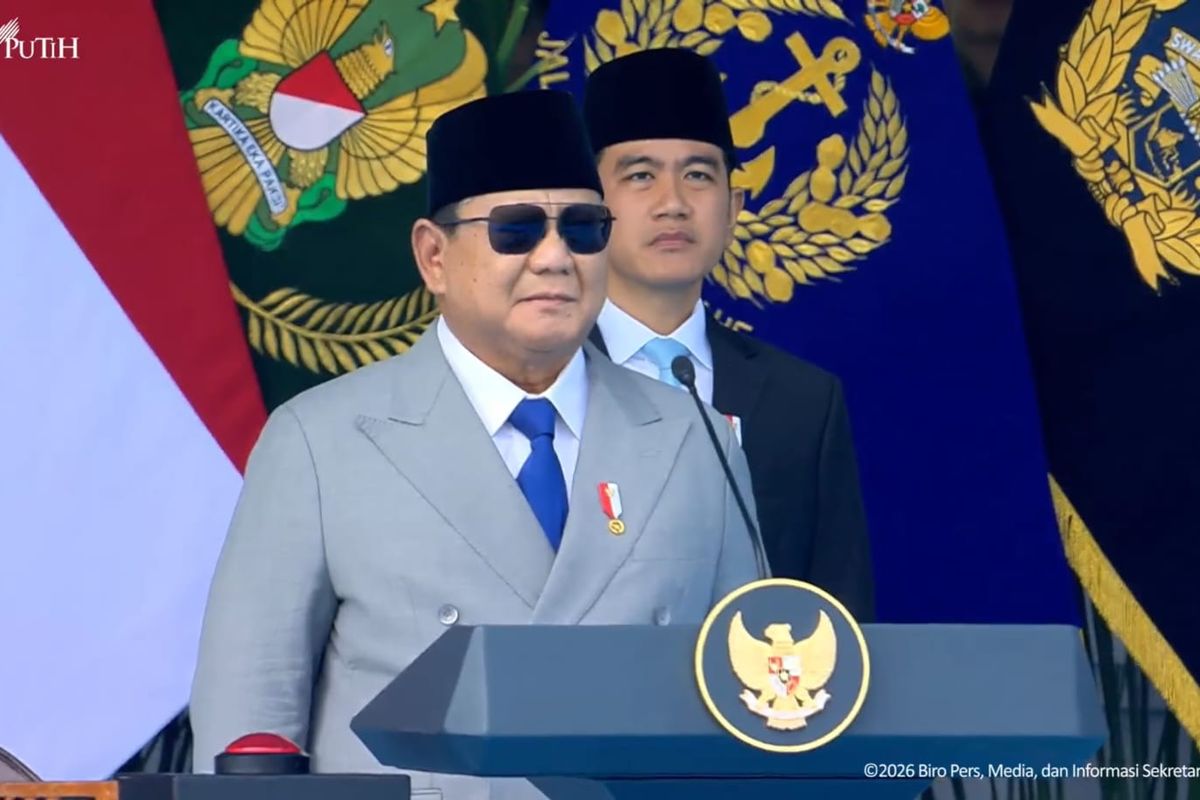
On October 20, 2026, the administration of President Prabowo Subianto and Vice President Gibran Rakabuming Raka will complete two years in office.
There are still three years remaining to fulfill promises, complete programs, and demonstrate the choices of policy.
It is too early to declare two years as the final judgment for a government. However, one aspect can already be scrutinized: how power is exercised.
In this respect, the measure of governmental success extends beyond economic growth, investment, development, or social programs.
Constitutional states pose another question: as the government increasingly wields its authority, are the institutions overseeing that power functioning equally robustly?
This question becomes critical after nearly two years of the Prabowo-Gibran administration.
One characteristic of Prabowo's administration is strong political consolidation.
The government has gained support from numerous political factions within the parliament.
The relationship between the President and the Parliament has been relatively cooperative, with the Merah Putih Cabinet formed initially comprised of 48 ministers.
Consolidation is not inherently wrong.
In a multiparty presidential system, it is nearly impossible for a president to pursue a governing agenda relying solely on their party.
Parliamentary support is essential for legislation, budget approvals, and various strategic policies.
Stability can even be an asset. A government not continually bogged down by political conflict has a better opportunity to maintain policy consistency.
Problems arise when strong consolidation lacks strong oversight.
Article 20A of the 1945 Constitution places oversight functions on par with legislative and budgeting roles of the parliament.
This constitution, therefore, does not envision parliament merely as a partner of the President in government administration.
Parliament also serves as the institution overseeing the use of executive power.
Here lies the paradox. The broader the parliamentary support for the government, the easier policies are enacted.
At the same time, maintaining institutional distance between those wielding power and those overseeing it becomes increasingly crucial.
A strong government is not an issue for democracy. The problem starts when strong power loses its checks and balances.
Official data provide a noteworthy perspective. The Central Bureau of Statistics recorded Indonesia's Democracy Index 2025 at 78.19, categorizing it as moderate.
At the national level, the freedom aspect scored 75.52, equality 80.33, and the capacity of democratic institutions 78.28.
However, at the central level, the freedom aspect only scored 66.80.
This figure cannot be the basis for concluding that Indonesian democracy is regressing. Yet, it is significant enough to warrant attention.
Democracy does not conclude once the elections are over. It truly thrives between elections: when citizens speak up, the press monitors, students protest, civil society voices dissent, and governments face criticism.
The demonstrations of August-September 2025 recorded significant notes. In its preliminary findings, the Ombudsman of the Republic of Indonesia reported that 4,667 individuals were arrested.
Of these, 3,753 were released, 131 were designated as suspects, and 372 remained detained when the findings were reported.
The Ombudsman also identified indications of maladministration, ranging from a lack of transparency and discriminatory treatment to the use of excessive force.