

Ma'ruf Amin Resigns as Chairman of MUI Advisory Council, What’s the Reason?
-
News
-
12 minutes ago
This article was translated by AI. Read the original article on Kompas.com. See Original
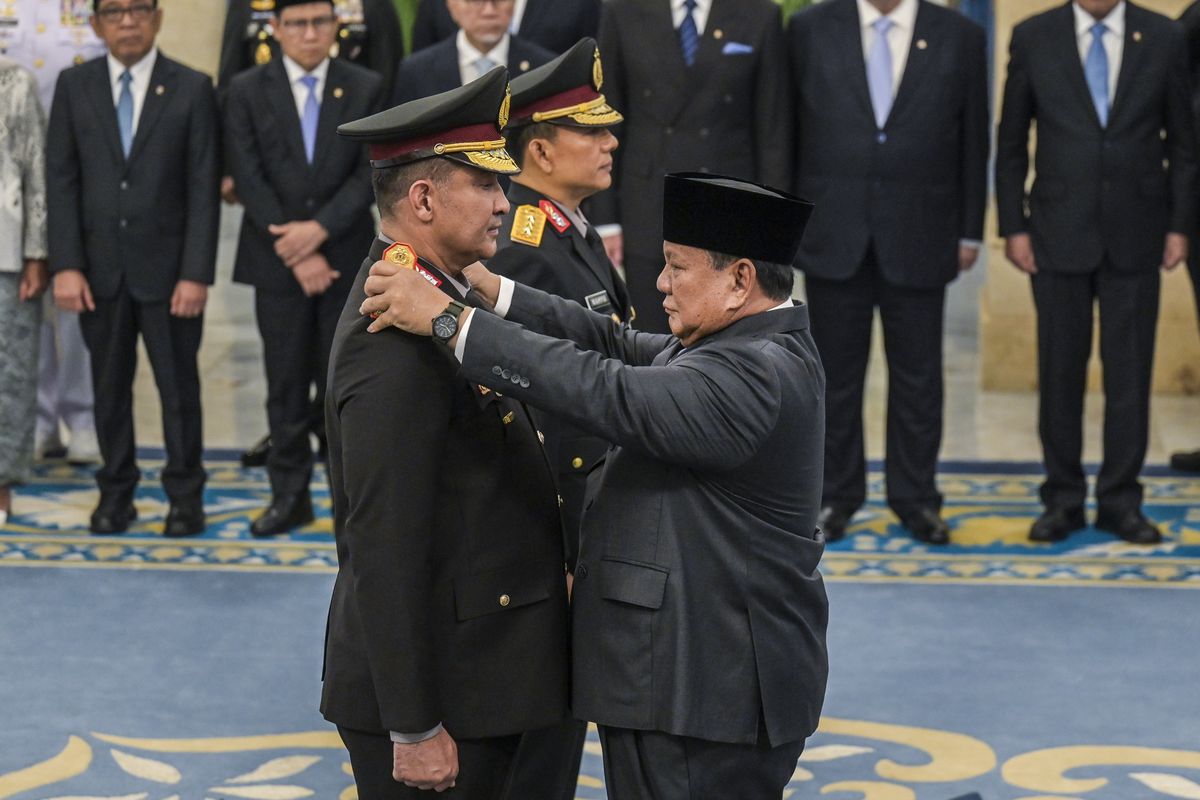
ALHAMDULILLAH, alhamdulillah, alhamdulillah, this is a phrase that flows from many mouths as they welcome the inauguration of Suyudi Ario Seto.
This four-star general becomes the new Chief of the Indonesian National Police (Kapolri).
Even such a brief moment marks the grandeur of that day, as the longing of helpless servants to quickly emerge from the wounds and suffering of justice in the legal world over the past five years.
After donning the four stars on his shoulders and being officially appointed as Kapolri, General Suyudi walked slowly to his mother, who sat in a wheelchair.
Unexpectedly, the general knelt at his mother’s feet, embracing and kissing her, just like a devoted son.
Immediately after, the Police People's platform, not Promoter, not Precision, echoed again in the hot afternoon, having already reverberated in the DPR that morning.
Allah Azza wa Jallah, indeed knows everything, far beyond what can be imagined about the weariness of the people who suffer, moaning endlessly to be given a Kapolri, in whom hope for an exquisite order of law blooms, as justice finds its place in every heartbeat of legal events, making it possible.
These impoverished people, lacking money and power, know only one thing; the law is never about lifeless letters in laws or court judgments.
The law, indeed, is not about lifeless letters in laws and court decisions.
No, it is not that. The law, in its ontological origins, is nothing but a yearning to honor the dignity of humanity, the greatest creation of the Creator.
This yearning does not arise from memories of the beautiful days gone by with the dawn, but rather from the concern that human dignity will crack, break, and perish if there is no guidance, direction, leadership, and compass.
The law is needed not for its name. No, once again, it is not. The law is needed because of the collective nature of humanity.
Living together as humans, forming communities or whatever it may be called, that is the essence of being human.
This essence also makes individuals different in many dimensions; capacities, desires, interests, and others, which often cause others to be hurt, wounded in countless life stories.
It has always been this way throughout all early civilizations; someone, regardless of their means, emerges, whether spontaneously or by design, to lead the community, pulling them apart or, conversely, bringing them closer to harmony.
In harmony, people do not prey upon one another, oppressing and injuring, and the justice of life and the grace of humanity are preserved.
This is not hypothetical, let alone an illusion. This is a postulate that does not require empirical verification to ensure the validity of its justification.
If living together must be conceptualized as contingency, it cannot fail to connect with one or several causes.
In this case, the cause is not about order as something inevitable in living together but about upholding the dignity of humanity.
This dignity is an imperative demand of perfect humans, which categorically holds an imperative power in its indescribable beauty.
Apriori, whatever a person thinks about the existence of something, including the existence of humans, one thing is clear: everything does not occur by itself or without encompassing and surrounding causes.
There always exists a transcendent absolute reality that can only be imagined apriori, not empirically, behind it.
The leader of the community, in whatever way that status is attached to them, is always an apriori replica of something that cannot be described.
The law, to the limit of apriori, is that replica. And that is why the yearning for goodness, to avoid saying justice in all its numerous variations that cannot be numerically depicted, continues to thrive.
Anyone who has ever immersed their mind in these theological dimensions knows the oppression of one’s fellow beings, loathing every aspect of it.
Even for a moment, a legal wound, that wound still devastates the perfect human.
To injure a perfect human never fails, whatever the reason, to ruin the grandeur of humanity. It is repulsive.
Mr. Kapolri, a mama’s boy who cannot use the four stars on his shoulders to stand tall before his aged mother, justifies his position as a new legal compass, with all its aspects inscribed with his mother’s advice.
A mother’s love never allows her children to forsake the grandeur of humanity, the epistemological root of justice.
No mother is unjust. That does not exist. A mother is always present in all matters of justice.