

Habiburokhman Requests Ban on 4 Bullying Suspects in Malang from Taking Exams: No Special Treatment!
-
News
-
34 minutes ago
This article was translated by AI. Read the original article on Kompas.com. See Original
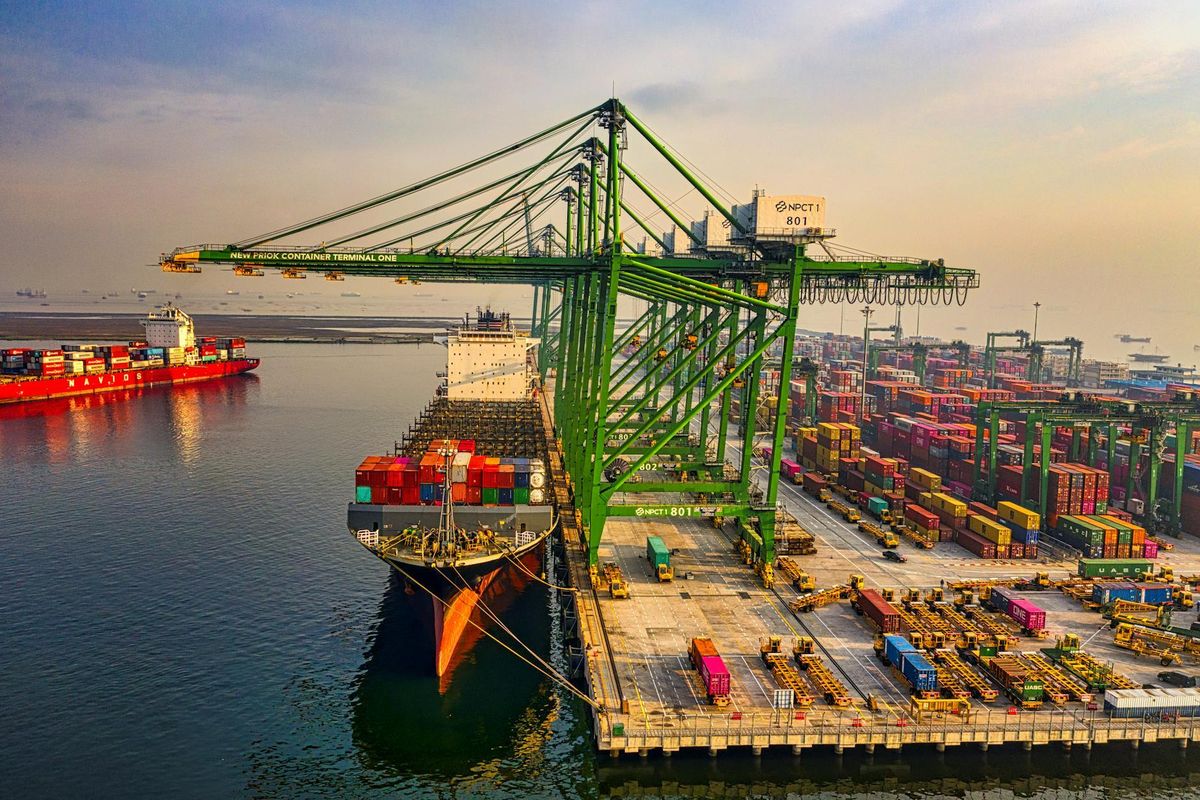
THE HIGH logistics costs in Indonesia, which far exceed those in neighboring Southeast Asian countries, are not a new discussion but rather a structural reality that continues to haunt the national economic resilience.
The geographical complexities of the archipelago, the disparity in shipping loads between the western and eastern regions, and the reliance on linear supply chains contribute significantly to elevated distribution costs.
When this reality becomes an unavoidable fact, the fundamental question shifts from how much efficiency we have failed to achieve to how we respond and fundamentally and conceptually reconfigure the national industrial and logistics economic model.
Is the idea of building an island-based industry utilizing local resources a rational solution, or is it merely a new efficiency trap that risks further fragmenting Indonesia's spatial landscape?
The concept of establishing independent industrial zones on each major island in Indonesia often arises as a spontaneous reaction to the high inter-island transportation costs.
At first glance, this idea seems attractive due to its potential to shorten logistical distances.
However, when analyzed through the lens of spatial economics theory and modern supply chain management developed at the Massachusetts Institute of Technology (MIT) and Harvard University, this purely insular approach harbors serious theoretical vulnerabilities.
From the perspective of the Spatial Economics and Agglomeration Economies theories advocated by Paul Krugman at MIT, the concentration of economic activity does not occur solely because of the presence of local raw materials, but due to industrial economies of scale, the availability of skilled labor, and well-developed supporting supply networks.
Forcing the establishment of processing industrial zones uniformly across each island without adequate economies of scale will only lead to duplication of capabilities, bloated fixed capital, and an inability to compete in the global market.
Questions regarding the existence of raw materials on each island also reveal geological and ecological disparities within the archipelago.
Indonesia's natural distribution of materials is not balanced.
Sumatra and Kalimantan are rich in fossil energy, palm oil, and metal minerals; Sulawesi possesses the largest nickel deposits; Papua holds potential for copper and gold; while Java has a concentration of human resources, market consumption, and high-value manufacturing networks.
Attempting to impose uniform downstream industries on every island will encounter the reality that not all islands have the complete raw materials needed to support a standalone manufacturing ecosystem.
This is where the Resource-Based View (RBV) theory, rooted in strategy studies at Harvard Business School, provides a foundational perspective: a region's competitive advantage is not built from standardized facilities but from the formation of unique capabilities that leverage specific, hard-to-imitate resource characteristics.
To address the challenge of high logistics costs, we must transform our paradigm from a centralized industrial model to a framework of Polycentric Industrial Ecosystems based on Distributed Manufacturing.
The Supply Chain Network Design theory from the MIT Center for Transportation and Logistics emphasizes the importance of designing logistics networks not as centralized hub-and-spoke systems relying on a single primary corridor, but as dynamically integrated multi-hub networks.
In this conceptual framework, Indonesia's islands are not treated as stand-alone industrial units (autarky) but as specialized production nodes interconnected within a regional value chain.
Each region focuses on developing downstream industries based on the comparative advantages of local raw materials, while advanced processing and integration of final products are distributed through measurable agglomeration economies.
The next theoretical step, rooted in Michael Porter's Creating Shared Value (CSV) concept from Harvard University, is to change our perspective on logistics costs, viewing them not merely as transport costs but as a variable that shapes ecosystem competitiveness.
High logistics costs in Indonesia are largely due to empty backhaul imbalances stemming from centralized consumption and manufacturing in Java.
An effective logistics system must be designed to create shared value in the raw material sourcing regions so that ships transporting raw or semi-finished goods to processing centers do not return empty but instead carry consumer goods and manufacturing inputs back to those areas.
Reconstructing this model demands an integration between spatial planning and national supply chain design, ensuring that the location of downstream industries outside Java is locked in by the certainty of multimodal connectivity and bi-directional loads.
Ultimately, responding to high national logistics costs cannot be achieved by escaping the geographical realities of the archipelago through ideas of industrial fragmentation by island.
The answer lies in strengthening supply chain architecture based on the concept of Resilient and Distributed Supply Chains.
Indonesia must be willing to invest in digitizing the supply chain, integrating the National Single Window, standardizing inter-island containerization, and developing energy infrastructure and initial processing facilities close to raw material sources.
By synergizing the locational advantages of eastern and western regions through precise cluster specialization, we can not only successfully reduce national logistics costs to approach ideal GDP levels but also lay the foundation for an inclusive, sustainable, and globally competitive Indonesian industrial sovereignty.

























