

PKB Engages 150 OSIS Students from Jabodetabek, Learning Political Awareness from an Early Age
-
News
-
3 minutes ago
This article was translated by AI. Read the original article on Kompas.com. See Original
THERE lies a paradox in economic development: a country can appear increasingly impressive in physical terms, while its people struggle more to meet their basic needs.
Government buildings may rise tall, new roads cut through forests, and urban areas designed with modern technology.
However, all this grandeur loses its significance when purchasing power weakens, job opportunities shrink, and households find it harder to fund their daily lives.
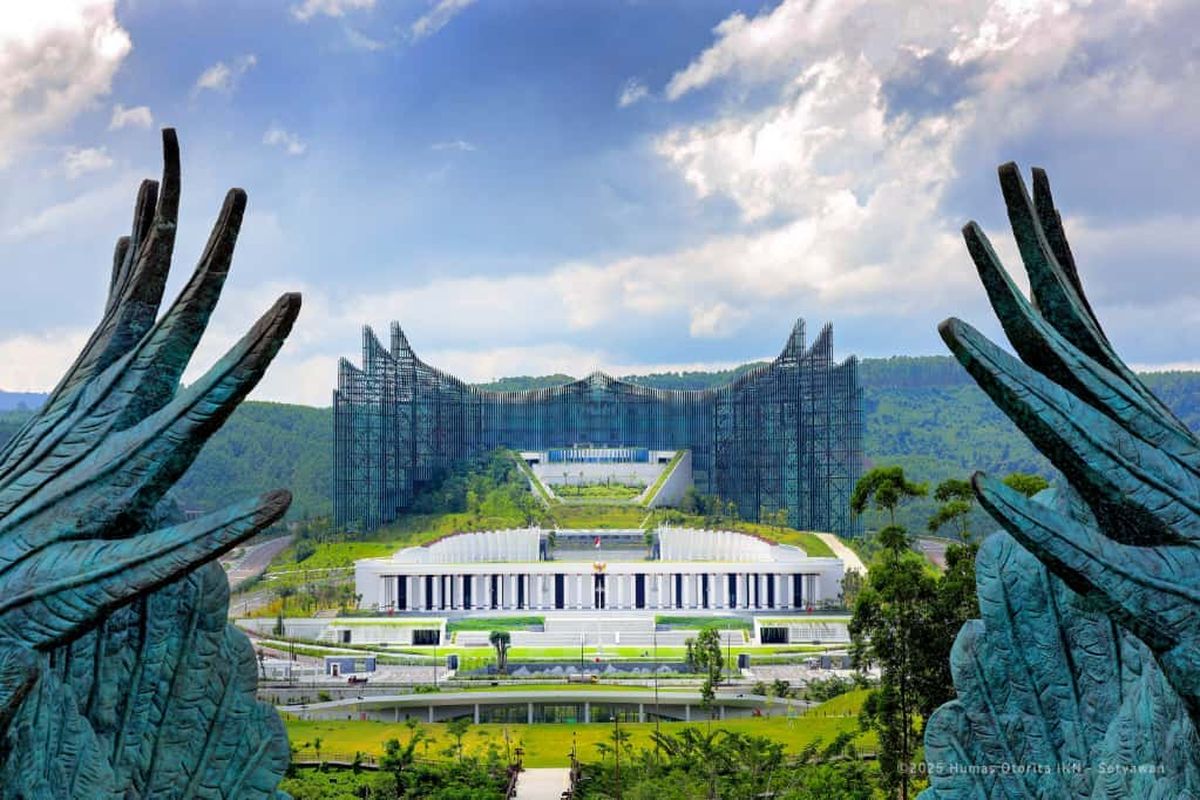
This paradox warrants reflection when discussing the continuation of the Nusantara Capital City (IKN) development.
The statement by the Chairman of the Deposit Insurance Corporation (LPS), Anggito Abimanyu, on November 23, 2026, signals a significant change in policy direction.
He revealed that IKN is no longer part of the Government Work Plan (RKP) of President Prabowo Subianto's administration.
As a consequence, the LPS has canceled plans to build an office in IKN, which had previously been allocated IDR 400 billion.
This decision may appear simple, merely canceling the construction of a building.
Yet, from an economic-political perspective, the issue is much larger: is the government correcting its national development priorities, or merely changing the order of projects without addressing the fundamental issues of IKN planning?
This question matters because development should not be measured merely by how much concrete has been poured, but by how much welfare it can generate.
Under the previous administration, IKN was placed as a national strategic project and a symbol of Indonesia’s transformation.
Its rationale was not entirely erroneous: reducing economic concentration in Java, promoting equitable development, creating new growth centers, and establishing a more modern governance structure.
The issue does not lie in the idea of moving the capital.
The problem is how such a massive project is planned, financed, and aligned with the nation’s fiscal capacity.
In public economics, there is the concept of opportunity cost, which refers to the cost of every expenditure decision.
Every rupiah allocated for IKN development means there are alternative opportunities that cannot be financed with the same amount.
Those funds might be better spent on improving schools, building healthcare facilities, strengthening the manufacturing sector, enhancing agricultural productivity, or creating jobs.
In other words, the IKN issue is not merely about how much budget has already been spent, but what must be sacrificed as the state continues to pursue this project.
Amid fiscal limitations, the government also faces financing needs for various priority programs, such as Free Nutritious Meals (MBG) and the development of Red and White Village/Neighborhood Cooperatives (KDMP).
Both programs have significant socio-economic objectives but still require evaluation of their effectiveness, targeting precision, and ability to produce measurable economic benefits.
The state budget (APBN) is not an unlimited funding source. According to the Finance Ministry's publication, as of August 31, 2026, state revenue was recorded at IDR 2,055.6 trillion, while state expenditure reached IDR 2,295.7 trillion, resulting in a deficit of 0.93 percent of GDP.
These figures do not yet indicate a fiscal crisis. However, a controlled deficit does not automatically imply that the government's fiscal space is expansive.
The state must still pay interest on debt, fund subsidies, meet mandatory expenditures, maintain transfers to regions, and provide budgets for priority programs.
Therefore, the government's ability to finance development should be assessed not only through the debt-to-GDP ratio but also through the ratio of interest payments to state revenue, primary balance, debt maturity structure, and spending flexibility.
A country that can still borrow does not necessarily have the capacity to finance all its ambitions.
The situation becomes more serious when looking at the government's debt position.
Data from the Directorate General of Financing and Risk Management of the Finance Ministry recorded government debt as of September 30, 2026, reaching IDR 10,326.93 trillion, with a debt-to-GDP ratio of 40.30 percent.
This ratio is still below the legal limit of 60 percent as stipulated in the State Finance Law.
However, using the legal limit as the sole measure of fiscal health is an analytical mistake.
What matters more is the country's ability to generate revenue to meet its debt obligations without sacrificing productive spending.
This is where the concept of fiscal space becomes relevant. Fiscal space refers to the government’s capacity to increase spending or change expenditure composition without disrupting fiscal sustainability and macroeconomic stability.
As fiscal space becomes tighter, the government must differentiate between spending that generates productivity and spending that primarily yields political prestige.
IKN certainly cannot be dismissed outright as a project without economic benefits.
Urban infrastructure, roads, clean water, energy, and connectivity have the potential to create long-term added value.
However, these benefits must be demonstrated through cost-benefit analysis, demand projections, infrastructure utilization rates, and the ability to attract private investment.
If development continues without certainty about economic activity, population growth, and adequate productive investment, Indonesia risks creating cities with expensive infrastructure but low utilization rates.
From a Keynesian economic perspective, government spending can stimulate growth through increased aggregate demand.
However, Keynes never claimed that every government expenditure is automatically productive. Its effectiveness is heavily influenced by the size of the fiscal multiplier.
Infrastructure development that generates connectivity, lowers logistics costs, and boosts industrial productivity has potential for long-term multipliers.
Conversely, spending that does not immediately create sustainable economic activity can yield lower multipliers.
There is also the risk of crowding out, which occurs when government deficit financing raises demand for funds in financial markets, driving up borrowing costs, and under certain conditions, reducing the private sector's access to financing.
This risk does not occur automatically with every deficit but becomes a crucial consideration as the state's financing needs grow.
Therefore, halting or postponing projects whose economic benefits do not justify their financing costs is not an anti-development move. On the contrary, it is a form of public economic discipline.
Experiences from other countries provide lessons that governments do not need to uphold a project solely because it has been announced, contracted, or has consumed a budget.
One current example is the cancellation of the East West Link infrastructure project in Melbourne, Australia, in 2015.
The newly elected Victorian government decided to halt the toll road project after changing policy.
The project, initially estimated to require over AUD 22.8 billion in investment over its implementation period, was ultimately canceled.
However, the cancellation did not come without costs.
The Victorian government faced termination costs estimated to exceed AUD 1.1 billion, including land acquisition, planning, and contract resolution costs.
The Auditor-General of Victoria also criticized the weak basis of the project's feasibility study and found that previous important decisions were driven more by political urgency than by economic benefits.
The crucial lesson is not that every expensive project must be canceled.
Rather, the government should rationally compare the costs of continuing the project against the costs of halting it.
In the investment economic perspective, there is the concept of sunk cost fallacy, which refers to the fallacy of maintaining a decision solely because money has already been spent.
In fact, past expenditures should not be the main reason for allocating new funds. Every decision should base on future marginal benefits and costs.
If the economic benefits of continuing the project are smaller than the additional costs, delaying, scaling down, or canceling may be more rational options.
Australia demonstrates that policy corrections require calculations.
Even stopping a project can cause significant contractual losses.
Thus, Indonesia needs to conduct a comprehensive evaluation of all IKN investment components rather than making decisions based solely on political sentiments.
Let’s not allow IKN to become a monument of ambitious development standing firmly on a fragile fiscal foundation.
Because, in development economics, the success of a government is not measured by how many projects it leaves behind but by how much welfare it has successfully passed on to the next generation.






















