

Minister Arifah Ensures Justice for the Family of Bullying Victim in Malang
-
News
-
24 minutes ago
This article was translated by AI. Read the original article on Kompas.com. See Original
SINCE the Reformasi era, choosing a vice president has almost always meant weighing balance. Red paired with green, Java with regions outside Java, one party with another.
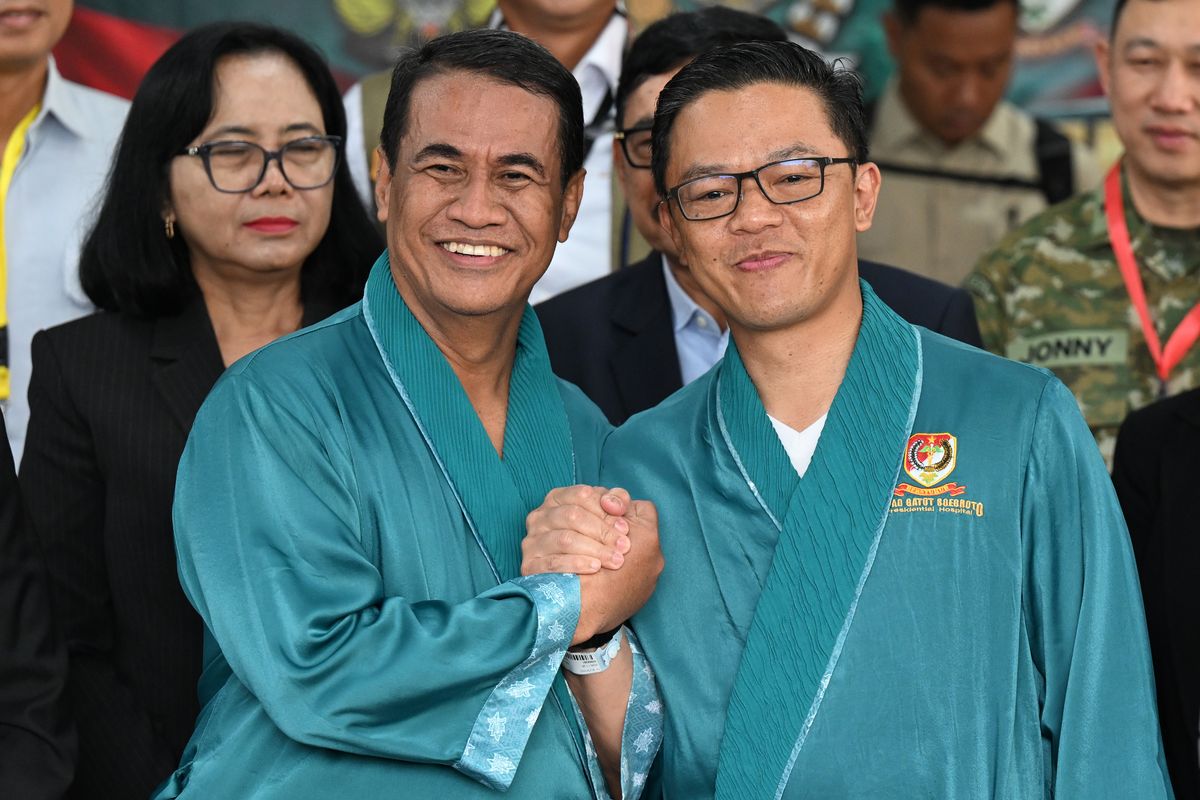
This time, President Prabowo Subianto has proposed two names to the MPR, Andi Amran Sulaiman and Sugiono, for what appears to be simple reasons.
According to the President, the considerations are solely based on achievements, service, and loyalty to the state.
There are no considerations of groups, organizations, or voter bases. This is good news for a democracy that has spent two decades counting vice-presidential seats as identity quotas.
However, good news does not necessarily mean all is well. Representation does not simply vanish. It is shifting, and this shift brings both advantages and disadvantages.
The logic of identity balance has a long history. In 2001, when the MPR chose a vice president to accompany Megawati Soekarnoputri, the choice fell to Hamzah Haz from an Islamic party as a counterbalance to the nationalist president.
In 2004, Susilo Bambang Yudhoyono paired with Jusuf Kalla, a mix of Javanese and Bugis from two different parties.
Joko Widodo repeated this pattern with Kalla in 2014 and with Ma'ruf Amin in 2019, using the most explicit nationalist and religious logic.
An exception occurred in 2009 when Susilo Bambang Yudhoyono chose Boediono, a nonpartisan technocrat.
The pairing of Prabowo and Gibran in 2024 remains representative, just of a new kind, namely the representation of the younger generation and the voting base of the previous administration.
Resistance to this duo largely targets the nomination process through the Constitutional Court's decision on age limits, not identity issues.
The MPR now again chooses a vice president, as it did in 2001. The difference is that both candidates available are from the President's inner circle.
Sugiono is the Secretary General of the Gerindra Party, who previously served as Minister of Foreign Affairs before being appointed Coordinating Minister for Human Development and Culture (Kompas.com, 1/10/2026).
Amran is a two-term Minister of Agriculture better known as a technocrat and businessman than as a party politician.
Hanna Pitkin, in The Concept of Representation (Berkeley: University of California Press, 1967), distinguishes between two types of representation.
Descriptive representation demands a representative similar to those represented, whether by ethnicity, religion, or organization.
Substantive representation requires a representative who works for the interests of those represented. For a long time, our vice presidential seats have been predominantly filled based on the first logic.
This choice opens the door to reach for the second logic. In this approach, the measure of a vice president's success is no longer about how well they represent a specific group, but rather how effective they are for farmers, workers, teachers, and fishermen from any background.
Such a measure is more demanding, as performance can be scrutinized, while origins cannot.
An interesting irony exists. Both candidates come from outside Java, with Sugiono born in Aceh and Amran in Bone, South Sulawesi.
Regardless of who is elected, the leadership pairing of this country remains patterned with elements from Java and regions outside Java, even if it wasn’t designed that way.
Perhaps this signals true maturity. Diversity is no longer treated as a quota that must be filled, but as a social reality that naturally exists.
The stance of religious organizations reinforces this impression. Nahdlatul Ulama has stated that they fully entrust the vice presidential seat filling to the President (NU Online, 17/11/2026).
Meanwhile, Muhammadiyah, as conveyed by Haedar Nashir during Muhammadiyah's 114th Milad in Palu (14/11/2026), only offers normative criteria about adherence to the constitution. There are no demands for a seat in the name of a group. That is the plus side.
The downside must also be weighed thoughtfully. It is important to note that identity logic has mainly operated during direct elections when candidate pairs must draw votes from various groups.
When the electorate is the MPR, that incentive weakens on its own. Thus far, there has been no electoral test to truly assert that the public has moved past identity considerations.
If Sugiono is elected, for the first time since Reformasi, the two highest positions in the country would be occupied by the chairman and the secretary general of the same party.
Scott Mainwaring in Presidentialism, Multipartism, and Democracy (1993) describes the combination of presidentialism and multiparty systems as a challenging mix, because the president must continually maintain coalitions in parliament.
In such combinations, the vice presidential seat has functioned as the glue of the coalition. If that seat is filled by a member of the president's own party, the glue is lost and must find an alternative.
Of course, there are positives. A pair from a single household promises solidarity and swift execution, while closing off the possibility of the emergence of two power centers in the palace.
Government continuity is also better maintained should anything happen to the president. However, such solidarity carries a significant burden.
Government failures can no longer be shared with coalition partners, as all responsibility falls on one party.
Divergent considerations in the highest decision-making space may also risk dilution, as ideological and organizational proximity facilitates agreement but complicates corrections.
The line between state interests and party interests can easily blur if the vice president still holds a structural party position.
The political pull is also significant. A vice president from the president's party will be seen as a successor candidate ahead of 2029.
Today’s approval from coalition parties might not hold when ambitions start to surface.
Maneuvering toward the next election could begin early and disrupt the cabinet's focus on serving citizens.
Comparing this to the United States, where the president and vice president typically come from the same party, is less relevant because that country follows a two-party system.
If Amran is the one elected, the risks turn in a different direction. He brings technocratic experience and a strong network in eastern regions, but without a significant party base in parliament, his bargaining power with the President is relatively limited.
On the other hand, his relative distance from the party could be a strength, as he would not bring any party agenda into the palace.
His entrepreneurial background and family networking in local politics also raise questions about potential conflicts of interest.
Thus, the rejection of a vice president may no longer be rooted in identity. It has shifted from asking about who they are to asking for whom they work.
For this shift to genuinely represent maturity, several conditions need to be met. The elected vice president should relinquish their party position, be given a measurable work mandate, and publicly disclose potential conflicts of interest.
The DPR must also remain critical, precisely because the vice presidential seat is no longer owned by a coalition.
While identity representation may retire, if what replaces it is mere loyalty to one person, are we truly maturing, or simply shifting from one form of representation to another that is narrower?

























