


Prabowo Proposes Establishment of Agency to Regulate Procurement of Goods and Services
-
News
-
2 minutes ago
This article was translated by AI. Read the original article on Kompas.com. See Original

JAKARTA, KOMPAS.com - The Constitutional Court (MK) has declared Law Number 5 of 2026 on the Third Amendment to Law Number 2 of 2002 on the Indonesian National Police (Police Law) to be form defected due to non-compliance with legislative procedures during its formation.
The MK has instructed the House of Representatives (DPR RI) and the government to rectify the Police Law within a maximum of one year from the issuance of the ruling. During the rectification process, the new Police Law remains in effect.
The DPR RI has stated it will review the Police Law through Commission III, while the government will ensure coordination with relevant ministries and agencies, including the DPR, to follow up on the MK's ruling.
DPR Deputy Speaker Sufmi Dasco Ahmad stated that the DPR will request Commission III to reassess the Police Law identified as form defective by the MK.
Dasco assured that the DPR respects the MK's ruling, which mandates rectification of the Police Law within a one-year timeframe.
"Yes, the Police Law that underwent judicial review has been declared conditionally constitutional, with the stipulation in its decision that rectification must occur within one year," Dasco said during an interview at the Parliamentary Complex in Senayan, Jakarta, on Tuesday (24/11/2026).
"In response to this, we will request the technical committee, in this case, Commission III, to conduct a reassessment. We will respect the MK's decision," he added.
In addition to reassessing the Police Law, Dasco mentioned that the DPR will also improve the harmonization mechanism in the legislative drafting process through a revision of the Law on the Formation of Legislation (UU P3).
According to Dasco, harmonization has, for a long time, been a stage for examining the substance and wording of legislative drafts.
The DPR, he stated, will clarify regulations concerning bills that need to go through harmonization and those that do not.
"In the revision of the law on legislative drafting, we will reestablish such matters; what requires harmonization and what does not, to ensure legal certainty for the laws that have been enacted," Dasco concluded.
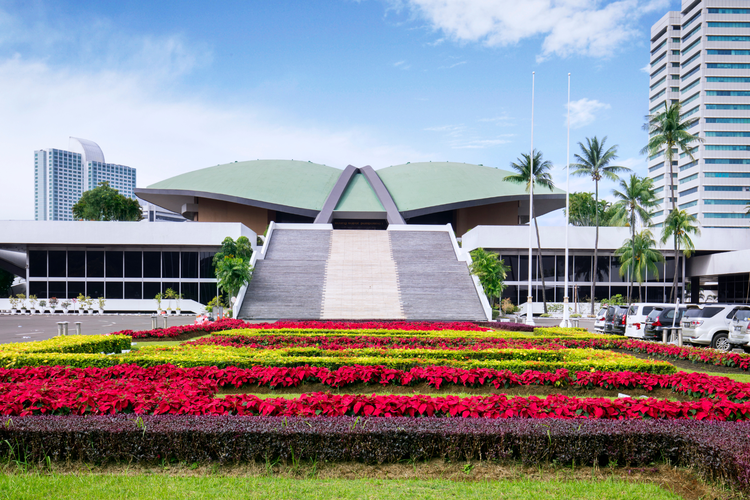 Illustration of the DPR. Background of the last educational qualifications of DPR RI members.
Minister of Law Supratman Andi Agtas confirmed that the government will follow up on the MK ruling declaring the Police Law defective.
"It will definitely be followed up," said Supratman when contacted by journalists on Friday (27/11/2026).
Supratman noted that the government is currently coordinating with relevant ministries and agencies to discuss the follow-up actions regarding the ruling.
"We are coordinating with ministries and agencies, including the DPR RI," he stated.
Member of Commission III DPR Hinca Panjaitan stated that the revision of the Police Law to follow up on the MK ruling could be included in the Open Cumulative National Legislation Program (Prolegnas).
The open cumulative Prolegnas is a list of draft laws that can be proposed and discussed outside the annual Prolegnas list to address specific legal needs.
Hinca mentioned that the DPR still has one year to amend the Police Law in accordance with the MK's ruling.
He argued that this deadline allows the DPR to follow through with the ruling through the legislative process.
"If the MK has issued a decision like that, then there will be a Legislative Body; it falls into the cumulative category. If given a year, there is still time," Hinca told reporters on Friday (27/11/2026).
Hinca emphasized that the DPR respects the MK's ruling, which is final and binding.
"Our constitutional system has indeed established a Constitutional Court, hasn't it? So, we respect that," Hinca concluded.
The MK stated that the formation of Law Number 5 of 2026 concerning the Third Amendment to Law Number 2 of 2002 on the Police did not comply with the stages of the legislative process.
This ruling was pronounced during the hearing of case number 251/PUU-XXIV/2026 on Monday (23/11/2026). The formal review request was filed by Zulfikar Putra Utama as Petitioner I and Muhammad Ezra Suhaeri as Petitioner II.
MK Chairman Suhartoyo stated that the Court partially granted the request of Petitioner I.
"We grant Petitioner I's request in part," Suhartoyo remarked while reading the ruling at the MK Building in Jakarta on Monday.
In its ruling, the MK declared that the formation of the Police Law does not conflict with the 1945 Constitution of the Republic of Indonesia and remains legally binding conditionally.
 The Constitutional Court building. The Constitutional Court (MK) has proposed an additional budget of IDR 67 billion for the 2027 fiscal year.
The Court provided a maximum of one year for lawmakers to rectify the formation process of the Police Law.
"It is declared that the formation of Law Number 5 of 2026 concerning the Third Amendment to Law Number 2 of 2002 on the Indonesian National Police does not conflict with the 1945 Constitution of the Republic of Indonesia and is conditionally legally binding as long as rectifications are made within a maximum of one year from this ruling's announcement," Suhartoyo said.
With this ruling, the new Police Law remains in effect while the DPR and the government carry out the necessary amendments.
However, if lawmakers fail to amend the Police Law within one year, the previous Law Number 2 of 2002 on the Police will revert to being applicable.
In its legal consideration, the MK highlighted the process of taking over the Police Bill from the 2019-2024 DPR by the 2024-2029 DPR to be established as a legislative initiative proposal of the DPR.
This process became problematic as it did not pass through the harmonization stage at the DPR Legislative Body (Baleg). Although harmonization is a required step defined in the legislative procedure.
MK Judge Enny Nurbaningsih explained that the plenary session of the DPR is indeed authorized to designate a bill as a legislative initiative. However, this authority cannot be used to bypass the legislative procedures stipulated in the UU P3.
"The authority of the plenary session to designate a bill as a legislative initiative is valid authority. However, this authority does not automatically provide a basis for disregarding the stages explicitly mandated by the UU P3," Enny read in the legal considerations.
Enny added that the DPR as a legislative body must comply with the provisions of the UU P3 which serves as a guideline at every legislative stage.
The MK also rejected the argument that the harmonization process was substantively fulfilled through other discussion stages, such as drafting the problem inventory list (DIM), work meetings (raker), working committees (panja), drafting teams (timus), and synchronizing committees (timsin).
"Based on the legal considerations outlined above, the Court concludes that the formation process of Law 5/2026 a quo not only did not proceed through the harmonization stage at the DPR, but also did not comply with the legislative formation stages," Enny declared.
"Nor did it adhere to the UU P3 and DPR Regulation 1/2020, thus failing to meet the legislative principles established in the 1945 Constitution of the Republic of Indonesia, which serves as the reference for both the UU P3 and DPR Regulation 1/20220 a quo," Enny added.

















