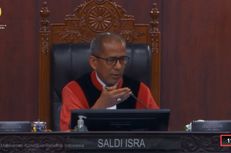
During the MK Hearing, Saldi Isra Questions the Differences Between Special Advisors, Special Envoys, and Wantimpres
-
News
-
1 minute ago
Writer
This article was translated by AI. Read the original article on Kompas.com. See Original

JAKARTA, KOMPAS.com - Margarito Kamis, a member of the Presidential Advisory Council (Wantimpres), has been summoned by the Constitutional Court (MK) as a relevant party in the judicial review case numbered 389/PUU-XXIC/2026 concerning Law Number 64 of 2024 on Wantimpres.
He is called as a representative from Wantimpres for a session scheduled for Wednesday (December 2, 2026).
The Chief Justice of the MK, Suhartoyo, made a light-hearted remark while reading the schedule for this ongoing case, stating that the session was intentionally held on Wednesday so that Margarito Kamis would not meet on Thursday.
"From the relevant parties of the Presidential Advisory Council, who will be represented by Mr. Margarito Kamis based on his authority. We have scheduled it for Wednesday so as not to meet on Thursday, right?" Suhartoyo joked with a smile at the attendees of the session.
In addition to Margarito, the continued hearing is also set to listen to testimonies from witnesses and experts for the petitioners.
Furthermore, witnesses or experts from the government and the DPR (People's Consultative Assembly) are also invited to attend if they are prepared.
"The statements and CVs should be prepared at least two working days before the trial takes place. And if those attending are academics, they should have permission from their respective universities or similar institutions," he added.
This case was filed by constitutional law activist Muhammad Riziq Maulana.
He argues that the absence of restrictions on the number of Wantimpres members in the contested law could burden the state budget (APBN).
"The absence of a limit on the number of Wantimpres members directly leads to an unmeasurable burden on the state budget," Riziq stated during the preliminary hearing of case number 389/PUU-XXIV/2026 on Monday (October 27, 2026).
Riziq is examining Article 7 paragraph (1) of the Wantimpres Law, which states,
"The Presidential Advisory Council of the Republic of Indonesia consists of a Chairman who also serves as a member and several members whose number is determined according to the needs of the President, taking into account the effectiveness of government administration."
The lack of a maximum limit in this article is the basis for Riziq's request for the MK to restore the maximum number of Wantimpres members to nine, as having too many is deemed a burden on state finances.
Representing the government, the Expert Staff of the Minister of Law for Economic and Social Affairs, Romi Yudianto, mentioned that the number of Wantimpres members is not explicitly limited but is implied in Article 23 paragraph (1) of the Constitution, which governs the principles of transparent and accountable state financial management.
He explained that the President's authority in determining the number of Wantimpres members provides space for policy that runs parallel with the authority of the Minister of Finance.
This aims to ensure the effectiveness and efficiency of state financial management.
The determination of the number of Wantimpres members is also based on the President's needs and the effectiveness of government administration.
Meanwhile, a representative from the DPR's Commission III, Martin Daniel Tumbelaka, explained that the authority to determine the number of Wantimpres members is not an absolute power of the President.
"Rather, it is an authority that must be accountable based on rational needs and purposes of government administration, as long as the number determined by the President is genuinely required for government effectiveness," Martin stated during the session, as quoted from the MKRI Youtube broadcast on Friday (November 27, 2026).
He elaborated that the parameters of need in determining the number of Wantimpres members relate to Article 5 of the Wantimpres Law, which allows the President to make divisions.
"The DPR RI explains that divisions can be adjusted according to the evolving needs of government, including the need for considerations in the fields of law, diplomacy, international relations, digital transformation, energy, food, environmental issues, and other strategic areas as they relate to the exercise of governmental power," Martin concluded.