
KPK Requests Klaten Legislators to Return Excess Fees to Klaten Inspectorate
-
News
-
13 minutes ago
This article was translated by AI. Read the original article on Kompas.com. See Original
November 25 is commemorated every year as Teachers' Day.
On this occasion, as a token of appreciation, parents or students sometimes give teachers flowers or even poems.
This year marks the 81st anniversary of the celebration, with the Indonesian Teachers' Association (PGRI) adopting the theme “Great Teachers, Strong Indonesia,” emphasizing that teachers are one of the key strengths in building the nation.
However, ahead of this Teachers' Day, there is one question that I cannot ignore: what kind of great teachers are we preparing if the values we teach in class are not always reflected in the significant decisions made outside the classroom?
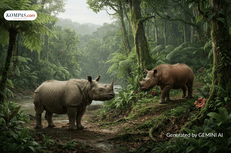
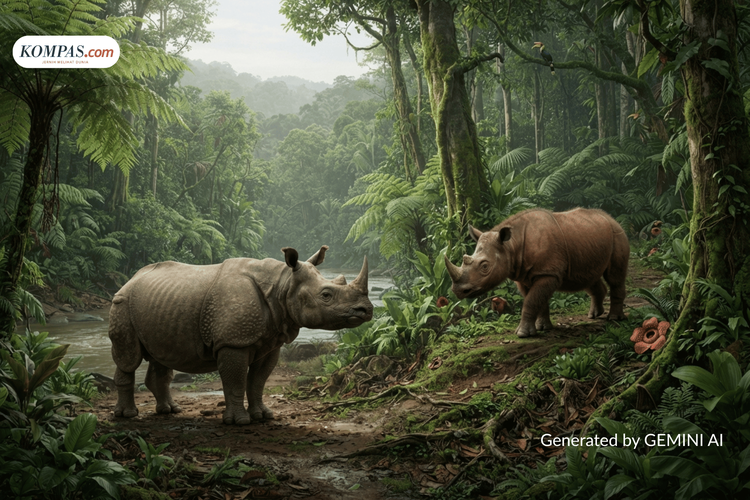
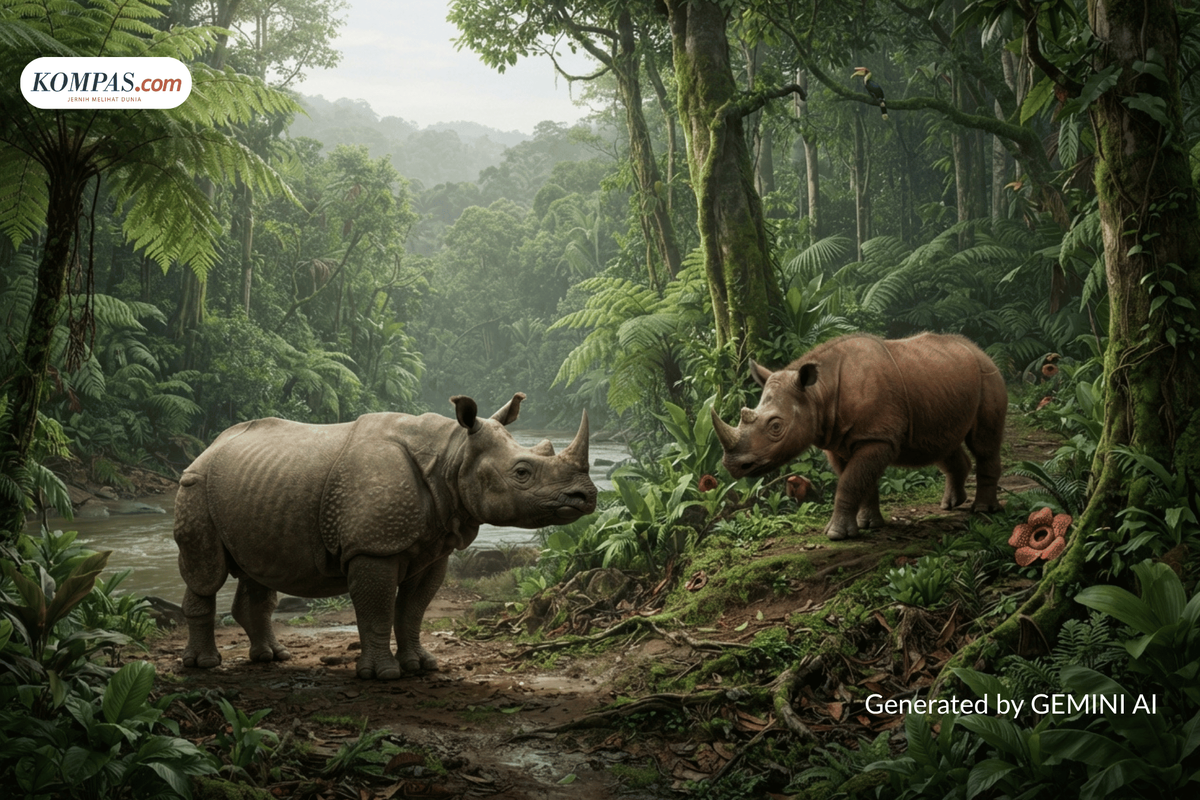
This concern is not without foundation, as during a recent lesson on ecosystems, my focus shifted abruptly when a seventh-grade student raised their hand and posed a question regarding the discourse about relocating the Javan rhino in Ujung Kulon due to the surrounding marine area falling within mining territory.
Honestly, when that question was asked, I, as a teacher, struggled to respond with a calm demeanor.
Not because I believe that mining will actually be operational, but because the question struck at the very core of the teaching profession.
Teachers have a moral obligation to be consistent between what they teach and what they exemplify.
Meanwhile, the facts reveal a starkly different reality with the issuance of the Ministerial Decision (Kepmen) ESDM Number 65.K/MB.01/MEM.B/2026 concerning Mining Areas in Banten Province, enacted on February 12, 2026.
In the accompanying map, the waters surrounding Ujung Kulon are categorized as Mining Business Areas (WUP).
Even though the government argues that some of the marine waters around the national park are not part of Ujung Kulon National Park itself.
However, the justification for designating WUP is a form of land-use planning, not an exploration or exploitation permit.
Moreover, the Ministry of Energy and Mineral Resources mentioned that this process is not new. The designation of these marine territories was previously excluded in Kepmen ESDM Number 1204 of 2014, subsequently included in Kepmen Number 3672 of 2017, and reaffirmed through Kepmen Number 84.K/MB.01/MEM.B/2022.
Kepmen 2026 is said to reassert prior decisions while also refining some stipulations based on proposals from the Banten provincial government.
Despite this, it is reasonable for the public to question and assess that the decision to relocate the Javan rhino from Ujung Kulon National Park to Alas Purwo warrants thorough analysis and reconsideration.
The fundamental question that drove the student to inquire is simple: why does the water surrounding the last home of the rarest wildlife in Java need to be included?
Especially as a science teacher, I was taught a simple lesson: nature does not read administrative maps.
The boundaries of conservation areas indicated on maps do not automatically restrict ecological interactions.
Waters, ocean currents, organisms, habitats, and ecological processes are interconnected. Lines on paper do not stop ocean currents, sediments, or the movement of living beings.
Ujung Kulon National Park itself spans approximately 120,000 hectares, with more than 44,000 hectares consisting of marine waters.
In other words, land and sea there are one home.
Therefore, activities outside the conservation area must be reevaluated if they pose potential impacts on that area.
Moreover, that area is inhabited by an extremely fragile creature, the Javan rhino (Rhinoceros sondaicus), which only exists in Ujung Kulon.
Official estimates indicate a population of 87-100 individuals, and reports from the IUCN have mentioned that the figure dropped from 78 down to 50 individuals after 26 were believed to have been killed by poachers.
Even though the precise figures are still debated, the common thread remains: their number is critically low.
The government itself acknowledges that the entire population is concentrated in one area, with the risk of disasters in the Sunda Strait and a breeding rate of about 58.5 percent.
Meanwhile, this year’s Teachers’ Day theme encourages teachers to think about what makes Indonesia strong.
On the other hand, our generation is being presented with various phenomena and information regarding government policies that induce distress.
In fact, Indonesia can only be strong if its generations grow up with intact values, and those values do not stem from lectures, but from exemplary behavior. This is where the irony lies.
Teachers in the classroom continually urge children to memorize that endemic species with small populations are very vulnerable to even the smallest disruptions.
Teachers also ask students to protect the rivers in their villages, not to litter, not to engage in activities that disrupt the balance of nature, and to care for living beings.
In ecotheology, they teach that nature is a trust and humans are stewards tasked with nurturing, not just utilizing.
Thus, when teachers ask students to sort waste or plant trees in schoolyards, they are indeed instilling a belief in the students that those who are knowledgeable and faithful will tread carefully around nature.
Then, how should teachers respond when their students read the news and inquire why that caution doesn’t always seem to be upheld at higher levels of elite power?
We understand that this country needs resources, investments, and jobs, and many families depend on these sectors for survival.
Their needs are real. However, what the government must understand is the significant difference between “not yet permitted” and “definitely safe.”
For fundamentally, good policies do not stop at asking, “what is permissible administratively?”
Instead, it asks: “What might we lose if we’re wrong, and can we bear the consequences?”
In environmental science, this is the essence of the precautionary principle. It demands that we exercise caution even when evidence of damage is incomplete, especially when what is at stake cannot be restored. Extinction is one of those risks. There’s no study that can bring back a species.
Given the controversy surrounding the relocation of the Javan rhino from Ujung Kulon to Alas Purwo, which has already sparked both support and opposition, the government should clearly demonstrate exemplary behavior.
Not only that, the government should convey to the public the basis of the ecological studies behind the designation of WUP in those waters, including risk assessments related to coastal and marine ecosystems along with their cumulative impacts.
Furthermore, the process has been ongoing for a long time, but we all know that this does not automatically answer whether the studies are still relevant to current conditions.
Secondly, open the door to public participation as widely as possible, starting with involving conservation experts, academics, local communities, and forest guardians before any further steps are taken.
Those living adjacent to these areas possess knowledge that is not always found in policy documents.
Then, if there is indeed no intention to permit mining that endangers Ujung Kulon, affirm firmly and bindingly in writing, not just through press statements.
On this Teachers' Day, educators do not wish to receive flowers, tumpeng, or poems from students that touch their hearts.
But allow me to represent all educators in Indonesia to say that the most anticipated gift is a policy that does not make us appear deceitful before our students.
Because the reality is that students rarely mimic the contents of textbooks; instead, they imitate what adults do.
A student may forget the definition of an ecosystem, but they will remember whether the decision-makers dared to choose nature even when the choice was difficult.
If great teachers, in the belief of the government, can strengthen Indonesia.
But a great teacher is still a human being who cannot work alone.
They need a state that aligns with the values they teach, so when a child asks, they can answer with their heads held high.
Let us not find ourselves in the future with teachers telling students that there once existed a species of rhino living in the western tip of Java.
Yet, back then, the teachers were only skilled at teaching how to care for it but not strong enough to protect it.