
Meutya Hafid: Journalistic Work Must Be Protected from Appropriation by AI
-
News
-
7 minutes ago
This article was translated by AI. Read the original article on Kompas.com. See Original
THERE are nations that view geography merely as expanses of land, coastlines, clusters of islands, and territorial boundaries.
However, there are also nations that understand geography as both a historical destiny and a source of strength to determine their future.
Indonesia should belong to the latter category.
As an archipelagic nation located at the intersection of two continents and two oceans, Indonesia not only possesses geographical advantages but also bears a geopolitical responsibility that shapes the trajectory of its history.
This perspective was increasingly highlighted during the National Seminar themed “Geopolitics and Indonesia’s Future”, organized by Universitas 17 Agustus 1945 (Untag) in Surabaya, East Java, on Monday, November 23, 2026.
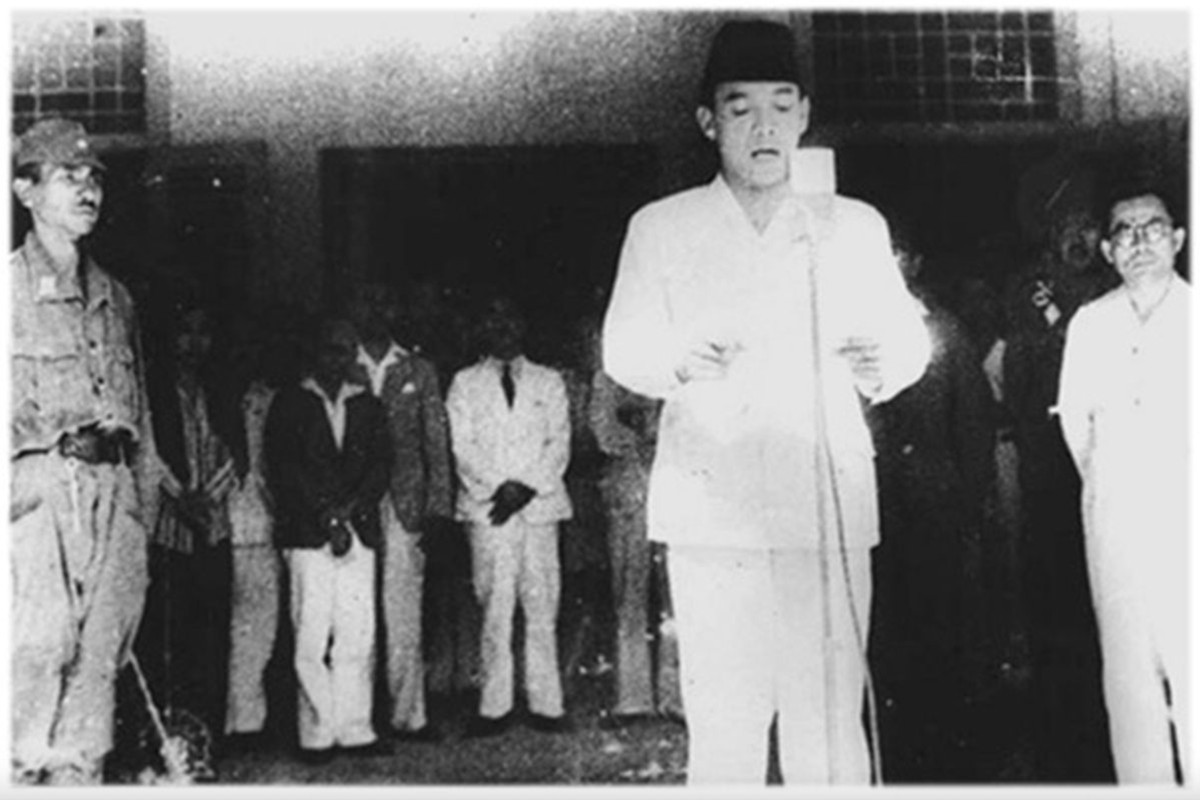
In a forum attended by approximately 450 participants, Dr. Hasto Kristiyanto revisited the geopolitical thoughts of Bung Karno.
He reminded the audience of the diminishing narrative of liberation in contemporary political discourse, while simultaneously positioning Pancasila as an instrument for changing social structures.
Therefore, the geopolitics of Bung Karno should not merely be perceived as a theory related to the relationship between territory and power.
Within it lies a deeper question: what is the purpose of a nation’s independence, what kind of strength is to be cultivated, and to whom should all that strength be dedicated?
Bung Karno once had significant concerns about the Pacific region.
This great leader of a great nation laid the groundwork to understand that geography is not just a matter of location, land mass, clusters of islands, or the expanse of oceans.
Geography is also a historical force that can determine the direction of a nation’s journey.
From the geopolitical perspective of Bung Karno, the Pacific is not an empty space separating continents but a strategic area where global economic, political, trade, defense, and civilizational interests converge.
Bung Karno once articulated his view that the future of the world lies in the Pacific, and whoever controls the region will exert significant influence worldwide.
This idea is compelling not only for its boldness in interpreting the changing times but also for reflecting the awareness that the center of gravity of global power can shift in response to economic, technological, and strategic interests of countries.
Now, as the world enters the 21st century, the relevance of these thoughts becomes increasingly apparent.
The Indo-Pacific region, connecting the Indian Ocean and the Pacific Ocean, has evolved into a center of global geopolitical competition.
In this area meet major economic powers, international trade routes, energy sources, and the defense interests of large nations.
Indonesia stands right in the middle of this strategic space. However, advantageous geographical positioning alone does not automatically generate geopolitical strength.
A strategic position only holds significance when accompanied by economic, technological, defense, and diplomatic capabilities that can transform geographical advantages into national bargaining power.
Indonesia must not merely be a crossroads of global interests but must be able to determine its own interests.
Today, the Indo-Pacific region is not just a geographical term but a strategic space that reflects changes in the structure of international power.
Whereas in the previous century, global geopolitical focus was heavily centered around Europe and the Atlantic, the Indian and Pacific Oceans are increasingly shaping global trade, security, and economic growth.
This shift is related to the economic rise of China and India, as well as the growing interests of the United States, Japan, Australia, and European countries in this region.
The rivalry between the United States and China is one of the main axes of Indo-Pacific dynamics.
The United States seeks to maintain its strategic influence, while China continues to expand its economic, technological, diplomatic, and military power.
This competition unfolds not only through military strength but also through control over semiconductors, artificial intelligence, energy, critical minerals, and digital infrastructure.
Consequently, contemporary geopolitics can no longer be read solely through maps of territories and military bases, but also through control over technology, trade, and global production networks.
Tensions surrounding Taiwan, the East China Sea, and the South China Sea illustrate how competition among major powers can affect regional stability.
The South China Sea, in particular, is an important international trade route and a region rife with maritime disputes.
Meanwhile, the strengthening of Quad and AUKUS signifies the emergence of new strategic configurations in the Indo-Pacific.
This dynamic is also linked to global geopolitical shifts. The Russia-Ukraine War, tensions in the Middle East, energy competition, and trade fragmentation demonstrate that conflicts in one region can have ripple effects on others.
Disruptions in shipping routes, changes in energy prices, and technological restrictions can affect global economic stability.
The world faces a paradox: economic interconnectedness is expanding while political competition sharpens.
Nations require international cooperation but, at the same time, must reinforce their economic security and defense.
In this context, Bung Karno’s idea about the Pacific acquires an even broader meaning.
Global influence is determined not only by the ability to control maritime territories and military power but also by the capacity to harness technology, build international norms, and propose ideas for a shared future.
The question is whether the Indo-Pacific will be a space for peaceful cooperation or merely an arena of great power competition.
South East Asia holds an important position in the Indo-Pacific chessboard.
This region connects the economic growth centers of East Asia with South Asia, the Middle East, Africa, and Europe.
The Straits of Malacca, Sunda, and Lombok are part of the international shipping network that supports global trade.
This position makes Southeast Asia a venue for the interests of major countries.
ASEAN seeks to uphold this region as an open area of cooperation not dominated by any particular power.
Through the principle of ASEAN centrality and the ASEAN Outlook on the Indo-Pacific, Southeast Asian countries aim to build an inclusive regional architecture through maritime cooperation, connectivity, and economic development.
However, the challenges faced are significant.
Differences in the interests of member states, the situation in Myanmar, disputes in the South China Sea, and the U.S.-China rivalry can impact ASEAN unity.
Therefore, ASEAN centrality requires political consistency, the capability to forge agreements, and the courage to uphold shared principles.
For Indonesia, this development has strategic significance.
Indonesia has direct interests in the security and maritime jurisdiction in the Northern Natuna Sea, including protecting sovereign rights in the Exclusive Economic Zone based on the 1982 UN Convention on the Law of the Sea (UNCLOS).
Sovereignty and sovereign rights form the basis for a country to manage natural resources, protect fishermen, and maintain maritime security.
However, Indonesia's geopolitical interests do not stop at merely safeguarding its territory.
The sea must become a source of prosperity and national economic strength.
Developing ports, inter-island connectivity, fisheries industries, processing of marine products, and strengthening coastal economies are integral to Indonesia's maritime strategy.
Likewise, mineral, energy, and natural resource wealth must be managed to create added value.
Thus, mastery of processing technologies, manufacturing industries, and distribution networks will enhance national bargaining power.
In facing great power competition, Indonesia must maintain a free and active foreign policy.
Being free does not mean distancing itself from international cooperation, while being active does not imply following every interest of major powers.
This principle provides space for Indonesia to collaborate with the United States, China, Japan, India, Australia, and other countries based on national interests.
Most importantly, these relationships must not diminish Indonesia’s capacity to assert its own stance.
Indonesia must be able to bridge the interests of various nations without losing its principles.
In an increasingly competitive world, diplomatic strength grows from the capability to build trust while maintaining principles.
The fundamental question surrounding the entire Indo-Pacific dynamic is how Indonesia positions itself in the changing world order.
Will it merely become a nation with a strategic geographical location, or evolve into a power that shapes the direction of the region?
This question takes us back to Bung Karno’s thoughts.
The 1955 Asian-African Conference illustrated Indonesia's past efforts to transform nations that once were subjects of colonialism into subjects with a voice in international relations.
The conference affirmed every nation’s right to determine its own future without having to submit to the will of major powers. This legacy shows that a nation's strength is not always measured by the number of warships, fighter jets, or defense budgets.
There is, therefore, a power that stems from ideas, international solidarity, and the courage to fight for justice.
Thus, Indonesia's geopolitical sovereignty must be built through strengthening maritime defense, economic independence, mastery of technology, energy and food security, and regional diplomatic leadership.
Geopolitics must not stop as a discussion about territorial boundaries and competition between nations.
Ultimately, it must answer how geographical space and national resources generate welfare for all citizens.
Bung Karno’s thoughts remind us that independence is not just about being free from colonialism; it is also about the ability to determine the course of one’s own history.
In the context of contemporary geopolitics, that teaching takes on new meaning: Indonesia must be independent in thought, autonomous in building national strength, and sovereign in determining its international relations.
The Pacific can indeed become one of the decisive centers of the world’s future.
However, for Indonesia, the real issue is not merely who will control the Pacific but how to ensure that the future of the region is not determined without the presence and interests of the Indonesian nation.
A nation must not merely exist in the vortex of history; it must possess the capability to shape history.