
Gibran's Nomination Hearing at DKPP, KPU to Present Former Chairman Hasyim Asy'ari as Witness
-
News
-
1 minute ago
This article was translated by AI. Read the original article on Kompas.com. See Original
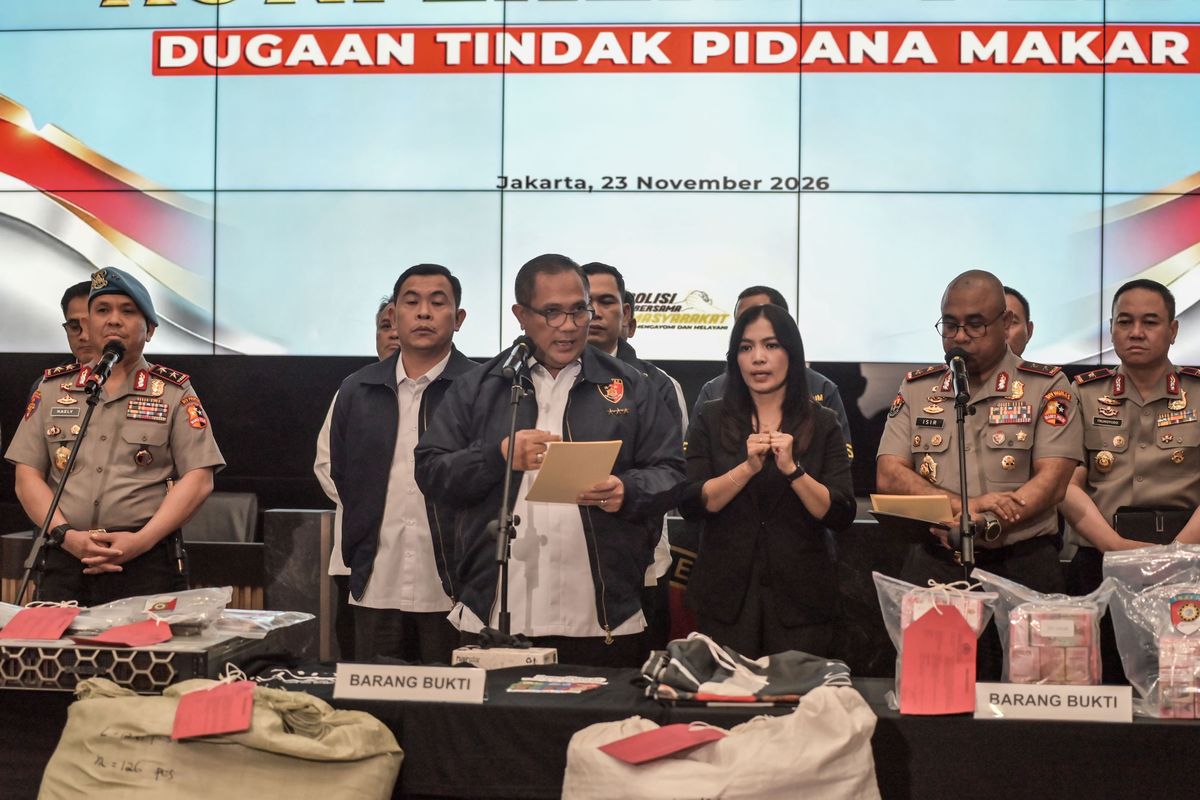
FORMER National Police Chief General Listyo Sigit Prabowo has been named a suspect for treason against President Prabowo Subianto along with five others.
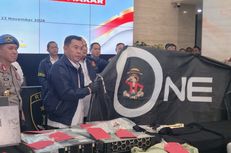
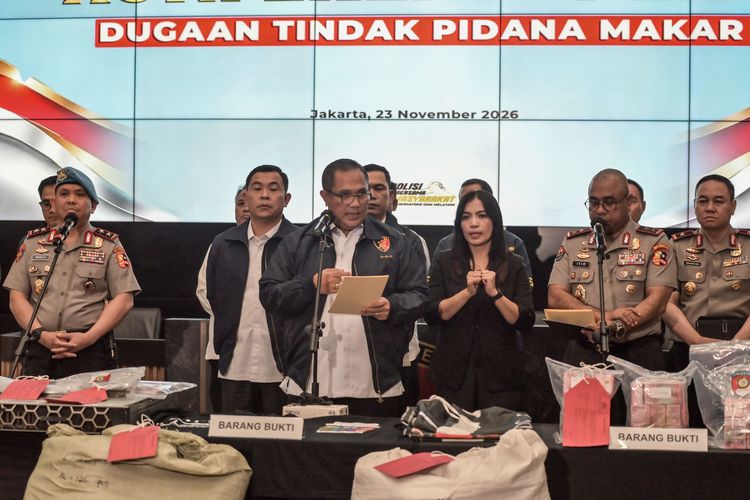
From the National Police's statement at a press conference on November 23, there are several pieces of evidence to frame suspect Listyo Sigit Prabowo (LSP) and his accomplices under treason charges.
These include 39 electronic devices, 250 shirts with the phrase "ACAB (All Cops are Bastards)," 251 black shirts featuring a three-finger salute, 20 One Piece flags, a blue evaluation and analysis notebook from the task force, and cash amounting to IDR 735 million.
Although not included in the list of evidence, two other items mentioned by the police could actually be categorized as instruments that LSP has deployed or would deploy: a number of police personnel (at least four generals and one middle-ranking officer) and individuals who would be mobilized as demonstrators wearing the aforementioned shirts and flags.
All these pieces of evidence have been constructed by the Criminal Investigation Department (Bareskrim) of the National Police to demonstrate LSP's end goal: the President's liberation from freedom or the President's incapacity to govern (Article 191 of the Criminal Code) and the overthrow of the government (Article 193 of the Criminal Code).
Clearly, such a significant ultimate goal could not be achieved if LSP and his accomplices' treasonous instruments were limited to those items mentioned.
On the contrary, in my reasoning, such a limited amount of evidence is more than enough if the mission LSP and his group intends to carry out is a false flag operation.
This means that LSP and his cohorts plan to infiltrate hundreds of people with those shirts and flags into a demonstration, coupled with their anarchistic actions.
A crowd with such identities and behaviors would provide a pretext for the police to disperse them.
Infiltrating a crowd with evidence in this way could be classified as a tactic for controlling chaos, especially when persuasive approaches are claimed to not be adequately responded to by protest participants.
Instead of undermining public trust in the government, such a false flag operation could be framed as police activity aimed at stopping demonstrations that could disrupt the government.
The question is, while the evidence cannot possibly support LSP and his group's malicious operation, why does the police still charge the former police chief and his associates with treason?
The answer lies in Articles 160 and 196 of the Criminal Code, which include the term "preparation." At this point, understanding the flow of criminal acts is essential: starting from motive, moving to preparation, attempt, and then culminating in commission.
The term "preparation" signifies motor activities that are a follow-up to realize an intention (motive).
On one hand, a treasonous intention as part of a human cognition does not meet the minimal requirements for a criminal process.
Nonetheless, humans are not prosecuted based on their thoughts, but rather on their actions.
On the other hand, for someone to be held criminally responsible for treason, they do not need to have committed treason (commission) or even attempted it (attempt). Simply showing preparation (preparation) enables someone to be brought to court.
The implication is that, although it was stated earlier that the evidence listed is far from adequate for a treason plot, due to the word "preparation" in Articles 160 and 196 of the Criminal Code, the police can still assert that the variety of items discovered at some treason outposts is sufficient for the purpose of preparation—that is, preparation—for treason.
Sufficiency of "preparation" as the minimal condition for treason reflects the weight of concern from the drafters of the Criminal Code.
This means that treason is so dangerous that actions considered merely preparatory must be intercepted by law enforcement authorities, and the perpetrators must be prosecuted.
However, on the other hand, when the police believe that a series of behaviors constitute preparation for treason, such judgments can be overly exaggerated.
The strongest indicators of this include, among others, the hundreds of shirts displaying "ACAB" and dozens of One Piece flags (with the words "One Peace") that the police have labeled as evidence of LSP's treason.
In contrast, in the United States, a person displaying the slogan "ACAB" would only be prosecuted if accompanied by calls for violence or harassment against particular police individuals.
Similarly, in Germany, criminal contempt laws apply to "ACAB" only when directed at specific police individuals or groups.
If "ACAB" is expressed as a general negative sentiment against the police, the individual is not subject to legal action.
In various other countries, using "ACAB" as a form of socio-political protest against the police can result in prosecution (usually a fine) if committed in the form of vandalism.
The above situation poses a potential to generate subsequent legal and political complexities. That is, how the police, both in the case of LSP and in similar future situations, risk being perceived by the public as overly allergic to symbols such as "ACAB" and One Piece.
This is analogous to the differing attitudes between the previous Coordinating Minister for Political, Legal, and Security Affairs, Budi Gunawan, and President Prabowo some time ago.
At that time, the Coordinating Minister labeled the hoisting of the One Piece flag as an act of provocation and a dishonor to the Red and White flag.
In contrast, President Prabowo viewed the flag as still within reasonable bounds—as a form of creative expression and public critique, as long as it did not obstruct or replace the Red and White flag.
If the legal and political complexities above are not managed well, there is a risk that the police will be seen as engaging in excessive criminalization against LSP and the Gank.
This means that, although there is strong evidence to conclude that LSP and his group engaged in illegal wiretapping, items such as shirts and flags are too far-fetched to then be used as the basis for designating LSP and his group as committing treason.
Excessive criminalization, in turn, is counterproductive to positive public sentiment toward National Police Chief General Suyudi Ario Seto.
Based on the presentation by the Head of Criminal Investigation Department of the National Police, I formulate LSP's actions into three objectives. LSP's objective is to maintain the position of National Police Chief. The goal is the erosion of public trust in the Prabowo Subianto government.
The aim—or the ultimate goal of LSP—is the realization of a situation depicted in Articles 191 and 193 of the Criminal Code.
If the police persists in holding that the aforementioned items are evidence of preparation for treason, linked to Article 193 of the Criminal Code, the police's work in this case will succeed in convincing the public that after the government is toppled, the police can quickly announce what LSP's next target is.
As a four-star general, especially a former National Police Chief, it can be assumed that LSP has certainly contemplated what he would do or what would transpire after the government is overthrown.
It is almost inconceivable that a high-ranking police officer of LSP's caliber would be obsessed solely with toppling Prabowo from the presidency, period.
The same applies when linked to Article 191 of the Criminal Code; it would be naive to assume that, as a former TB-1 with the longest term, LSP's thoughts would stop solely at paralyzing President Prabowo's government.
In other words, should criminal proceedings conclude at the moment LSP and his group are subjected to penalties, there would seem to be a lack of genuine state action to reach what should be the desired endpoint.
Assuming the legal process—let's just say—has been completed, it could still feel incomplete since it was contained to a certain scope, preventing the deeper mysteries of LSP's mind from being revealed, which is, "after Prabowo is toppled, what then?"
There is still one more concern that also relates to the incompleteness in uncovering the alleged treason case involving LSP and his group.
Starting from two facts. First, the Lawful Interception Management System (LIMS) has been owned by the police institution since 2010. Second, the police are not a clean state institution devoid of the abuse of power.
According to Human Rights Commission data, the police rank first as the state institution most frequently reported by the public.
The serious question is: is General Listyo Sigit Prabowo really the only National Police Chief who has ever engaged in illegal wiretapping?
Besides Prabowo Subianto, have there been previous presidents who also fell victim to abuse of power by TB-1?
Where are the wiretap data utilizing LIMS prior to 2025—neatly archived or also lost?