

The MK Claims that the Discussion of the Police Law in the DPR Does Not Comply with the Stages of Law Formation
-
News
-
7 minutes ago
This article was translated by AI. Read the original article on Kompas.com. See Original
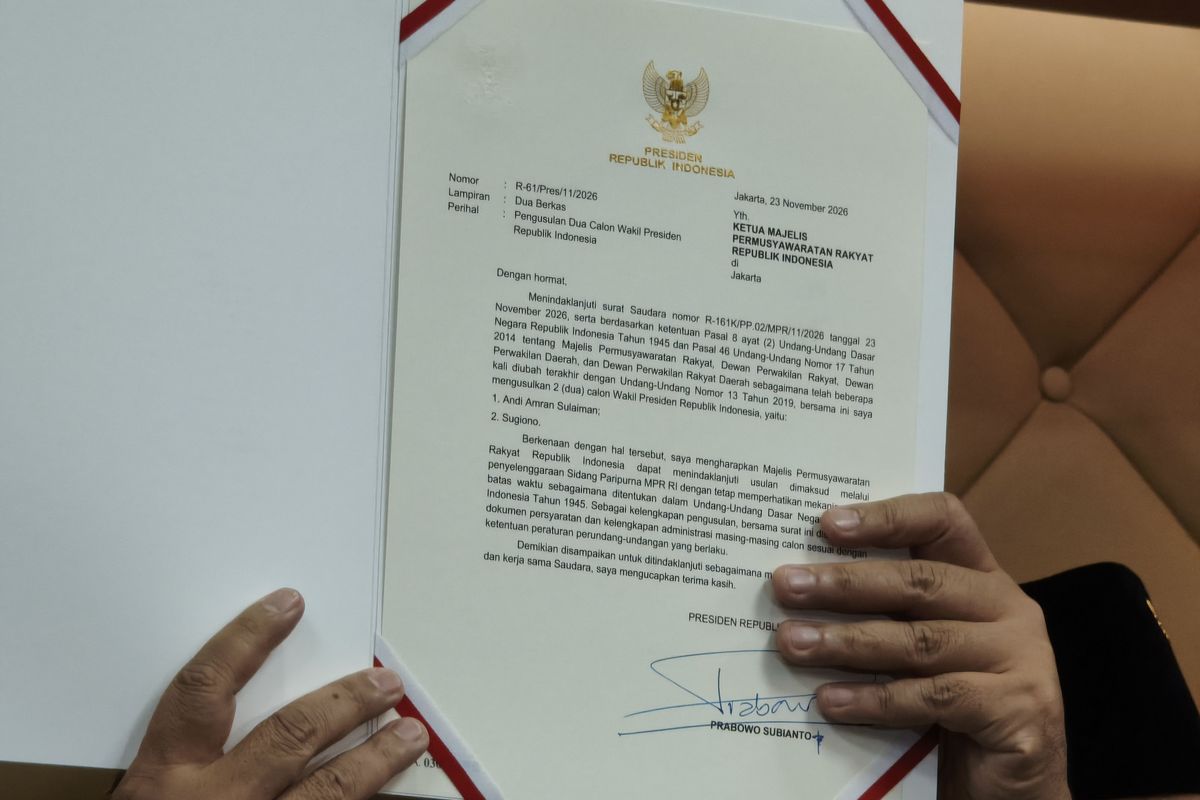
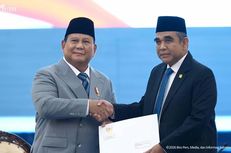
FINALLY, President Prabowo Subianto submitted two names for vice presidential candidates to the People's Consultative Assembly (MPR) on Monday (23/11/2026).
Andi Amran Sulaiman and Sugiono emerged as the answer to the political speculation that had arisen since Gibran Rakabuming Raka announced his withdrawal.
Prior to this, several names were discussed, ranging from Sufmi Dasco Ahmad to Yusril Ihza Mahendra.
Now, the speculation about who the President would nominate has come to an end. However, a much more intriguing question arises: why did Prabowo choose these two figures?
In politics, a leader's decisions never stand alone.
They relate to past experiences, present interests, and future possibilities that one wishes to shape.
Therefore, the nomination of Amran and Sugiono is compelling not merely as a constitutional requirement, but also as a political communication regarding the direction of Prabowo's power.
Niklas Luhmann, in his work Trust and Power, explains how power operates as a communication medium that enables decisions to unfold within a complex society.
From this perspective, the two names forwarded by the President are not merely personal choices, but decisions that alter the future possibilities of political relations.
Both have equivalent constitutional standings.
However, upon examining their networks, experiences, and political positions, Amran seems to offer potential for power expansion that differs from Sugiono's.
Andi Amran Sulaiman is no stranger in the government.
He previously served as Minister of Agriculture during Joko Widodo's first term, was reappointed in October 2023, and retained by Prabowo in the Merah Putih Cabinet.
Born in Bone, South Sulawesi, Amran has experience as a bureaucrat in plantation companies, an entrepreneur, and a government official.
He established the Tiran business group before being widely recognized as a minister known for fieldwork, decisiveness, and achieving targets.
This experience granted him a network that extends beyond agricultural bureaucracy.
He connects with local governments, business actors, and parliament through various policy discussions and budget considerations.
Nonetheless, the ability to manage a ministry is certainly different from the responsibilities of a vice president who must grasp the entirety of state issues.
There is also an interesting geographical dimension. Amran hails from South Sulawesi, a region that previously produced Jusuf Kalla, who served as vice president in two different administrations.
They certainly cannot be equated. However, Amran's presence opens the possibility of re-strengthening representation from Eastern Indonesia in national leadership.
Moreover, Amran is a figure who traverses both the Jokowi and Prabowo administrations.
As the political relationship between these two figures undergoes reconfiguration following Gibran's withdrawal, Amran's presence may serve as a communication channel that maintains relations between power groups.
Herein lies the relevance of Edward Aspinall's and Ward Berenschot's thoughts in Democracy for Sale (2019).
Indonesian politics does not only unfold through parties and formal institutions but also via personal networks, patronage, and reciprocal relationships among elites. Amran is at the intersection of several of these networks.
Certainly, extensive relationships do not automatically guarantee political success.
However, in a government supported by numerous interests, the ability to connect diverse groups is an important source of influence.
Another dimension that cannot be overlooked is Amran's relationship with large business environments, including Andi Syamsuddin Arsyad or Haji Isam.
The two are related by kinship and connected through the business sphere. This network positions Amran at the crossroads of bureaucracy, politics, and economic power.
Jeffrey A. Winters, who has long studied Indonesian oligarchy, illustrates how wealth concentration can yield significant political influence, even amidst a functioning democratic system.
This perspective is crucial for understanding the relationship between power holders and capital owners, without necessarily deeming every business connection as a deviant practice.
For Prabowo, ties to the business world can be a source of support for development.
However, for the public, this closeness raises questions regarding transparency, conflicts of interest, and independent decision-making.
So, how should we interpret Sugiono's nomination?
As the Secretary General of the Gerindra Party and Minister of Human Development and Cultural Coordination, Sugiono is a figure who has grown within Prabowo's political environment.
He is recognized as part of the cadre group close to Hambalang, with personal and political ties to the President that were established long before Prabowo came to power.
If Amran reflects the potential for network expansion, Sugiono represents the continuity of the President's inner circle.
In a certain reading, his nomination can also be seen as a way to maintain internal balance while fulfilling the constitutional mechanism requiring two candidates.
However, it is too far to consider Sugiono merely as an administrative complement.
His closeness and loyalty to Prabowo constitute a political asset in their own right.
Especially since, even if not elected, Sugiono still has avenues of influence through the party and government.
Thus, these two names reveal two distinct power needs: to expand political relations while maintaining continuity of trust within the President's environment.
The next question is how the MPR will respond to Prabowo's choice.
Politically, the parliament's configuration allows for significant governmental coordination.
Prabowo's supporting parties hold a majority in the DPR. However, the MPR also comprises DPD members who have their own considerations.
Amran has experience dealing with parliamentary dynamics through discussions on agricultural policy, budgets, and national food issues.
This experience could facilitate political communication, although acceptance of his candidacy will still require a constitutional process.
Here, Samuel P. Huntington's insights in Political Order in Changing Societies become significant.
Political stability cannot be established solely through the strength of leaders or elite agreements but requires institutional frameworks capable of managing diverse interests in an orderly manner.
Therefore, the selection of a vice president is not merely a test of Prabowo's coalition strength.
This process will also gauge the MPR's ability to exercise its authority transparently, constitutionally, and responsibly.
A large coalition makes coordination easier.
However, overly concentrated political power can also narrow oversight space if dissent is regarded as a hindrance to governance.
If Amran is ultimately elected, the Prabowo–Amran pair will face challenges far greater than forming political agreements.
Indonesia still grapples with cost of living pressures, employment issues, economic inequality, and global uncertainties.
Amran's experience in the agricultural sector could help the government link food production policies with price stability and farmer welfare.
However, sectoral experience does not automatically address the entirety of economic issues.
The government still requires industrial strengthening, productive investment, public services, and policies capable of expanding economic opportunities for society.
Another issue is how the relationship between the President and vice president is built.
Prabowo needs a partner who can implement joint decisions but also convey differing views when necessary.
Personal closeness can facilitate communication. Conversely, a relationship overly reliant on loyalty risks reducing the space for corrections.
Political trust should allow for differing opinions to be managed, not eliminated.
Returning to Luhmann, trust helps mitigate uncertainty because humans cannot control every possibility of the future.
However, trust always carries risk. It can be maintained when subsequent experiences provide reasons to continue believing.
This is the fundamental challenge for the Prabowo administration, whoever is ultimately chosen by the MPR.
Political support and economic networks may help bolster governance, but they do not automatically generate public trust.
In the end, the most important question is not whether Amran is closer to Prabowo than Sugiono, or how extensive his political and economic networks are.
The question is whether the power configuration formed can improve the lives of the people.
Because power can be built through elite agreements, but public trust cannot be commanded through political decisions.
Indonesia is not merely waiting for a new vice president.
Indonesia is waiting for a new reason to believe that changes at the peak of power truly bring change to the lives of the people.