

Wiretap Findings of Listyo Sigit and Associates Allegedly Followed by Mass Movements
-
News
-
7 minutes ago
This article was translated by AI. Read the original article on Kompas.com. See Original
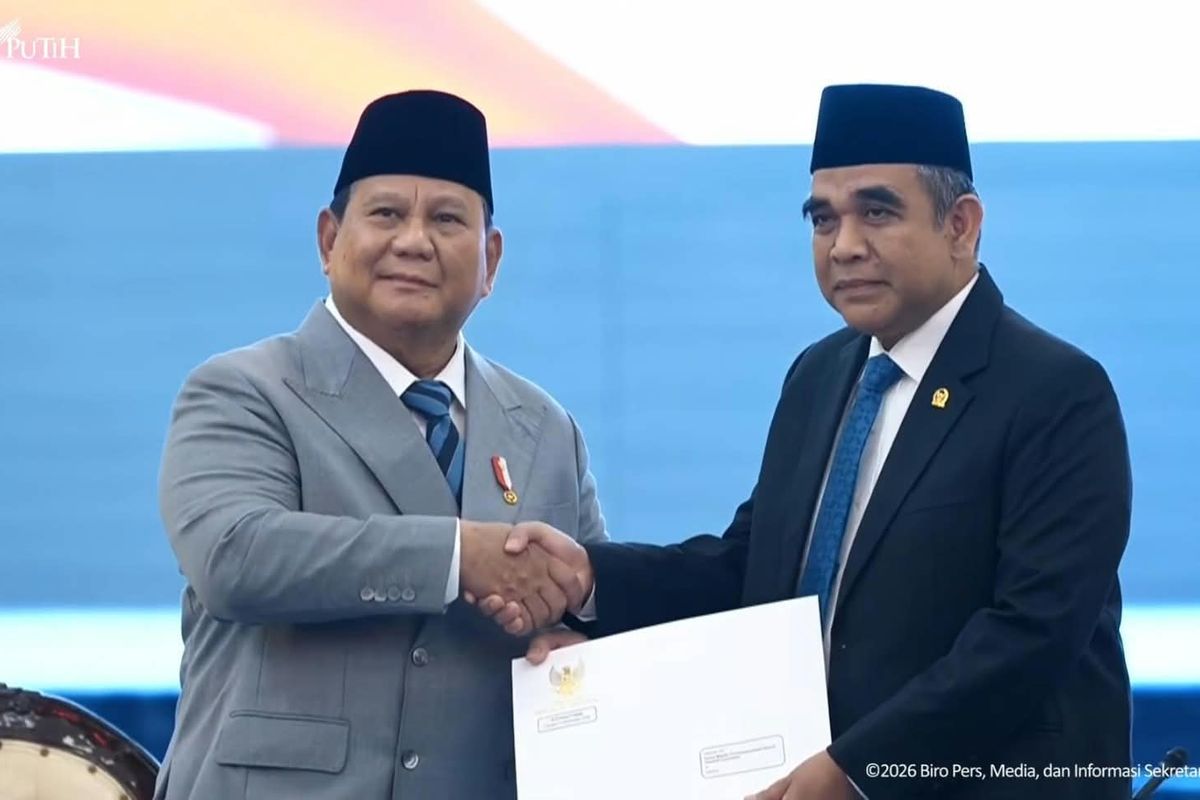
ON DECEMBER 11, 2026, the People's Consultative Assembly (MPR) and President Prabowo will conclude a turbulent chapter in governance by filling the vacant vice presidential seat.
Two names have been proposed, one will be chosen, and promptly inaugurated.
Currently, the noise has narrowed down. President Prabowo has submitted two candidates to the MPR: Sugiono and Andi Amran Sulaiman.
These are not just ordinary names. Both are close associates of the President, both work directly within the cabinet, and both understand how the President thinks and makes decisions.
But precisely because of this, the real question is not merely: who is closer to Prabowo?
A more honest and meaningful constitutional question is: who can translate that closeness into leadership that adheres to the constitution?
Indonesia needs a Vice President who is not just trusted by the President.
Indonesia needs a statesman capable of transforming that political trust into an effective government trusted by the public.
Article 8 paragraph (2) of the 1945 Constitution stipulates that if the vice presidential office is vacant, the MPR must choose a replacement from the two candidates proposed by the President, no later than 60 days.
This constitutional stipulation has been used by the President to determine his running mate.
However, the constitution does not hand over the entire decision to the President. The MPR still has the authority to choose. And the public has the right to question.
Filling the vice presidential seat is not a transaction of power among elites. It is a constitutional mechanism to ensure government continuity.
Samuel P. Huntington in Political Order in Changing Societies (1968) reminds us that stability is not merely the absence of conflict.
Stability is the ability of institutions to manage change without losing effectiveness and legitimacy.
Here lies the importance of examining these proposed names, not just praising them. Both have different credentials. And those credentials must be tested individually.
However, those credentials do not automatically prove one's capacity to fulfill the constitutional responsibilities of a Vice President.
Sugiono is known as a calm, loyal, and meticulous figure in his work.
Having served as Foreign Minister and Secretary-General of the Gerindra Party, he is accustomed to being in the President's decision-making circle.
His advantages are clear. He understands diplomacy, governance, and the President's work language.
In a presidential system, such harmony is important. If the President and Vice President are not aligned, government coordination can be disrupted.
Yet, calmness can also raise a question. Can someone so loyal still offer corrections when the President is wrong?
Max Weber in Politics as a Vocation (1919) introduced what he calls the ethic of responsibility.
A leader must consider the real consequences of their political decisions, not just their good intentions.
This means loyalty to the President must be placed within a higher loyalty: to the constitution, to the people, and to the state.
The Vice President is not merely a political aide who always justifies the President.
They must also be able to voice critical considerations when political decisions may stray from public interests.
If Sugiono is elected, his greatest test will not be his ability to work alongside the President.
He already possesses that. His greatest test will be whether he dares to say no when necessary.
A good partner is not only one who can strengthen the President's decisions but also one who can prevent the President from making misguided choices.
Amran Sulaiman comes from a different background. As Minister of Agriculture, he is known as a field worker, assertive, and results-oriented.
His strength lies in his track record of execution. He is used to dealing with concrete issues: food, distribution, prices, and farmers' welfare. He does not just talk about political stability, but about the needs of the people.
In the context of a government pursuing economic targets and food security, a figure like Amran holds a unique appeal. He offers leadership that can be directly felt by the public.
However, experience managing a sector does not automatically translate to experience leading a government overall.
Managing a ministry is different from accompanying the President in state affairs that are much broader: from politics, law, to inter-agency relations.
The test for Amran is whether his managerial capacity can elevate to a statesman-like capacity.
Can he bridge differing political interests, not just solve technical problems in the field?
These two names present two different leadership models. Sugiono offers stability in coordination and diplomacy. Amran offers stability in work and results.
Both can be analyzed through the concept of political brokerage, the ability to bridge competing interests.
Arend Lijphart in Patterns of Democracy (1999) emphasizes the importance of power-sharing, negotiation, and consensus in managing democracy.
In coalition governance, the ability to build compromise is indeed necessary.
However, we must be honest: elite consensus is not always identical to the interests of the people.
Political compromise may expedite problem resolution.
But it can also weaken oversight if all political forces too easily agree to the government's will. When everyone agrees at the top, who will remind those below?
This is the test for whoever is ultimately elected.
Their experience must be assessed through their ability to build cooperation while respecting the oversight functions of the DPR, the independence of law enforcement, and the freedom of public criticism.
An effective Vice President is not merely one who resolves political deadlocks but ensures that the resolution does not sacrifice the principles of the rule of law.
In a presidential system, the center of governmental responsibility lies with the President. The Vice President performs his constitutional role as the companion, as well as the President's replacement under the circumstances defined by the Constitution.
Therefore, leadership harmony is essential to avoid competition for authority and political fragmentation. We all know the dangers of double suns.
But avoiding double suns does not mean building unbalanced power.
If the President and Vice President originate from the same political force, coordination may be easier.
Conversely, concentration of power can also increase if oversight mechanisms are not in place.
James Madison in The Federalist No. 51 (1788) reminds us that power must be controlled through institutional designs, not merely by relying on the goodwill of those in power.
Thus, the issue is not whether Sugiono or Amran comes from the President's circle.
The issue is how the consolidated power can remain accountable.
Unity of leadership is necessary for government effectiveness. But that unity must not turn into political uniformity that weakens democracy.
Filling the Vice Presidential seat through the MPR has a constitutional foundation. But the legality of the appointment does not automatically guarantee political and moral legitimacy.
David Beetham in The Legitimation of Power (1991) explains that the legitimacy of power relates to three aspects: compliance with rules, normative justification, and public acceptance of power.
Therefore, whoever is chosen between Sugiono and Amran must build legitimacy through integrity, accountability, and results felt by the public.
For Sugiono, the issue is how calmness and loyalty are translated into courageous stances. For Amran, the question is how managerial assertiveness translates into statesmanlike wisdom.
Experience within the cabinet is one type of capacity. The ability to govern that serves the people is another capacity that still must be proven. These cannot substitute for each other.
Who will be chosen? The MPR, with its statesmanship, must not stop at loyalty, proximity, or party support.
Coordination capacity, institutional experience, and working relationships with the President are relevant reasons to consider both candidates.
However, all three must be tested alongside integrity, the courage to correct, and commitment to democracy.
Indonesia requires a Vice President capable of maintaining government continuity without using stability as an excuse to silence criticism.
Here lies the fundamental difference between a confidant and a statesman.
A confidant safeguards the interests of their leader. A statesman ensures that leadership remains in the interests of the nation.
Thus, the real question is no longer simply: Sugiono or Amran?
But rather, who among them can prove that their closeness to Prabowo can be dedicated to the constitution and the people?
Because the measure of a Vice President’s success is not how close they are to the center of power, but how far that power can deliver justice, welfare, and dignity for the people.
And if the chosen candidate can prove that, then the answer becomes clear: not because they are Prabowo’s confidant, but because they have become a statesman of public affairs (res publica).