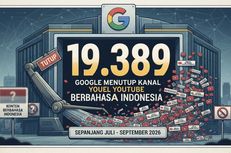
Komdigi to Request Google Clarification on Closure of 19,389 YouTube Channels
-
News
-
Just now
This article was translated by AI. Read the original article on Kompas.com. See Original

JAKARTA, KOMPAS.com - The House of Representatives Commission I has proposed that the Draft Law (RUU) on Artificial Intelligence (AI) be included in the Medium-Term National Legislation Program (Prolegnas).
Following this, user protection or societal safety has become an inseparable mechanism from the proposed law.
So, what forms of protection should be integrated into this new regulation?
Digital economy expert and Executive Director of ICT Institute Heru Sutadi emphasized that the bill must regulate limits on this form of artificial reasoning.
Humans should be placed at the center of AI governance as a form of protection.
"Protection must place humans at the center of AI governance," Heru told Kompas.com on Thursday (November 19, 2026).
Heru explained that protection also includes the right to know.
Citizens, he noted, have the right to know when interacting with AI.
They should also receive explanations for significant automated decisions, as well as mechanisms for objection and recovery if harmed.
Additionally, a personal data protection mechanism is essential.
"Personal data must be safeguarded, while deepfake, identity manipulation, and exploitation of vulnerable groups should be firmly addressed. AI developers and operators must also be accountable for systemic risks," Heru stated.
Cybersecurity expert from Vaksincom, Alfons Tanujaya, echoed these sentiments, stating there are at least three fundamental rights and protections for users outlined in the bill.
First, the right to know, meaning the public must be informed when interacting with AI, as opposed to a human.
This includes when individuals use call center services or are evaluated by algorithms.
Second, the right to intervene.
This right is aimed at regulating jobs that cannot rely entirely on systems.
"Decisions for critical matters such as layoffs, loan refusals, scholarship selections, and social assistance must not rely solely on systems/AI. Human involvement is essential," Alfons asserted.
Third, the preparation of a kill switch mechanism. Alfons noted this mechanism should be established in advance to address failures or issues within AI-operated systems.
This system must also anticipate burdens on society.
Alfons cautioned that the burden created by the system should concentrate upstream, not downstream or on users.
"Therefore, the public should not solely be advised to be cautious and smart not to be deceived, but rather the applications should be safety by design; the obligation for security rests with the platform providers before products are released to the public. This regulation should be enforced by an independent supervisory body with the authority to uphold established rules," Alfons stated.
Heru also reminded that ideally, protection should not stop at penalties after damage occurs.
Protection must encompass prevention, audits, oversight, and victim recovery.
Heru hopes the existence of regulations will enable Indonesia to become not just a user and market for AI, while the rules, technology, and economic values are dictated by others.
"The AI Law must protect humans while simultaneously building national sovereignty and competitiveness in AI," Heru emphasized.
Additionally, Alfons urged that regulations be thoroughly discussed.
The final outcome should be beneficial and able to address any issues involving artificial intelligence.
It should also be tailored to Indonesia's conditions and needs.
"We should not create artificial intelligence regulations due to legislative FOMO, which could end up harming local startups and AI research, while big tech giants become even more dominant," Alfons explained.
Concerning its contents, Alfons requested that the bill not only cover technical aspects.
The draft should maintain a technology-neutral principle and not rigidly define technology.
The government and the House of Representatives should categorize AI according to the levels of risk it poses.
"Categorize AI into risk levels such as low risk, high risk, and completely prohibited risks," Alfons outlined.
Technologies that can be categorized as low risk include photo filters and shopping recommendation filters.
High-risk technologies should encompass medical diagnoses, job selection, credit assessments, and law enforcement.
While completely prohibited risks include psychological manipulation, misinformation, and illegal uses.
"Technical data may be elaborated in derivative regulations or a regulatory sandbox scheme to allow quick revisions and adaptation to fast-changing developments," Alfons asserted.
Heru added that the AI Draft Law should regulate AI risk classification, algorithm transparency, developer and user accountability, data protection, intellectual property rights, system security, AI use in strategic sectors, and prohibit practices that endanger public safety.
"The law should establish principles, obligations, and oversight mechanisms, while technical standards can be set through adaptive derivative regulations. Periodic evaluations, a regulatory sandbox, and engagement with industry, academia, and the public are also necessary," Heru stated.
Notably, there are several reasons why Commission I proposed the AI bill to be included in the Medium-Term Prolegnas.
Aside from the needs arising from the development of the digital world, other countries already have similar regulations.
Some of these include Indonesia's neighboring countries, such as Malaysia and Singapore.
"For instance, Malaysia, Singapore, China, and countries far away like Europe and the United States have gone much further in their regulations," said Dave during the Coordination Meeting on the Drafting of Priority Prolegnas 2027 at the Legislative Agency (Baleg) of the House on Tuesday (November 17, 2026).
Currently, Commission I is still prioritizing the completion of several other laws, such as the Cybersecurity Law (KKS) and the Broadcasting Law, which have already been proposed as DPR initiatives.
Furthermore, Commission I is working on amending one article in the bill regarding the Amendment of Law Number 23 of 2019 on the Management of National Resources for State Defense.
"This is not lengthy; only one article needs to be revised in accordance with the Constitutional Court's decision," Dave stated.