
Critique the Government, Reflect on Ourselves
-
News
-
23 minutes ago
This article was translated by AI. Read the original article on Kompas.com. See Original
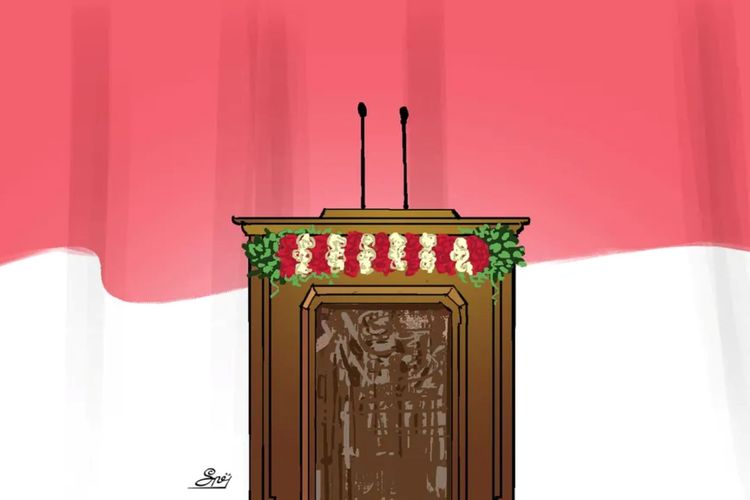
IN November 2026, President Prabowo Subianto's administration will have been in power for two years.
Public spaces and social media are abuzz discussing the government's performance.
Critiquing the president is both a right and a duty of citizens in a democracy.
However, amidst the fervor to hold the government accountable, there is a simple question we need to reflect on.
Could it be that the very traits of President Prabowo that we criticize the most are also present within ourselves?
To be fair, we need to examine the government’s performance data from both angles. On one hand, public trust remains high.
A survey by Parameter Politik Indonesia conducted from September 26 to October 6, 2026, reported that 65.2 percent of citizens are satisfied with the president's performance and 65.4 percent with the government's overall performance.
Similarly, a Poltracking Indonesia survey conducted in October 2026 noted a public trust level of 64.8 percent, primarily due to the government's success in maintaining religious harmony (73.8 percent) and national unity (67.0 percent).
This is supported by tangible achievements up to October 2026: Free Health Checks served 99.1 million citizens, the Nutritious Food Program (MBG) reached 56.99 million recipients, the economy grew by 5 percent, biodiesel B50 saved foreign exchange of Rp170 trillion, and 10,000 Merah Putih Village Cooperatives have been operational.
However, Poltracking recorded general satisfaction at only 55.3 percent.
Citizens are most disappointed with the economic performance (36.8 percent), job opportunities (33.3 percent), and prices of essential goods (31.3 percent).
These data reveal that while the government has produced concrete results, it also has many weaknesses that need criticism.
Nevertheless, leaders do not emerge from a vacuum. A leader’s traits often reflect the traits of their society.
There are four traits of power that we often unconsciously mimic in our daily lives.
First, stubbornness and a desire to dominate. Research from STIA Al-Amanah Junwangi and BRIN found that President Prabowo still employs a rigid military command style.
On April 8, 2026, the president acknowledged his label of "stubborn" and deemed that trait important for upholding national principles. Now, let’s reflect on ourselves.
We often feel free from authoritarian traits because we are ordinary citizens.
In reality, our true nature surfaces when holding minor power, such as being a boss at work, a committee chairperson, a neighborhood leader, a lecturer, or a WhatsApp group admin.
When in a minor position, we often force others to comply with our wishes.
If others resist, we label them as stubborn. If we reject advice, we express it firmly and stick to our principles.
Second, an anti-critique attitude and a penchant for diverting conversations. A report by Remotivi and SAFEnet as of November 8, 2026, noted that 127 pieces of critical content on social media were taken down, almost double the previous period.
The president also referred to the "Dark Indonesia" movement as malicious on November 12, 2026, ridiculed university experts on November 14, and countered criticism over his international visits on November 15 by comparing it to the administration of former President Joko Widodo, who was criticized for rarely traveling abroad.
This attitude of rejecting correction is strikingly familiar in our daily lives.
Many netizens express anger when the government is anti-critique, yet they often lash out and block friends with differing opinions on social media.
When reprimanded by partners or coworkers for mistakes, we rarely apologize and tend to highlight others' errors instead.
Third, grand ambitions without financial consideration. By November 2026, the government is facing a tax shortfall of Rp 514 trillion.
While the state treasury struggles, the budget for MBG still consumes Rp 335 trillion; meanwhile, the cabinet is growing with the appointment of 26 members of the Presidential Advisory Council, alongside discussions on limiting modern minimarkets.
Even at the Muhammadiyah Tanwir in Palu on November 14, 2026, the president promised additional funding of Rp 100 billion for each provincial capital and at least Rp 20 billion for each regency.
We collectively criticize the government for being wasteful. However, many of us persist in forcing a luxurious lifestyle at home and going into debt for social status without considering our financial capability.
Fourth, sweet in words but violating rules in practice. The president often makes strong speeches against corruption, from threatening to dismiss corrupt officials in Sentul on February 2, 2026, to condemning "greedy economic vampires" on November 14, 2026.
However, the public observes that the government continues to distribute positions while neglecting to enforce tobacco regulations, even facing a lawsuit from the Save Our Surroundings Indonesia coalition on November 12, 2026.
Forest fires have also devastated 1.9 million hectares of land by September 2026, yet the government plans to open up 12.7 million hectares of damaged forest for biofuel.
The New York Times on November 10, 2026, also highlighted officials’ lack of concern for the environmental disasters in Sumatra, Kalimantan, and Papua.
In our daily lives, we are the same. We denounce nepotism but still seek help from "insiders" when dealing with documents, job applications, or avoiding fines.
We criticize officials for lacking empathy, yet we also mock disaster victims who hold different political views.
Of course, these similar traits do not equate to the level of responsibility between ordinary citizens and the president.
If ordinary citizens are stubborn, anti-critique, or wasteful, the only ones who suffer are their own families.
Conversely, when these traits are exhibited by a president, the impact risks hundreds of trillions of rupiah in tax money, millions of hectares of forest, and the fate of 280 million Indonesian citizens.
Therefore, criticism of the government must not cease. However, this reflection should serve as a shared contemplation.