
Considering DPD Elements in the Vice Presidential Selection
-
News
-
1 minute ago
This article was translated by AI. Read the original article on Kompas.com. See Original
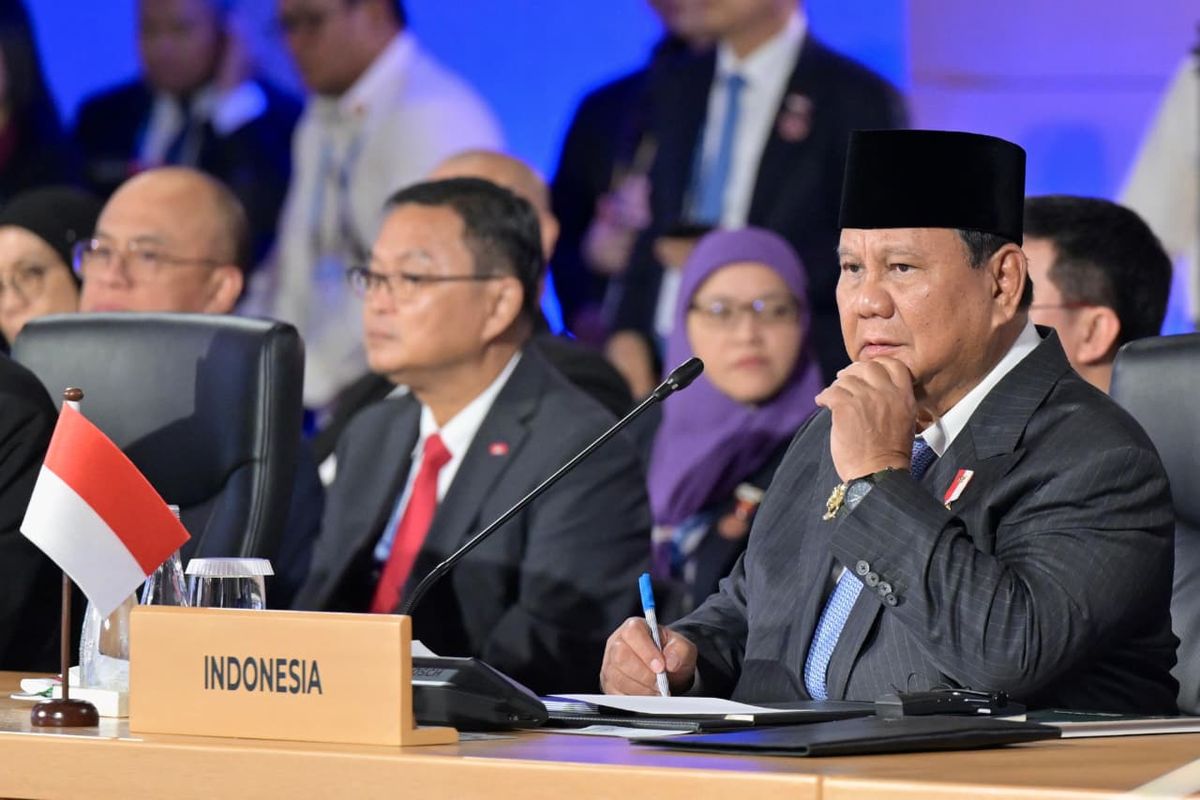
TRANSITION The change of Vice President should create space for regional perspectives in national leadership and serve as a moment to reevaluate the relationship between central and regional governments.
The selection process for the vice-presidential candidate to replace Gibran Rakabuming Raka reveals an intriguing trend.
Most names being discussed in national political conversations typically come from elite circles of political parties, parliaments, and governments.
This phenomenon can be understood, as political parties have been the main source for recruiting national leadership.
However, amidst this dynamic, a pertinent question arises: why is the potential for a vice-presidential candidate from the Regional Representatives Council (DPD) not taken more seriously in public discourse?
This question is not meant to pit the DPD against the DPR, nor to diminish the role of political parties in democracy. It is an invitation to broaden our perspective.
Indonesia is not only a nation built through political party representation, but also an archipelago that features diverse regions, social characteristics, economic potentials, and developmental challenges that are not always the same.
In this context, the idea of a vice-presidential candidate from the DPD deserves to be discussed as an alternative thought on national leadership.
This is not because the position should belong to a specific institution, but because regional issues require a stronger voice in the central government agenda.
The DPD is a significant product of constitutional reform. This body was established to ensure the representation of regional interests within Indonesia's political system.
Unlike the DPR, which represents political interests through parties, DPD members are elected individually from each province.
In the 2024–2029 period, there are 152 DPD members representing 38 provinces, with four from each.
The presence of the DPD reflects the idea that regional interests cannot always be fully represented by the political party configuration.
There are issues that transcend ideological lines and electoral interests, such as developmental inequalities, power distribution, fiscal relations, management of natural resources, and the protection of regional characteristics.
The question is whether this regional representation has adequate space within strategic national decision-making processes?
This inquiry becomes even more relevant when we observe that the majority of government agendas, from infrastructure development to budget management, are heavily dictated by central government policies.
Regions do have autonomous authority, but their fiscal capacity and execution ability are still significantly influenced by national decisions.
Therefore, national leadership needs a perspective that understands not only the elite dynamics in Jakarta but also the realities of governance and community life in the regions.
More than two decades after reform, decentralization has transformed the face of Indonesian government.
Local governments have gained authority to manage various governmental affairs and set development priorities according to community needs. However, the journey of regional autonomy has not been entirely smooth.
One of the most fundamental challenges is the fiscal dependency of regions on the central government.
According to an INDEF study on fiscal decentralization from September 2026, around 78 percent of revenue for municipalities still comes from transfers to regions.
The study also identified the impact of transfer efficiency policies on local government spending, particularly capital expenditures.
This figure reflects a paradox. Regions have significant responsibilities in providing public services and stimulating local economies but remain largely dependent on the central government's fiscal capabilities.
When transfers decrease, it can further constrict regional development space. Infrastructure, basic services, and local economic development programs can potentially be affected.
Another issue is the continually reorganizing distribution of authority. Law Number 23 of 2014 regarding local governance has regulated the division of governmental affairs between the center, provinces, and municipalities. Subsequent sectoral regulation changes have also influenced this authority space.
In such situations, regional autonomy should not merely be understood as a division of administrative affairs. Autonomy must be accompanied by fiscal capacity, security of authority, and healthy coordination relations between the center and regions.
This is where the need for a regional perspective in national leadership becomes relevant. The central government needs to understand that policies appearing efficient nationally may not yield the same impact for every region.
This idea is not without legal foundation. Article 397 of Law Number 23 of 2014 mandates the establishment of the Regional Autonomy Advisory Council (DPOD), with further stipulations governed by Presidential Regulation Number 91 of 2015.
Under this presidential regulation, the Vice President serves as the Chairperson of the DPOD and is also a member. The council is tasked with advising the President on regional structuring policies, special autonomy funds, balancing financial relationships between the central and local governments, and resolving regional governance issues and relationships with ministries or agencies.
This position indicates that regional autonomy issues are not merely technical matters assigned entirely to ministries; they are part of the presidential strategic agenda.
Indeed, the Vice President does not directly take over the responsibilities of ministers or regional heads. The DPOD does not serve as a policy executor either.
However, the Vice President's role as the chair underlines the importance of coordination and advice to the president in maintaining the quality of central-regional relations.
As such, experience and a deep understanding of regional issues may become one of the relevant qualifications for the vice-presidential candidate.
Constitutionally, DPD members are also MPR members. In the mechanism for filling the vice-presidential vacancy, Article 8 paragraph (2) of the 1945 Constitution stipulates that the MPR selects the Vice President from two candidates proposed by the president.
This means that DPD members have a position as part of the MPR in that selection process.
However, it must be emphasized that the authority to propose the two candidates lies with the president, not the DPD.
Therefore, the idea of a vice-presidential candidate from the DPD should be framed more as an aspiration and alternative within the discourse of national leadership rather than an institutional authority claim.
On the other hand, the DPD has space to express views on the qualifications of leadership that the country needs. Such aspirations could focus on the importance of figures who understand decentralization, have government experience, and are able to connect national policies with regional needs.
This is not a demand for the DPD to gain special rights. It raises the question of the openness of recruitment sources for national leadership.
If political parties have space to offer their best cadres and leaders, why can’t the experience and regional perspectives also be considered in the same process?
Of course, one does not automatically qualify to become Vice President just because they come from the DPD. Institutional origin is not the only criterion for leadership capacity.
The vice-presidential position requires competencies that extend far beyond merely voicing regional interests.
The individual being considered must possess integrity, a track record in governance, an understanding of economic and fiscal matters, the ability to manage inter-ministerial coordination, as well as insights into international relations and geopolitics.
They must also understand issues of defense, security, democracy, and human development.
Moreover, the vice-presidential candidate needs to be a strategic partner to the president, rather than creating a competing power center.
They should have the capacity to convey critical viewpoints, but remain aligned within the constitutional framework and a clear division of responsibilities.
With the same standards, anyone from the DPD, DPR, political parties, bureaucracy, or professional circles must be evaluated based on their capacity and record.
There should be no privileges based on institutional origin, but there should also not be restrictions on leadership sources limited to certain political elite circles.
The change of Vice President presents a moment to raise questions that are larger than just who will fill that position.
Does national leadership sufficiently reflect the complexity of Indonesia as an archipelagic nation? Are the relationships between the center and regions balanced?
And has regional aspiration received adequate space in strategic decision-making?
The idea of a vice-presidential candidate from the DPD could be a gateway to discussing all these issues. It is not an automatic solution to the problems of decentralization, nor a guarantee that central-regional relations will improve immediately.
However, this idea opens up possibilities to broaden perspectives in the recruitment process for national leadership.
Ultimately, what the president needs to consider is not the institutional origin of an individual but whether that person has the capacity to strengthen governance while understanding the needs of all regions in Indonesia.
Because the success of national development is not solely determined by how strongly the central government controls the development agenda, but also by how far regions have the space, capabilities, and opportunities to grow.