

Indonesia to Receive Airbus A340-500 from Turkiye
-
News
-
Just now
This article was translated by AI. Read the original article on Kompas.com. See Original
SURVEILLANCE is an instrument that can be employed by the state for law enforcement purposes. However, such authority is not without limits.
Its use directly intersects with the right to privacy and individual freedoms, thus it must comply with the principles of legality, strict procedures, and adequate oversight mechanisms.
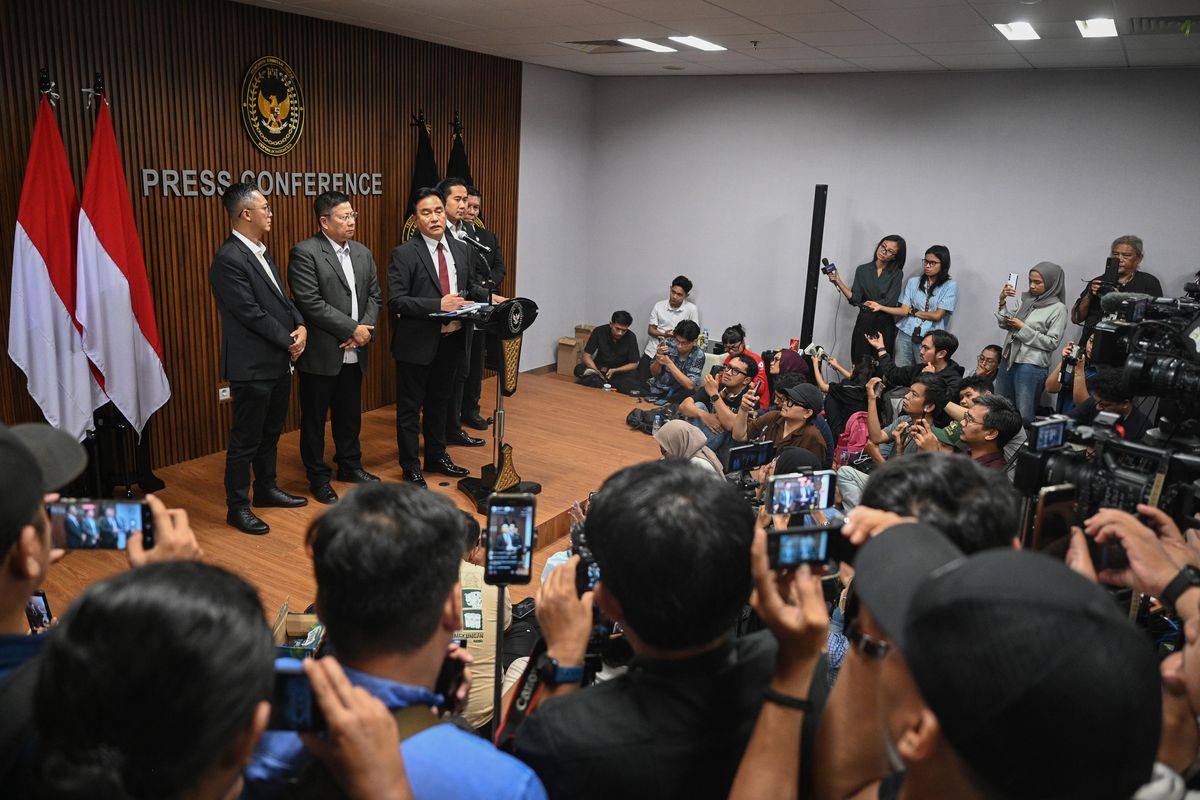
This issue has resurfaced following the revelation by the Indonesian National Police's Criminal Investigation Agency (Bareskrim) regarding allegations of illegal surveillance against President Prabowo Subianto and several other individuals.
According to Bareskrim's statement on November 3, 2026, these actions were reportedly carried out throughout 2025–2026.
Several phone numbers were entered into the Lawful Interception Management System (LIMS) without verification and were intercepted without any relation to investigative processes.
In October 2026, the suspects were also alleged to have ordered the deletion of records from the surveillance. This case came to light after a staff member reported it on October 30, 2026.
In addressing this matter, Coordinating Minister for Law, Human Rights, Immigration, and Corrections, Yusril Ihza Mahendra, proposed that the National Cyber and Encryption Agency (BSSN) serve as an external overseer of all surveillance devices owned by state institutions.
This proposal is crucial to consider, especially in light of the absence of specific laws governing surveillance comprehensively.
In fact, the Constitutional Court's Decision Number 5/PUU-VIII/2010 has emphasized the importance of regulating the procedures for surveillance through legislation.
So, how should surveillance oversight be structured to prevent governmental authority from evolving into an instrument of abuse of power?
The fundamental issue in the governance of surveillance lies in the lack of an integrated legal framework.
In Decision Number 5/PUU-VIII/2010, the Constitutional Court noted that the regulation of surveillance is still scattered across several laws with varying mechanisms and procedures. This situation poses potential deviations in its implementation.
Therefore, the Court believes that a specific law is necessary to comprehensively regulate surveillance, including procedures for each agency with authority.
The Court also underscored that surveillance represents a limitation of the constitutionally guaranteed right to privacy.
Such rights can be restricted, but these limitations must be based on law as stipulated in Article 28J paragraph (2) of the 1945 Constitution of the Republic of Indonesia.
This means that the power of surveillance cannot merely be granted through general norms or internal institutional policies.
Legislation must clearly establish the legal basis, objectives, authorized officials, licensing procedures, timeframes, and oversight and use of surveillance results.
In its ruling, the Court determined that Article 31 paragraph (4) of Law Number 11 of 2008 concerning Information and Electronic Transactions contradicts the 1945 Constitution and holds no binding legal force.
This ruling reinforces that technical regulations through subordinate regulations cannot replace the need for adequate legal grounding to limit human rights.
Consequently, the establishment of surveillance law should not only grant authority to officials but also provide boundaries and protection guarantees for everyone.
The proposal to position BSSN as an external overseer requires further examination, particularly regarding its independence and jurisdiction.
Oversight of surveillance should not solely focus on the examination of equipment but also encompass the legality of orders, objectives of surveillance, identities of targeted parties, and management of interception results.
In other words, oversight must cover the entire process, not just its technological aspects.
In this context, there is an issue to be considered. Amnesty International revealed in 2024 that various institutions, including BSSN, purchased surveillance technologies and spyware from 2017 to 2023.
This information, as reported, should be a consideration when designing BSSN's role as an overseer.
It is essential that an agency involved in the surveillance technology ecosystem is not placed as the sole overseer without adequate guarantees of independence and accountability.
Oversight of surveillance needs to be constructed via layered mechanisms that separate three functions: authorization, execution of surveillance, and oversight.
BSSN can perform technical audits of devices, systems, and records of surveillance tool usage.
Meanwhile, authorization should involve an independent authority designated by law, including a court licensing mechanism.
Oversight must also be accompanied by periodic audits, reporting obligations, restrictions on access to surveillance results, and recovery mechanisms for affected parties.
This functional separation is critical to ensure that surveillance authority does not concurrently become the power to supervise and control itself.
The regulation of surveillance must place human rights as a fundamental starting point, not just an additional consideration. Every act of surveillance must adhere to the principles of necessity and proportionality.
This means surveillance can only be conducted for legitimate purposes when other means are insufficient and must be limited to the information and duration that are truly necessary.
Law enforcement interests cannot justify arbitrary surveillance over the private lives of citizens.
On the other hand, civil society must be involved in crafting surveillance legislation, especially organizations focused on human rights, press freedom, and privacy protection.
This involvement is crucial so that regulations are not merely developed based on the technical needs of law enforcement but also consider potential abuses of power and their impacts on civil liberties.
Transparency must also be enhanced through regular oversight reports to the public, at least regarding the number of requests and implementation of surveillance, types of violations, and follow-up on complaints, without disclosing information that could disrupt law enforcement processes.
Equally important, the law must provide mechanisms for complaints and redress for individuals subjected to unlawful surveillance.
Effective oversight must not only identify violations but ensure accountability for perpetrators and restoration of rights for victims.
Surveillance authority is indeed necessary to protect public interests. However, the state also has an obligation to ensure that this instrument does not threaten the rights of citizens that should be protected.