
New Vice President: Regions Must Not Be Neglected Again
-
News
-
33 minutes ago
This article was translated by AI. Read the original article on Kompas.com. See Original
THE TRANSITION of the vice president amid the government's journey is not merely a matter of filling a vacant position.
This is a political and constitutional momentum to redefine the direction of national leadership, including how the state treats regions within the framework of the Unitary State of the Republic of Indonesia (NKRI).
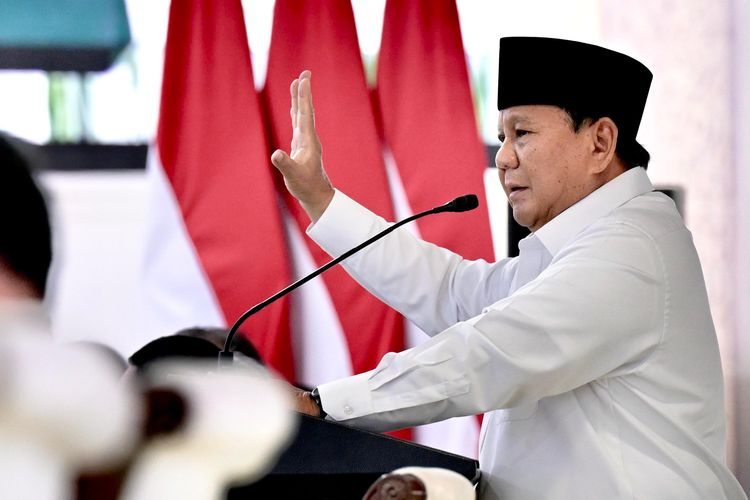
After Gibran Rakabuming Raka stepped down as vice president, President Prabowo Subianto is obligated to propose a replacement candidate for the remainder of the administration's term.
The name exchange has begun to heat up. Several political figures and regional leaders are rumored to have a chance at holding the position.
However, amid the political speculation, there is one substantive criterion that must not be overlooked: Indonesia needs a vice president who understands local governance issues, is aware of regional autonomy concerns, and cares about regional welfare.
Why is this criterion important? Because the relationship between central and local governments has not been going well lately.
The relationship between the central government and local regions has shown signs of tension recently. Local governments are complaining about centralized authority, shrinking fiscal space, and diminishing flexibility in determining developmental priorities.
Cuts to Regional Transfers (TKD), for instance, are not just numerical issues in the state budget (APBN). Such fiscal policies directly affect a region's capacity to fund public services, build infrastructure, reduce poverty, and meet the basic needs of the community.
Indonesia has 546 autonomous regions, each with diverse characteristics, fiscal capacities, issues, and development needs.
Not all regions have adequate Original Local Revenue (PAD). A majority still rely heavily on transfers from the central government.
When fiscal policy becomes increasingly concentrated at the center while public service responsibilities remain predominantly with local governments, an imbalance arises between authority, responsibility, and funding capabilities.
As a result, regional heads find themselves in a difficult position. They are expected to improve services and community welfare, but their room for maneuver is becoming more limited. It is no surprise that unrest and protests from several local governments have emerged.
This issue should not be seen merely as local elite dissatisfaction with central policies. At its core, there is a fundamental question regarding the consistency of decentralization implementation and the future of regional autonomy.
It is here that a vice president who understands regional issues is needed.
Constitutionally, Article 4 Paragraph (2) of the 1945 Constitution states that in carrying out his duties, the president is assisted by one vice president. This provision positions the vice president as the president’s assistant.
There is no separate distribution of governmental powers automatically attached to that position.
However, this does not mean the vice president is merely an institutional complement or simply a substitute for the president in case of absence.
The vice president can be granted political mandates and strategic assignments to assist the president in handling government issues requiring special attention. One such strategic issue is the central-local relationship.
Indonesia is not a small country with uniform regional characteristics. This archipelagic nation possesses remarkable geographical, social, cultural, economic diversity, and governmental capacity.
Managing Indonesia cannot be done with a Jakarta-centric perspective alone. A deep understanding of the realities in various regions is necessary.
A vice president who understands regional autonomy can become a communication bridge between the president and local heads. They can help identify issues faced by local governments, convey their aspirations to the president, and seek solutions when central policies conflict with regional needs.
By law, the vice president is also mandated by Law No. 23 of 2014 on Regional Government as the chairman of the Regional Autonomy Advisory Board (DPOD), and specifically for Papua, the vice president also serves ex officio as the Chairman of the Accelerated Development Steering Committee for Special Autonomy Papua (BP3OKP) as per Law No. 2 of 2021 on Special Autonomy for Papua.
Thus, the vice president does not merely alleviate the president’s workload but also helps ensure that national policies remain sensitive to regional diversity.
We do not want the relationship between the center and the regions to operate solely in a one-way command pattern. Regional autonomy requires partnerships, coordination, clear division of responsibilities, and respect for the authority of each tier of government.
So, should the vice president who understands the regions come from local heads, former governors, or members of the Regional Representative Council (DPD)? Not necessarily.
Understanding the regions is not synonymous with having served in local governance. What is more important is having knowledge, experience, insights, and a commitment to the administration of regional governance.
A person could come from Jakarta, be a political party figure, an academic, or a central government official, yet possess a profound understanding of decentralization and regional autonomy.
Conversely, having previously served as a regional head does not guarantee comprehensive understanding of autonomy issues.
Therefore, track record, intellectual capacity, and leadership must be primary considerations.
A vice presidential candidate should understand the Regional Government Law, the financial relationship between the center and regions, division of governmental affairs, regional bureaucratic governance, and the problems of inter-regional development inequality.
They must also have the courage to inform the president if a national policy could potentially harm the regions. Loyalty to the president should not be interpreted as the need to justify all policies.
Indeed, a good assistant is someone who can provide critical input and alternative solutions.
In addition to capacity, the political factor certainly cannot be ignored. The president needs a vice president who can collaborate, has chemistry, and does not create dual leadership issues.
To fill the vice president’s position for the remainder of the approximately three-year administration, considerations of political stability and loyalty to the president are relevant.
In this context, it is not problematic if the vice president comes from the same political party as the president. In fact, this choice can reduce potential internal political competition leading up to the 2029 presidential election.
A replacement vice president during a term has a different context than a vice presidential candidate chosen at the outset in a presidential election contest.
In the early period of governance, political representation and party coalitions may be more dominant.
Meanwhile, during a mid-term transition, government continuity, the president's trust, and shared political orientation become stronger considerations.
The president certainly does not want a vice president who becomes a political competitor, builds their own power, or creates conflicts.
However, political loyalty should not be the only measure. A vice president who is merely loyal but lacks capacity will struggle to add value to governance.
Conversely, a capable vice president who does not share political orientation and trust may also pose problems.
Both must go hand in hand: governance competence and political alignment.
Several names have begun circulating. From the perspective of representation and experiences with regional institutions, names like DIY Governor Sultan Hamengku Buwono X and Chairman of the DPD RI Sultan B. Najamudin have emerged. Both have relevant track records and connections to institutions and regional issues.
Meanwhile, from the political and governmental circles close to President Prabowo, names like Sufmi Dasco Ahmad, Sugiono, and Muzani have been mentioned.
These names certainly have their respective backgrounds and strengths. Nevertheless, the debate should not stop at who is closest to the president, who is strongest politically and ideologically, or who has the best chance of garnering party support.
The public needs to know what capacity each candidate offers. What is their view on decentralization? What are their ideas for addressing fiscal imbalances?
How will they improve coordination between the center and the regions? Do they understand the issues faced by regions outside of Java?
Unfortunately, the discussion on high-ranking state officials often focuses more on political calculations than on assessing capacity and ideas.
Therefore, when two names have been proposed by the president to the MPR, it would be better if before the MPR members vote, both candidates are asked to present their core thoughts on assisting the president.
It is important to emphasize that the vice presidency is not just a political prize or a place to hold leaders who have contributed to the party and president.
There is one thing that President Prabowo should pay attention to. The vice president is not merely the president’s companion or a reserve tire waiting their turn when the head of state is unavailable.
Article 8 of the 1945 Constitution indeed places the vice president as the president's replacement under certain conditions. However, in daily governance, the vice president should be a strategic force that helps the president address national issues.
Therefore, the change in vice presidents should be a moment to improve the quality of national leadership, including rectifying the increasingly imbalanced relationship between the center and the regions.
The president needs to provide a clear mandate to the new vice president to oversee decentralization, strengthen coordination across levels of government, advocate for fiscal justice, and ensure regional voices are truly considered in national policy-making.
We must not allow regional autonomy to remain a mere constitutional slogan, while governance practices drift toward recentralization.
Nor should local leaders be treated merely as implementers of central policies without adequate authority and fiscal support to meet the needs of their constituents.
Regional autonomy is not a gesture of charity from Jakarta. It is a mandate of reform and a constitutional choice to bring governance closer to the people, accelerate development equity, and nurture diversity within the framework of the NKRI.
Regions are not subordinates merely waiting for orders from the center but strategic partners in building Indonesia.
Thus, the new vice president must be more than just the president’s trusted ally. They must also be a figure trusted by the regions, understand the pulse of regional issues, and have the courage to voice regional interests before the president.
Loyalty to the president should not diminish the courage to remind him when national policies could potentially harm regional interests.
The change in vice presidents should not only result in a change of personnel but must also be an opportunity to correct the direction of governance.
Indonesia does not lack leaders who speak of unity. What is needed is leadership that can realize unity through justice, equality, and respect for regional diversity.
Because the NKRI will not grow stronger merely due to power being increasingly concentrated in Jakarta.
The NKRI will be solid when the center is strong without weakening the regions, the regions are empowered without reducing the authority of the center, and people in all corners of the country receive equal justice.
The vice president may change, but the fate of the regions must not remain the same: heard when their aspirations are needed, but ignored when policies are set.