

Police General Hendro Pandowo to Lead Ethics Hearing for Inspector General Eko Hadi on Prabowo Wiretap Case
-
News
-
13 minutes ago
This article was translated by AI. Read the original article on Kompas.com. See Original
THERE is a child whose diploma equivalency has been challenged. Although the plaintiff withdrew the complaint, the ripple effects forced the child to resign from their position.
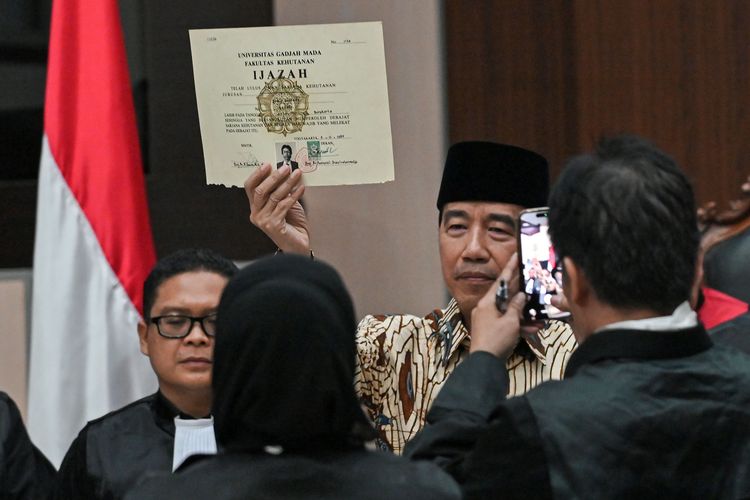
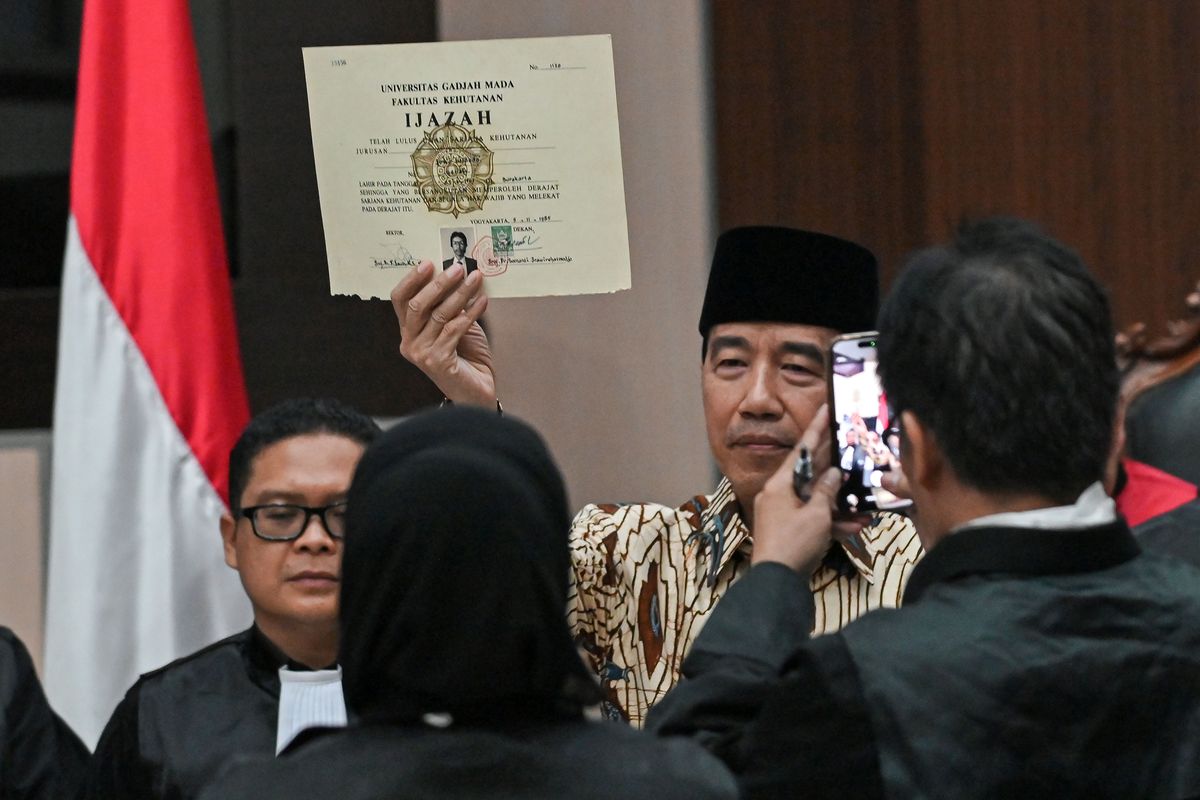
There is a father whose diploma authenticity has come under scrutiny. The father filed a report against them, which ultimately led to the plaintiffs being seated in the defendant's chair.
Both cases target diplomas, but they follow different paths and yield different outcomes.
If, in the future, we question a document used for a candidate's nomination, what evidence should we seek and which doors should we knock on?
On Friday (November 13, 2026), the National Police announced that Joko Widodo's diploma does not need to be re-evaluated.
The day prior, Gibran Rakabuming Raka submitted his resignation letter.
According to the People's Consultative Assembly (MPR), the letter did not specify any particular reasons. A plenary session of the House of Representatives (DPR) that was supposed to discuss the proposal for a Statement of Opinion was canceled.
Both matters converge on the issue of evidence, but each demands different answers (CNN Indonesia, November 13, 2026, along with the MPR RI and ANTARA, November 12, 2026).
Refly Harun was involved in both cases. He assisted the petitioners in the Gibran case at the Constitutional Court.
He also served as Roy Suryo's legal counsel when Roy's camp requested a re-evaluation of Jokowi's diploma.
The lawyers are the same. The questions differ. What is the government's basis for equating Gibran's education to that of a high school diploma? And what evidence can refute the conclusion that Jokowi's diploma is authentic? (detikcom, October 6, 2026, and CNN Indonesia, November 13, 2026).
In Decision No. 01/PHPU.PRES-XXIV/2026, the Constitutional Court declared that the application from Denny Indrayana and his associates was inadmissible.
The dispute over the results of the 2024 Presidential Election was deemed unsuitable for disqualifying a vice president who has already been inaugurated.
In its reasoning, the Constitutional Court stated that the proceedings did not find convincing evidence regarding foreign graduation documents that could serve as a basis for Gibran's educational equivalency.
Graduation from high school or its equivalent is a requirement for candidacy. With that, the case is closed.
This reasoning leaves questions about the documents used to satisfy that requirement (Constitutional Court, October 6, 2026).
Legal consequences arose from another case. On October 30, the Supreme Court granted the cassation of Muhammad Subhan Palal in Decision No. 742 K/TUN/2026.
The Ministry of Education and Culture then revoked Certificate No. 9149/D.D1/KS/2019 through Decision No. 206 Year 2026.
On November 12, the lawsuit, backed by Denny at the Administrative Court, was declared null as the subject had been annulled and revoked.
A day prior, 120 members of the DPR from eight factions proposed a Statement of Opinion.
The Supreme Court's ruling pertains to the validity of the equivalency certificate. The issue of position followed its own path. Gibran resigned before that proposal was discussed in plenary (Supreme Court, October 30, 2026, DPR RI, November 11, 2026, and Kemenko Kumham Imipas detikcom, and MPR RI, November 12, 2026).
On the father's side, UGM records that Jokowi graduated on November 5, 1985.
The Criminal Investigation Unit examined the original diploma against three comparative diplomas and concluded it was authentic.
After Jokowi reported the allegations regarding his diploma, Roy Suryo and Dr. Tifauzia Tyassuma became defendants. Their errors will still need to be proven in court.
The police stated that re-evaluation is unnecessary, while Roy’s team requested the judges to reassess the document.
Time also differentiates the consequences of both cases. Gibran was still in office when his equivalency certificate was revoked.
The controversy raised by Roy and Tifa emerged after Jokowi completed his term (UGM, April 15, 2025, detikcom, May 22, 2025, and Kompas.com, November 5, 2026, and CNN Indonesia, November 13, 2026).
In Germany, Minister of Defense Karl-Theodor zu Guttenberg resigned after his doctoral degree was revoked due to plagiarism. “I am a human who can make mistakes,” he stated.
In Australia, the High Court disqualified five out of seven examined members of parliament for holding foreign citizenship when they were nominated.
One of them was Deputy Prime Minister Barnaby Joyce.
In Germany, the revocation of a degree was followed by a decision to resign. In Australia, the court's decision directly determined eligibility for parliamentary seats (ABC News, March 1, 2011, and High Court of Australia, October 27, 2017).
However, the procedure may seem orderly when political interests precede the examination table.
In the ethical matter concerning the age requirement for candidacy, the Honorary Council of the Constitutional Court found severe violations and dismissed Anwar Usman from his position as Chief Justice (Constitutional Court, November 7, 2023).
“The rule of law protects citizens from the will of the powerful,” said Ursula von der Leyen, President of the European Commission (European Commission, September 30, 2020).
At the verification table, that protection is tested at a simple moment.
Will an examiner dare to write “not qualified” when influential individuals are already waiting for their signature?
And if they do, who will ensure that their records remain in the files?
Oversight must begin before the candidates are appointed.
The ministry's inspectorate needs to trace the basis for issuing equivalency certificates back to the graduation documents and confirmation from the issuing institution.
The General Election Commission (KPU) needs to document who examined, what was confirmed, and how objections were addressed.
Examiners with conflicts of interest should withdraw from the examination.
The Election Supervisory Agency (Bawaslu) needs to monitor verification and trace the follow-up to their findings.
A summary of the verification should be disclosed while protecting personal data so that election monitors, the media, and citizens have time to raise objections and receive written responses before the candidates are affirmed (PP No. 60 of 2008, PKPU No. 19 of 2023, and Perbawaslu No. 14 of 2023).
For citizens, first determine what needs to be examined.
If the files are not open, request copies through the Public Information Disclosure Officer (PPID). If rejected, raise an objection and, if necessary, pursue a dispute in the Information Commission like Bonatua Silalahi.
If the verification procedures are suspected of being violated, bring initial evidence to Bawaslu before the deadline.
To contest an equivalency certificate, note the number, issuer, and basis for issuance, then check the legal standing and the appeal deadline at the Administrative Court.
If the diploma's authenticity is in doubt, point out specific irregularities and request an examination of original documents against verifiable comparisons.
Keep written responses and monitor follow-up actions (Central Information Commission, January 14, 2026, Bawaslu, Hukumonline, October 31, 2026, and CNN Indonesia, November 13, 2026).
The case concerning the diplomas of father and child has led us to turn to a desk, long before the inauguration.
There, an officer could pick up the phone, contact the document issuer, and record their answer.
If citizens still raise objections, they should be given time to investigate.
In the upcoming inauguration room, everyone will hear the oath. At that desk, far earlier, the state is put to the test by a quiet voice, “May I see the original?”