
Prabowo Teases Yandri Susanto's Push to Become Minister of Village Development, Initially Intended for Bahlil
-
News
-
9 minutes ago
This article was translated by AI. Read the original article on Kompas.com. See Original
THERE are weeks when politics moves faster than our ability to digest it. The beginning of November is one of those times.
In just ten days, Listyo Sigit Prabowo, the former Chief of Police who recently took office as Chief of Staff to the President, was detained by the Criminal Investigation Agency as a suspect in an illegal wiretapping case against the President.
Then, on Monday, November 9, three cadres from the Indonesian Solidarity Party in the cabinet—Raja Juli Antoni, Giring Ganesha, and Isyana Bagoes Oka—simultaneously departed from the party.
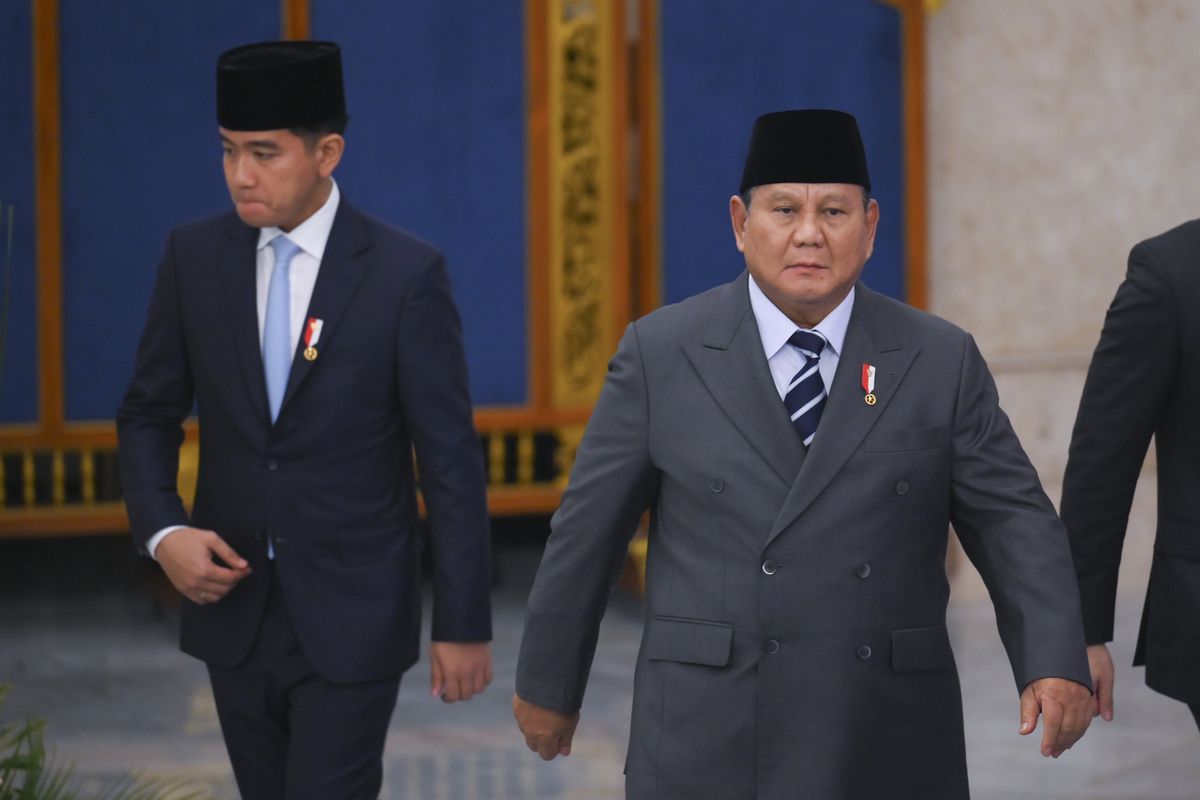
Three days later, Gibran Rakabuming Raka personally submitted his resignation letter as Vice President to the People's Consultative Assembly.
At first glance, this sequence of events appears to represent a nearly perfect victory. One by one, the connections in Joko Widodo’s government are being severed, while President Prabowo Subianto remains untouched.
He seems to be at the peak of his power, unaffected by the waves of demands that are pulling his deputy down.
However, it is here that the questions begin. Is Prabowo really that strong? If he is, what kind of strength is he building, and what is the cost he must pay?
None of this happened overnight. The pattern has been apparent since the reshuffle in September 2025, when Budi Arie Setiadi, the chairman of the Projo volunteers, was removed along with Sri Mulyani and Dito Ariotedjo.
The October 2026 reshuffle solidified this; Pratikno, one of Jokowi's closest aides, was removed from the Coordinating Minister for Human Development and Culture position, while Listyo Sigit was no longer leading the National Police.
The palace has repeatedly denied that this overhaul aimed to remove the previous administration's officials. While this denial deserves to be noted, the results are hard to overlook.
Two years ago, Jokowi's popularity helped carry Prabowo to the palace, and Gibran's candidacy was the most tangible result of their cooperation. Now, that bond is being unraveled piece by piece.
Nonetheless, we must be cautious not to interpret all this as a scenario orchestrated from a single table.
The wiretapping case is still in the legal process, and investigators have yet to reveal its motives. The Supreme Court's ruling regarding Gibran's educational document is also not a palace decision.
It is more likely that Prabowo did not create every event but skillfully capitalized on them. He knows when to wait, when to let processes unfold, and when to make decisions.
In politics, the ability to read the moment often matters more than the ability to plan.
PSI politicians seem to have read the same situation. Raja Juli claims he wants to work full-time supporting the President as the Minister of Forestry.
This reasoning is understandable, but the timing is hard to detach from context. As sentiments toward Jokowi worsen, distancing oneself from the party led by his son is the safest move.
Then, could Prabowo also be implicated in the demands for Gibran's impeachment as Vice President? The answer, at least for now, is almost certainly no.
Our constitution does not provide a route for the impeachment of a president merely due to unpopularity. Article 7A of the 1945 Constitution demands specific legal reasons: treason against the state, corruption, bribery, other serious crimes, disgraceful acts, or failure to meet the requirements to remain president.
Here is where the fates of Gibran and Prabowo diverge. Gibran has a clear legal loophole. The Supreme Court's ruling regarding his equality certificate provides a basis for the phrase "no longer meet the requirements," and the DPR has begun to roll out the right to express opinions.
Prabowo does not have a similar loophole. Public dissatisfaction, no matter how deep, is not a constitutional reason.
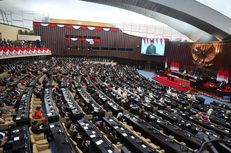
The pathway is layered and steep. According to Article 7B, any DPR proposal must be approved by two-thirds of the members present in a plenary session attended by at least two-thirds of the members.
The Constitutional Court would then test this before the MPR decides with a quorum of three-quarters and a two-thirds majority of the present members.
With the coalition holding a substantial majority in parliament, that door will only open if the coalition fractures, and so far, there are no signs of that. On paper, Prabowo is indeed untouchable.
However, being untouchable on paper does not equate to being strong in the public's eye. The dissatisfaction is real, and its slope is steep.
Poltracking records that satisfaction with the government dropped from 78.1 percent in October 2025 to 55.1 percent in August 2026.
SMRC detects an even steeper decline, from 81.2 percent in November 2025 to 51.1 percent in July 2026. While a majority still expresses satisfaction, the wind direction has shifted.
Over the last two years, public disappointment has almost always found another target. Whenever a policy stalls, the finger points easily toward "Jokowi's people,” toward dual loyalties within the cabinet, or what is often referred to as "the Solo Gang."
Jokowi's shadows operated like a shield, absorbing some of the anger before it reached the President's desk.
This is the rarely calculated price of consolidation. Once Jokowi’s ties are severed, that point of blame disappears as well.
In the future, when the prices of basic necessities rise, the rupiah falters, or flagship programs stumble in the field, the public’s gaze will shift directly to the President himself.
Centralized power in a single figure is indeed difficult to undermine from the inside. However, it is easily eroded from the outside: by the streets, by the market, and by elites adept at reading the wind direction.
Those who today gravitate toward this new center of gravity move with a simple logic. The same logic that could later drive them away again.
The first test of that strength is now at hand. Article 8, paragraph (2) of the 1945 Constitution stipulates that if the Vice President's position is vacant, the MPR must convene within 60 days to elect one of the two candidates proposed by the President.
The two names proposed by Prabowo will answer this article’s questions more honestly than any analysis.
If he chooses someone of capacity who can balance the coalition, we are witnessing a confident strength.
If the choice solely falls on a loyalist, we are observing a nervous power seeking to ensure that no other eyes and ears reside within the Palace.
Back in April, before his team, Prabowo asserted that this nation chose to govern democratically, placing sovereignty in the hands of the people.
That statement now faces its test. Democracy does not only function through layered impeachment mechanisms.
It also operates through daily public assessment in markets, on social media, and at family dinner tables.
Prabowo is almost certainly not going to be impeached. But, it is precisely when there is no one left to blame that he will be fully judged on his actions.
That is the rarely calculated price of consolidation: concentrated power always comes with an indivisible responsibility.