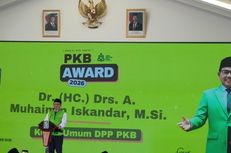
Cak Imin Encourages Pesantren-Based Vocational Schools to Elevate Standards to International Levels
-
News
-
54 minutes ago
This article was translated by AI. Read the original article on Kompas.com. See Original

EVERY 10th of November, our nation, Indonesia, commemorates Heroes' Day to honor the bravery and sacrifices of those who fought for independence.
The Battle of Surabaya on November 10, 1945, is not just a historical event but a testament that independence, sovereignty, and the honor of the nation must be fought for collectively.
This event teaches us that heroism is not only about the courage to face an enemy but also about the willingness to place national interests above personal ones.
In 2026, Heroes' Day carries the theme: “My Hero, My Inspiration, Walking Together, Continuing the Struggle.”
This theme reminds us that heroism should not be a mere ceremony or an homage to the past. Its values must be manifested through tangible actions in addressing national issues.
The question is, how does the current generation continue the struggle of the heroes amidst increasingly complex strategic environmental changes?
In the past, the Indonesian nation faced colonialism and armed threats, but today's challenges are more diverse.
Geopolitical competition, global economic uncertainty, technological advancement, climate crises, food and energy resilience, corruption, and social inequality are interlinked.
Threats to the state do not always take the form of armed conflict. Economic dependence, environmental degradation, weak institutions, and declining public trust can also undermine national resilience.
Why do I emphasize this? I recall the statement of the President of the Republic of Indonesia, Prabowo Subianto, who reminded us that Indonesia's journey towards becoming an advanced nation is not an easy road.
Many countries share similar aspirations, but not all succeed in realizing them. This commemoration should not merely serve as a reminder of the magnitude of the challenges but also as material for reflection on our readiness to face them.
These challenges are undoubtedly complex. However, we must not stop at worry or merely recognize various limitations.
Indeed, challenges should be a momentum for self-improvement, strengthening human resource capacity, developing knowledge, and encouraging innovation in various sectors.
The progress of a nation cannot rely solely on the wealth of natural resources or the magnitude of development ambitions, but is also determined by the ability of its people and institutions to learn, adapt, and innovate.
Indonesia not only needs to aspire to become an advanced nation but must also build the capacity to genuinely realize that ambition.
This view aligns with the concept of human security in the 1994 United Nations Development Programme (UNDP) report.
Security is not only about protecting the nation’s territory but also about safeguarding individuals from poverty, hunger, illness, job uncertainty, and environmental degradation.
Thus, national security and the welfare of the people are mutually reinforcing.
These challenges are evident in various events throughout October to early November 2026.
Student demonstrations on October 20 and 28 in several cities, for example, raised issues regarding living costs, handling forest and land fires, national spending priorities, anti-corruption efforts, and protection of civil liberties.
Such aspirations need to be objectively understood as a reminder that development requires communication, participation, and accountability.
Peaceful expression of opinions is a fundamental part of democracy that must be respected and addressed.
The forest and land fires in Sumatra and Kalimantan also illustrate that environmental issues are not merely ecological problems. Their impacts touch on health, economic activities, biodiversity, and community livelihoods.
As of October 24, 2026, the National Disaster Mitigation Agency (BNPB) recorded approximately 25,409 hectares of land burned, with around 17,942 hectares still unextinguished according to preliminary monitoring.