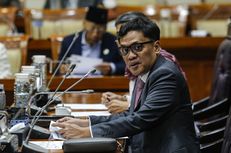
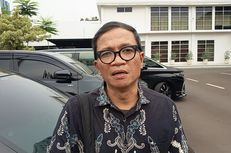
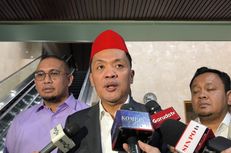
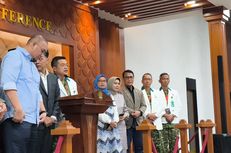
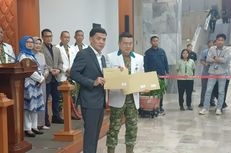
The petitioners in Case Number 399/PUU-XXIV/2026 include Sabiq Muhammad as Petitioner I, who is a village head, Maksum Syam, Chairman of the Sajogyo Inti Utama Foundation (Sajogyo Institute) as Petitioner II.
Additionally, Muhammad Tauhid Aminulloh, Chairman of the Edukarya Negeri Lestari Cooperative, acts as Petitioner III.
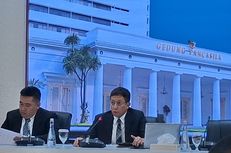
Agil Oktaryal, the petitioners' attorney, presented nine reasons for the petition.
The first is the ignored authority of members in determining the direction of the cooperative.
The second points out that the imposition of
KDKMP funding eliminates residents' roles in development decisions and disregards cooperative democracy principles, thereby violating their rights to collectively advocate for their interests.
The third concern is that the KDKMP program cannot automatically be the basis for imposing financial burdens and village assets or for bypassing deliberation in determining cross-year funding policies.
"Village funds are a crucial instrument for financing development and governance at the village level, required sustainably to meet community needs, including basic services and infrastructure development," he stated.
The fourth point argues that the Village Law does not explicitly guarantee the financial responsibility of task givers, allowing the burden of financing central programs to be transferred to villages.
Petitioners assert that if the central government assigns village heads to implement or support KDKMP, it must first ensure the availability of adequate financing for such tasks.
"The intended financing must be clearly formulated as a separate funding component associated with the program and assignments, so it should not be misconstrued as sourced from existing village funds intended to finance development and community empowerment needs," he clarified.
The fifth point underscores the neglected principles of democracy and cooperative independence.
The petitioners argue that the establishment of KDKMP disregards democratic principles and independence, with its implementation being determined more by the central government than by the needs and decisions of the members.
The sixth point notes that the use of village funds for KDKMP should not compromise the fulfillment of basic rights of the community without adequate assessment of needs and benefits.
The seventh point posits that the KDKMP program lacks a legal basis, leading to adverse impacts on governance.
The eighth point highlights that external control over decisions, without clear accountability and disregard for cooperative independence principles, contradicts Article 28D paragraph (1) of the 1945 Constitution of the Republic of Indonesia.
The ninth point stresses the urgency of implementing Constitutional Court Decision Number 28/PUU-XI/2013 to establish a new Cooperative Law.
The Petitioners Seek Court Approval
In their petition, the petitioners request the Court to fully grant their application and declare the contested provisions contrary to the 1945 Constitution of the Republic of Indonesia and lacking binding legal force, conditional on not being interpreted as requested.
The petitioners ask for the Court to assert that the central government’s assignments to villages must be accompanied by adequate funding from the task giver's budget and must not be shifted through reductions in Village Funds or guarantees of village assets.
They also request that government priority alignments should not serve as a basis for mandating the use of Village Funds for the formation, capitalization, operational costs, or payment obligations of cooperatives that are part of government programs.
Additionally, the petitioners seek that the results of Village Deliberations and Cooperative Member Meetings cannot be disregarded by interventions or decisions from external parties.
The petitioners further implore the government to halt the implementation model of the KDKMP program that forces the establishment of cooperatives and burdens risks onto villages until a new law aligning with cooperative constitutional principles is established.