
Observers: It Would Be More Elegant if Listyo Sigit Attended the Ethics Hearing
-
News
-
4 minutes ago
This article was translated by AI. Read the original article on Kompas.com. See Original
TRIAL of the alleged defamation and slander regarding accusations of Joko Widodo's fake diploma merits attention that goes beyond legal issues.
There is a battle of perceptions taking place outside the courtroom. Someone who is consistently cornered may garner sympathy, while the attacking party faces questions about the appropriateness of their actions.
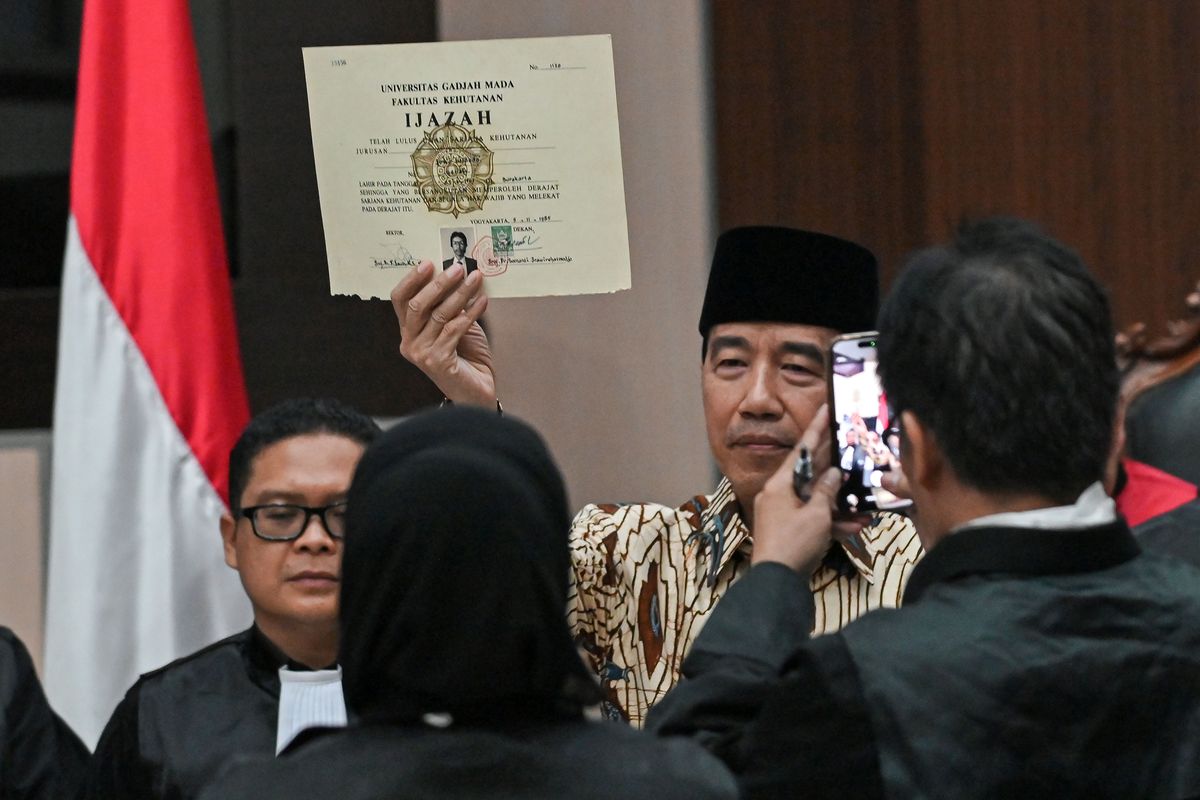
On Thursday (November 5, 2026), Jokowi appeared as a witness in a trial at the East Jakarta District Court.
He displayed his diplomas from elementary school through to higher education. After obtaining permission from the panel of judges, he also showed the documents to court visitors.
However, the presentation of these documents did not immediately resolve the controversy.
Roy Suryo remained skeptical about their authenticity, dismissing Jokowi's testimony and requesting re-examination of the evidence at a forensic laboratory other than that of the National Police.
This is despite the fact that the diploma had already been tested by the National Police's forensic lab.
This incident recalls the assumption that the issue would be resolved once Jokowi presented his diploma.
In reality, showing documents in court does not automatically lead the accusers to accept them.
Stigmas and subjective perceptions will always linger when issues are tied to emotion and not well rationalized.
“Just because it’s in court doesn’t mean it’s resolved,” Jokowi said after the trial.
He left the settlement of the matter to the panel of judges and sought justice regarding the accusations against him (Jokowi in various news sources, 2026).
This attitude reflects a broader issue in our political debate: is there a political agenda behind this diploma issue?
Questions about a public figure's documents can be raised. Evidence testing has its place in court proceedings.
However, public debate loses direction when every answer merely gives rise to new excuses to uphold initial conclusions.
The diploma controversy has the potential to be sustained due to its political utility.
As long as the accusations persist, Jokowi’s name remains associated with doubts about his honesty and suitability.
The impact can extend to his family and the political power he is associated with.
This possibility represents an interpretation of the political function of an issue.
To assert that there are movers, funding, or specific coordination behind it still requires evidence.
Nevertheless, the public can assess how a particular issue is continuously used to erode trust in an individual.
It is here that a possibility arises that contradicts the aim of the attack.
Repeated allegations can lead to saturation. Those who initially followed the controversy with curiosity may begin to wonder why the issue fails to reach a resolution.
Jokowi’s patience could be a source of empathy as well as public sympathy. This patience does not necessarily mean the absence of anger.
In his remarks after the trial, he expressed disappointment with a trembling tone, revealing the sorrow that emerged alongside the accusations made by the accuser, which also touched on the honor of his parents.
For some, such an attitude may be easier to understand than a lengthy legal technical debate.
They see someone humbly coming to answer a court summons, providing testimony, and facing accusations through the available legal procedures.
The potential for an increase in public sympathy is open, including among long-time supporters who have recently started to distance themselves.
Disagreement with a former president's policies during his tenure does not erase empathy for him as a human being.
If the court eventually finds Roy Suryo guilty, especially if the verdict has permanent legal force, Jokowi potentially stands to gain additional political capital.
This ruling could strengthen the perception that he has taken the necessary steps to protect his reputation.
However, the assessment of his policies and the legacy of his administration remains a separate matter.
Yet, in shaping public perception, the restoration of one’s reputation can have significant consequences in politics.
Criticism of power should stem from the interests of the people and be backed by evidence.
The same standards apply when assessing former leaders and those who criticize them.
Therefore, those who hope the diploma controversy will continually weaken Jokowi need to consider the possibility of the opposite.
Prolonged attacks could redirect public attention to his patience.
Empathy and sympathy that grow from there could become an additional political strength that his opponents initially sought to undermine.