

General Election Law Challenged Again at MK, Applicant Requests Minimum Master's Degree for DPR Members, Bachelor's for DPRD
-
News
-
Just now
This article was translated by AI. Read the original article on Kompas.com. See Original
JAKARTA, KOMPAS.com - The government has proposed that asset confiscation in the draft Asset Confiscation Law (RUU Perampasan Aset) can be carried out without a criminal conviction.
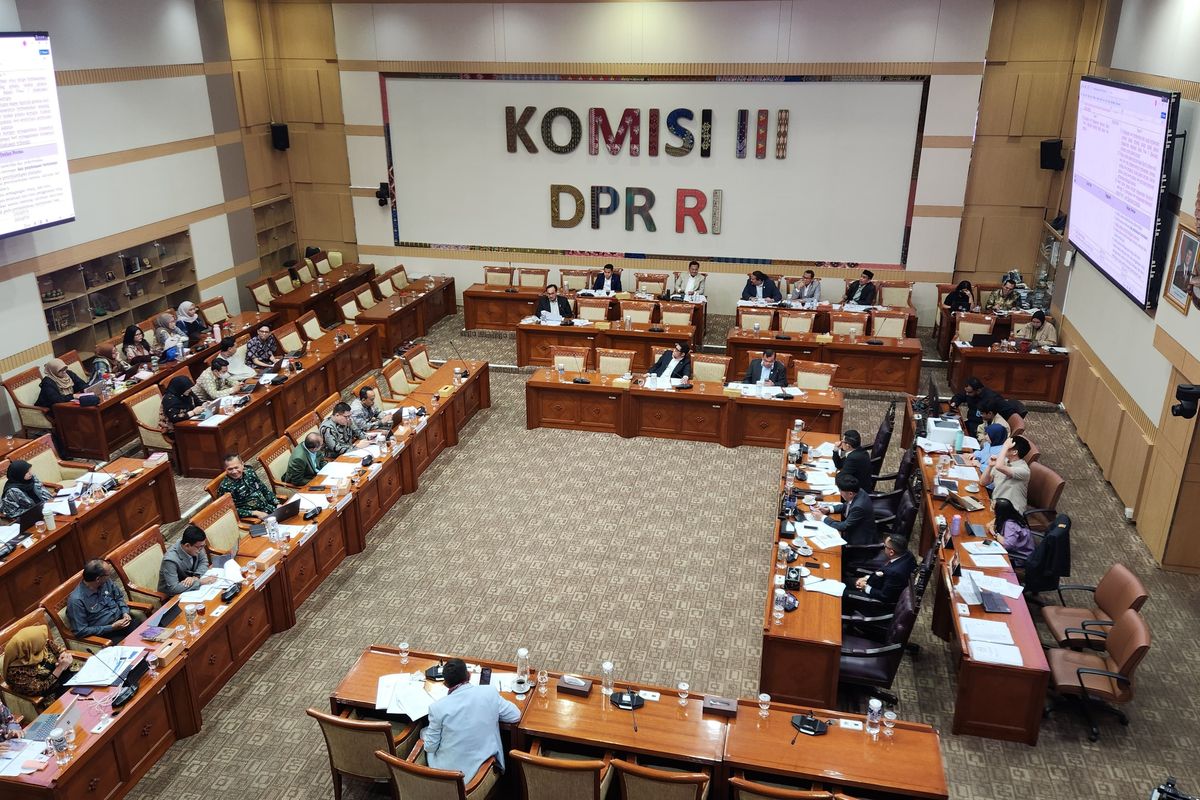
This was outlined in the government's problem inventory list (DIM), read by Dhahana Putra, the Director General of Legislation at the Ministry of Law and Human Rights (Kemenkum) during a working meeting discussing the Asset Confiscation Bill related to Corruption and Other Criminal Offenses with Commission III of the DPR on Thursday (5/11/2026).
"There is a change in the definition; asset confiscation of criminal offenses, henceforth referred to as asset confiscation, is a law enforcement process conducted by the state to take over the control and/or ownership of criminal assets based on a court decision that has permanent legal force," Dhahana stated during the working meeting, as quoted from a livestream on TVR Parliament on Thursday.
"Whether based on a criminal conviction against the perpetrator of a criminal offense or without a criminal conviction against the perpetrator of a criminal offense," he continued.
He explained that this definition of asset confiscation is a consequence of Article 3 of the draft Asset Confiscation Bill.
This article includes Non-Conviction Based Forfeiture or confiscation of assets without a criminal conviction.
"So this is one of the consequences if we look at the scope of Article 3 in this law," Dhahana added.
After hearing the DIM from the government, several members of Commission III highlighted the definition of asset confiscation that could occur without a criminal conviction.
Commission III member Soedeson Tandra explained that everyone agreed that asset confiscation must go through the courts.
"Even though it's Non-Conviction Based, the confiscation must be through the court. Thus, I agree with what is in the draft from the DPR. We are no longer discussing whether this is Conviction Based or Non-Conviction Based, because both must go through the court," Soedeson stated.
He emphasized that asset confiscation can only be carried out once there is a judicial ruling that has permanent legal force.
"Even if it's Non-Conviction Based, the state cannot just take it away," Soedeson noted.
"So both types, whether Conviction Based or Non-Conviction Based, must have permanent legal force," he reiterated.
Meanwhile, Commission III member Hinca Panjaitan argued that the definition of asset confiscation without a criminal conviction has far-reaching consequences.
 Illustration of the Asset Confiscation Bill. The contents of the Asset Confiscation Bill: 16 main regulations, types of assets to be confiscated, and methods of confiscation.
A similar viewpoint was echoed by Commission III member Mangihut Sinaga, who pointed out a contradiction between the title of the bill and the definition of asset confiscation that mentions it can occur without a criminal conviction.
"Because we are discussing criminal matters, if we are discussing criminal matters, it means it has already gone through a process. Meanwhile, a (non-conviction) ruling has not yet become final and not processed; does this not lead to multiple interpretations or become a debate in the future?" Mangihut questioned.
Observing the ongoing debate, Commission III Chairman Habiburokhman remarked that the definition of asset confiscation is a crucial aspect of the bill.
"We must be careful because even though this is in the definition, it is the most important definition in this law," Habiburokhman stressed.
Therefore, the working committee of the Asset Confiscation Bill decided to postpone the discussion on the DIM related to the definition of asset confiscation.