

DPR Members Demand Polri to Uncover Key Actors in Scam Syndicate in the Philippines Involving 141 Indonesians
-
News
-
58 minutes ago
This article was translated by AI. Read the original article on Kompas.com. See Original
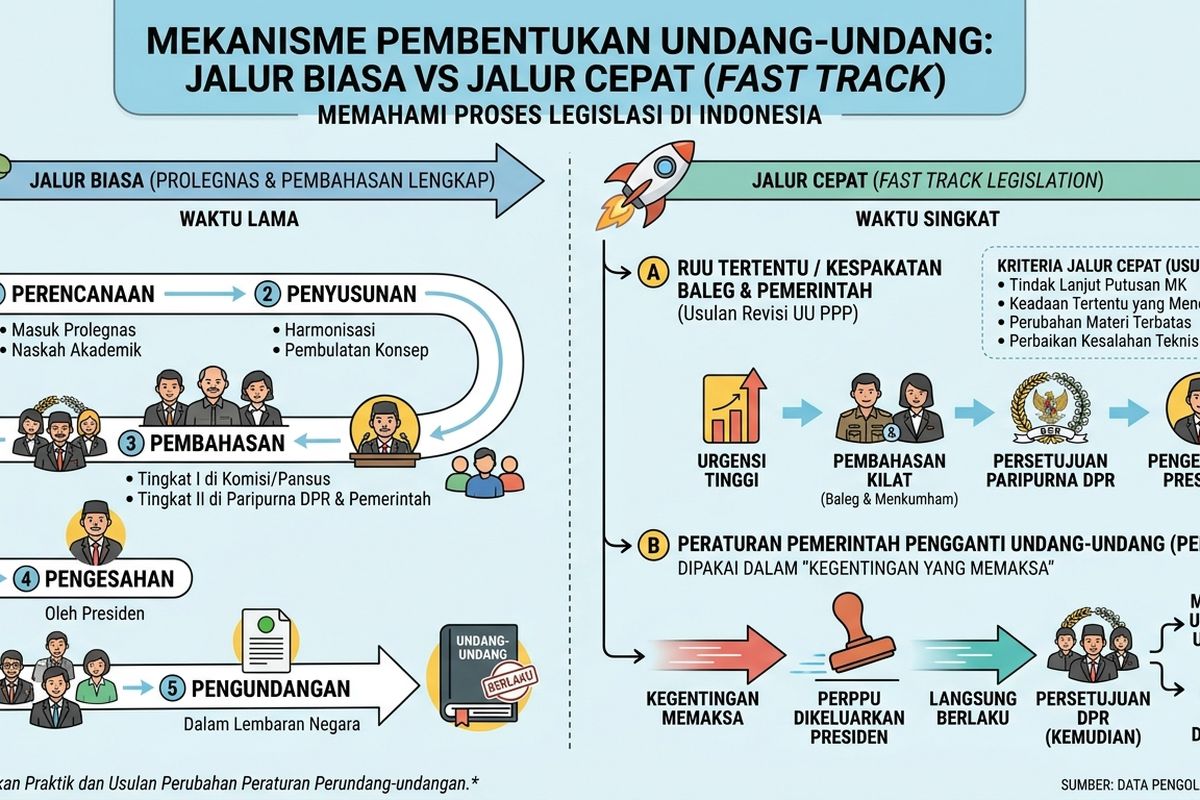
JAKARTA, KOMPAS.com - The formation of laws (UU) is now proposed to have a fast track mechanism. This mechanism will be regulated in the Draft Law (RUU) on the Formation of Laws (RUU PUU).
Parliament argues that this fast track is necessary given that laws are an important legal instrument.
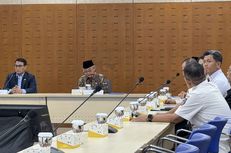
“Here, the formation of laws through a fast procedure is part of the legislative process. We divide it into two: following the standard procedure or the fast procedure,” said the Head of the Expertise Agency of the Indonesian House of Representatives (DPR RI), Bayu Dwi Anggono, during a meeting of the Legislative Body (Baleg) of the DPR RI at the DPR building in Jakarta on Tuesday (3/11/2026).
Lucius Karus, a researcher at the Indonesian Parliamentary Community Concern Forum (Formappi), stated that the existing mechanism actually accommodates fast-track discussions for certain conditions, one of which pertains to international agreements.
According to Lucius, the public has not raised issues with draft laws that are known from the start to be part of the types of draft laws mentioned.
“Such as types of draft laws for ratifications, follow-ups on Constitutional Court decisions, and others,” he explained.
He understands that the mechanism has not been rigidly and clearly defined.
However, the limited nature of changes or the ratification of international agreements can be understood as requiring expedited discussion. This is because the substance of the draft law already exists.
“The DPR is only following standard procedures before ratification,” Lucius told Kompas.com on Thursday (5/11/2026).
At least six conditions have been proposed for using the fast track. First, to ratify certain international agreements that urgently need to be implemented, including ratifications.
Second, to follow up on Constitutional Court decisions that include deadlines for changing or replacing laws. Third, to make limited changes to existing laws.
“If the changes are minor, then a quick approach is possible,” Bayu added.
Fourth, to correct technical writing errors; fifth, to amend the attachments of laws; and sixth, certain conditions that ensure urgency in forming laws through fast procedures.
Bayu explained that using a fast track in these conditions requires joint approval from the DPR's legislative apparatus and the minister or agency head overseeing government affairs in law formation.
“So, point f is separate from a to e; it certainly requires legislative body approval regarding this fast-track legislation,” Bayu stated.
Regarding these conditions, Lucius expressed concern that the fast-track path could be used as a “shield” under the guise of urgency.
He highlighted the sixth condition, which states “certain situations that ensure urgency for rapid law formation.” Urgency, he notes, could be interpreted differently if no further explanation is provided.
“If this certain situation is not detailed, it will open the door for the DPR to justify quick processes based on their needs or interests,” Lucius remarked.
Moreover, Lucius pointed out that the law-making mechanism has often been criticized for failing to ensure meaningful public participation.
Through the fast-track proposal, the People's Representatives seem to confirm that the law-making process has been far from perfect.
“This fast-track proposal seems to validate a flawed process that the DPR has practiced all along. It would be a serious danger if the Expertise Agency is used as a stamp by the DPR regarding deviant practices in discussing draft laws,” Lucius asserted.
Previously, DPR RI Legislative Body member Reni Astuti also called for transparency regarding law discussions, following the proposal for a fast track.
She believes that speed should not mean discussing matters in a closed environment, abandoning the principle of transparency.
“We should not disregard the principles of openness and meaningful participation in this process,” said Reni in the same meeting.
Reni acknowledged that the fast track mechanism in law formation is an innovation in legislation.
However, she reminded that this mechanism should not compromise the quality of legislation and input from the community.
“We want the legislative products to be not just procedural, but also substantive, addressing and resolving real problems in society,” Reni clarified.
Meanwhile, Bayu emphasized that the fast-track mechanism does not mean eliminating stages in the law formation process.
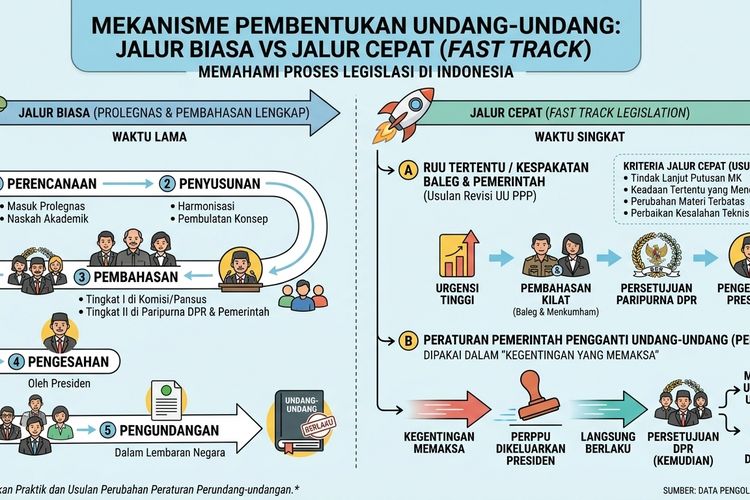
The formation of laws, whether through standard or fast procedures, must go through all stages. These stages include planning, drafting, discussing, ratifying, and enacting.
The difference between the two procedures lies only in the time frame for completion. In fast-track procedures, certain stages have a shorter time limit compared to standard procedures.
“In fast-track legislation, the maximum is one session period and cannot be extended. This differentiates it from standard procedures, which can span three session periods and may be extended; fast track is limited to one session period and cannot be extended,” Bayu explained.
The timeline for harmonizing RUU by Baleg and issuing presidential letters also differs.
Through the fast-track mechanism, the issuance of presidential letters and the formation of teams must be completed within a maximum of 30 days.
This timeline is twice as fast as the standard route, which can take up to 60 days.
Meanwhile, the provisions regarding the ratification of laws remain unchanged as they are established in the Constitution.
“So the only difference is the timeline at the initial drafting and discussion stages. The stages are all the same,” Bayu concluded.