
Prabowo Meets Dasco in a Private Meeting at the Palace, What Was Discussed?
-
News
-
1 minute ago
This article was translated by AI. Read the original article on Kompas.com. See Original

JAKARTA, KOMPAS.com - Floods and landslides have seemingly become an annual agenda. Observers of regional autonomy argue that disaster mitigation has yet to become a priority.
“Disaster management tends to receive substantial attention only after incidents have occurred, while pre-disaster activities, especially mitigation and risk reduction, often lack prioritization,” said Djohermansyah Djohan, Professor at the Institute of Domestic Administration (IPDN), to Kompas.com on Tuesday (3/11/2026).
According to data from the National Disaster Management Agency (BNPB), flooding has returned to various regions at the start of this rainy season.
BNPB reported four flood events in Deli Serdang Regency, North Sumatra; Lumajang and Malang Regencies, East Java; and Pidie Jaya Regency, Aceh as of November 2, 2026.
Last year, floods were the most prevalent disaster, occurring 2,009 times out of a total of 4,727 disasters.
Such hydrometeorological disasters should be preventable.
Djohermansyah Djohan stated that the recurring floods across various regions indicate that mitigation has not yet become a priority for local governments.
The recurrence of such cases should serve as an important lesson. Unfortunately, the government only appears to be active after the waters overflow, homes are submerged, infrastructure is damaged, and casualties occur.
“In reality, disaster mitigation is still often treated as a secondary concern. When a disaster strikes, everyone is mobilized. Once the situation returns to normal, vigilance slowly fades,” Djohermansyah explained.
He noted that this pattern demonstrates that disaster management continues to focus more on responding to disasters than on preventing risks.
In disaster management, mitigation is the most fundamental step to reduce potential losses, including human casualties and economic and social damage.
The former Director General of Regional Autonomy at the Ministry of Home Affairs revealed that local governments bear the primary responsibility for reducing disaster risks in their regions.
This role is explicitly outlined in Law No. 24 of 2007 concerning Disaster Management.
Article 8 of the law states that local governments are responsible for protecting communities from the impacts of disasters, reducing disaster risks, and integrating risk reduction efforts into development programs.
Additionally, local governments are mandated to allocate a disaster management budget through their regional budgets (APBD).
“Law No. 24 of 2007 concerning Disaster Management provides a foundation for the government to conduct comprehensive disaster management, from pre-disaster, emergency response, to post-disaster,” Djohermansyah elaborated.
The acting Governor of Riau from 2013 to 2014 stated that there are several reasons why local governments struggle to manage disasters effectively.
First, there are budget constraints. In preparing their regional budgets, spending on disaster management often prioritizes emergency response and recovery needs.
Meanwhile, mitigation, whose benefits are not always immediately visible, often competes unfavorably with other development programs considered more urgent or easier to showcase publicly.
Second, there is a weak utilization of technology. In fact, technological advancements enable governments to map disaster-prone areas, monitor river flow, detect floods early, and quickly disseminate warnings to communities.
“Without adequate technology and information systems support, local governments will always lag in recognizing signs of impending disasters,” Djohermansyah stated.
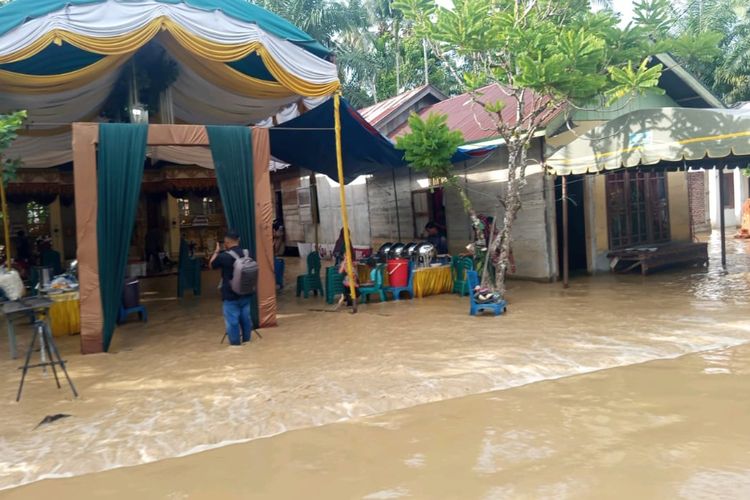 A total of 43 villages in 10 districts in Aceh Barat Regency, Aceh Province, are submerged in floods after heavy rainfall has affected the area for the past three days.
Third, there is poor management of natural resources and environmental control.
Forest exploitation, land clearing, damage to watersheds, and development that ignores environmental carrying capacity increase flood risks.
Ironically, oversight of destructive environmental activities often fails to be effective.
Fourth, there are spatial planning issues. Many settlements and buildings are located in disaster-prone areas, including riverbanks and water catchment zones.
“Local governments often hesitate to enforce spatial planning violations because they face economic, social, and even political interests. As a result, disaster risks continue to be perpetuated through negligence,” Djohermansyah remarked.
These various causes present the real challenge. He recognizes that disasters are indeed natural phenomena.
However, the extent of damage is a result of human failure in managing space and the environment.
Furthermore, he proposes that local governments should quickly change their responsive policy paradigm to a preventive one. The aim is to prevent similar disasters from recurring each year.
Moreover, the government still needs to allocate substantial budgets to rehabilitate and reconstruct the areas in Aceh and Sumatra affected by last year's flooding.
Post-disaster recovery should not merely restore conditions to what they were before the disaster. The infrastructure rebuilt must be more resilient to disaster threats.
“The principle of build back better should be applied, that is to rebuild with better quality and resilience,” he stated.
However, he emphasizes that the central government's support will be meaningless if local governments remain passive.
Therefore, local governments must take action. The Regional Disaster Management Agency (BPBD) and regional heads must lead efforts to build community preparedness.
Djohermansyah stressed that local leaders cannot simply sit behind desks, waiting for reports from the BPBD or instructions from the central government.
“They must actively go to the field, check river conditions, flood-prone areas, embankments, drainage systems, and at-risk settlements. Communities must also be continually reminded not to be complacent during long dry spells,” he asserted.
Thus far, BNPB has requested all local government officials—governors, regents, and mayors—to enhance readiness for facing potential hydrometeorological disasters through Circular Letter No. 4 of 2026.
This anticipation was reiterated by the Acting Head of the Data, Information, and Disaster Communication Center at BNPB, Berton Panjaitan, during a press conference on Tuesday (3/11/2026).
He urged local governments to map disaster-prone areas down to the village and district levels to anticipate the impacts of the rainy season.
“We hope that for these counties or cities, it can be further detailed so that threats or information about heavy rain occurrences can be localized to specific areas or counties or villages that are at risk,” Berton stated on Tuesday.