
Prabowo Meets Dasco in a Private Meeting at the Palace, What Was Discussed?
-
News
-
1 minute ago
This article was translated by AI. Read the original article on Kompas.com. See Original
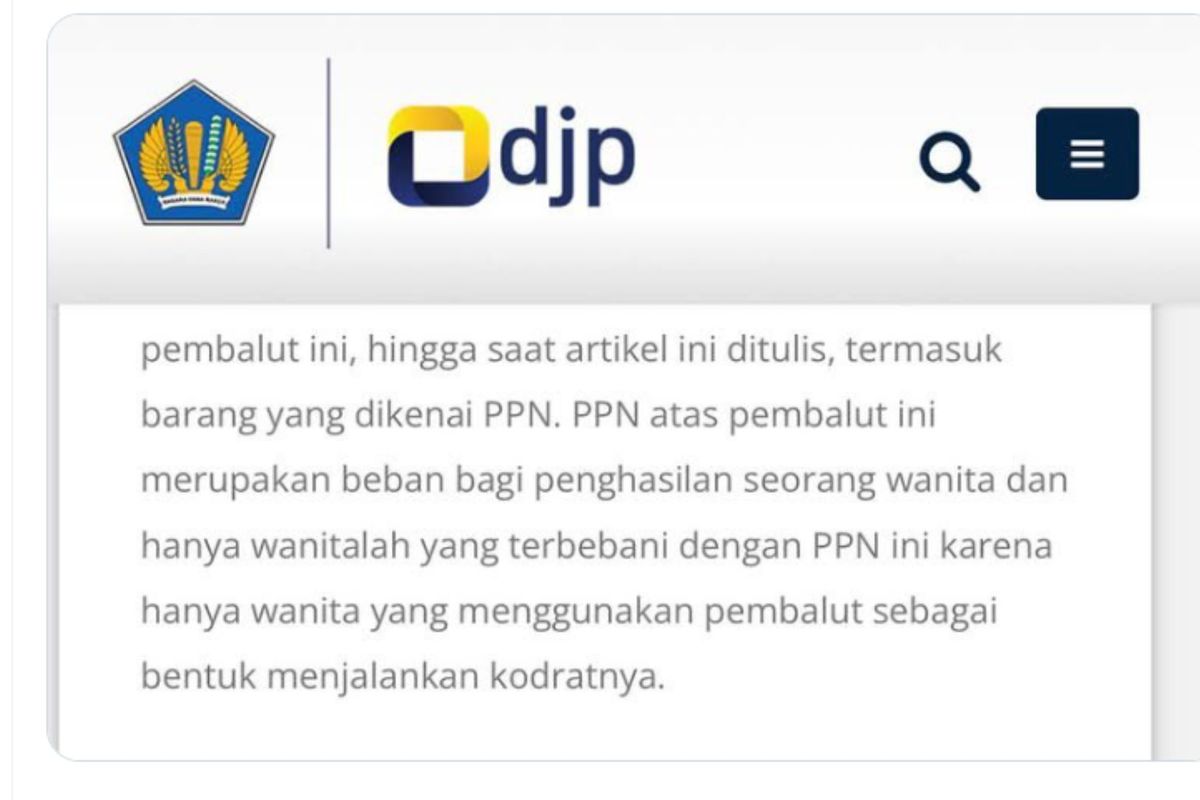
JAKARTA, KOMPAS.com - The implementation of an 11 percent Value Added Tax (VAT) on sanitary pads has sparked significant discussions throughout October 2026.
This percentage positions Indonesia as the country with the second-highest sanitary pad tax in ASEAN.
Only the Philippines, which levies a tax of 17 percent, ranks higher.
In contrast, neighboring Malaysia has exempted sanitary pads, categorizing them as one of the 5,443 tax-free items.
The taxation, which has been in effect since 1984, has drawn public criticism.
Many view sanitary pads as essential items, representing a necessary monthly expense for the majority of women.
Agustinus Subarsono, a Public Policy expert from Gadjah Mada University (UGM), stated that the taxation of feminine hygiene products warrants criticism.
He believes that the VAT on sanitary pads reflects an unfair political policy bias.
While he acknowledges the Directorate General of Taxation (DJP) of the Ministry of Finance's explanation that VAT is a general consumption tax, he argues that taxation must be applied fairly.
"In principle, taxes should be imposed fairly. The taxation on sanitary pads indicates an unfair political policy bias," Subarsono told Kompas.com on Tuesday (3/11/2026).
He explains that this injustice arises from the generally weak political position of women.
He acknowledges that women presently lack political bargaining power, leading to policies that do not promote gender equality.
This is further exemplified by the income tax (PPh) on the salaries and allowances of members of the Indonesian House of Representatives (DPR), which is covered by the government through the state budget.
Members of the DPR are perceived to have stronger bargaining power compared to the general populace.
"This is what I call unfair political policy bias. If the government seeks to raise taxes, why not require DPR members to pay taxes on part of their income? That would be wiser, fairer, and would gain political support from citizens," Subarsono explained.