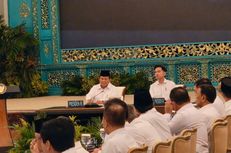
Prabowo Meets Dasco in a Private Meeting at the Palace, What Was Discussed?
-
News
-
1 minute ago
This article was translated by AI. Read the original article on Kompas.com. See Original

JAKARTA, KOMPAS.com - Martin Daniel Siyaranamual, an expert presented by the government in the constitutional court hearing regarding the Judicial Review of Law No. 3 of 2022 on the Capital City (IKN), stated that the development of IKN is beneficial for public health.
"When we talk about access to health, there are many factors involved, such as the reduction of stunting prevalence and the decrease in worm infestations, which are essential benefits to consider," Martin said during the proceedings of case number 299/PUU-XXIV/2026 at the Constitutional Court (MK) in Central Jakarta on Tuesday (3/11/2026).
In addition, he pointed out that improved access to mobility and education also constitutes benefits from the development of IKN.
He emphasized that the IKN project is not solely about economic development and the increase in Gross Regional Domestic Product (PDRB) in Kalimantan, but also brings advantages to the surrounding communities.
"It provides better job opportunities for the local population," the economic expert remarked.
However, Martin cautioned about the costs associated with IKN development.
This includes changes in land management and their impact on local communities, as well as the potential loss of biodiversity.
Therefore, he argued that the development of IKN should be considered very carefully.
The indigenous communities of the Balik Tribe in East Kalimantan, represented by Sibukdin, along with the Alliance of Indigenous Peoples of the Archipelago (AMAN), have filed a challenge to Article 21 of the IKN Law, which they believe does not provide adequate protection for indigenous peoples.
The applicants urged the government not only to consider the rights of indigenous peoples but also to listen to their opinions and obtain their consent regarding developments in indigenous territories.
The Balik indigenous community is also demanding recognition and legal certainty regarding their existence and customary rights in Sepaku, East Kalimantan.
The Balik Indigenous People of Sepaku and AMAN are testing Article 21 of the IKN Law. Both are questioning the phrase "considering" in that article.
They seek to replace the phrase "considering" with "obtaining collective consent from indigenous peoples," so that the article would read as follows:
Spatial planning, land affairs, and transfer of land rights, environmental management, disaster mitigation, as well as defense and security as referred to in Articles 15 to 20 are to be carried out after obtaining collective consent from indigenous peoples conducted freely and without coercion, based on true, complete, and understandable information, and providing protection for individual rights or communal rights of indigenous peoples and cultural values that reflect local wisdom.