

Bekasi Mayor Silent After 8-Hour Interrogation in Corruption Case Involving Joint Oil Operations
-
News
-
4 minutes ago
This article was translated by AI. Read the original article on Kompas.com. See Original
JAKARTA, KOMPAS.com - The Free Nutritious Food Program (MBG) is undergoing revamping through the launch of MBG 2.0.
The National Nutrition Agency (BGN) aims to enhance program governance, increase supervision, and ensure budget utilization is more transparent and efficient.
This overhaul comes amidst various challenges in the implementation of MBG, ranging from food safety supervision to accountability for budget usage.
To address these issues, BGN has prepared a number of changes, including the utilization of AI-based surveillance cameras, the implementation of a buffet system, and the development of digital platforms.
BGN Head Sudaryono stated that the MBG 2.0 transformation isn't just about continuing the food distribution program, but rather it represents an opportunity to evaluate and improve its implementation.
"This isn't merely about continuing the program; the MBG 2.0 transformation provides a chance to evaluate, improve, and strengthen the implementation of MBG," Sudaryono said at the MBG 2.0 Transformation event in Jakarta on Thursday (29/10/2026).
The MBG 2.0 concept is built on three main priorities: eradicating corruption, strengthening governance and oversight, and enhancing transparency and collaboration.
To realize these priorities, BGN is preparing a range of innovations, from technology-based kitchen monitoring to changes in food serving mechanisms and budget management.
So, how can these various innovations be effectively realized and not just remain plans?
One of the innovations prepared by BGN includes integrating surveillance cameras or CCTV in MBG kitchens with a centralized monitoring system.
Sudaryono has targeted connecting between 5,000 to 10,000 Nutritional Fulfillment Service Units (SPPG) to CCTV that can be monitored centrally by the end of 2026.
"We aim that by the end of this year, at least 5,000 to 10,000 kitchens out of 26,300 kitchens will be connected to the centralized CCTV, which will then be integrated or observed through artificial intelligence," Sudaryono remarked.
He noted that this system is necessary to ensure that food processing and serving in each kitchen meets standard operating procedures (SOP).
Sudaryono explained that many kitchens already have CCTV.
However, the recordings are not yet fully connected to the central BGN monitoring system.
"So, the kitchens already have local CCTV. But what we want to do is ensure that the CCTV footage is accessible to the Kitchen Committee and connected to the central system," he added.
Through AI technology, BGN hopes to detect violations of cleanliness standards and food processing.
For instance, monitoring if food ingredients are placed on the floor or staff not wearing gloves while cooking.
As of now, CCTV has been installed in 70 SPPG.
This number will gradually increase to cover 300 SPPG before being expanded to thousands of other kitchens.
Sudaryono hopes that this monitoring can reduce the incidence of food poisoning during MBG implementations.
He mentioned that the food safety incident rate or Incidents per Million Servings (IPMS) in Indonesia reached 5.3 from January to December 2025.
This figure dropped to 3.9 in January-July 2026 and further declined to 3.6 in August-October 2026.
"Pray for us, support us, give us input, criticism, suggestions, anything to help us reach the level of America, which is zero. We want zero; there should not be a single person (who experiences poisoning)," he emphasized.
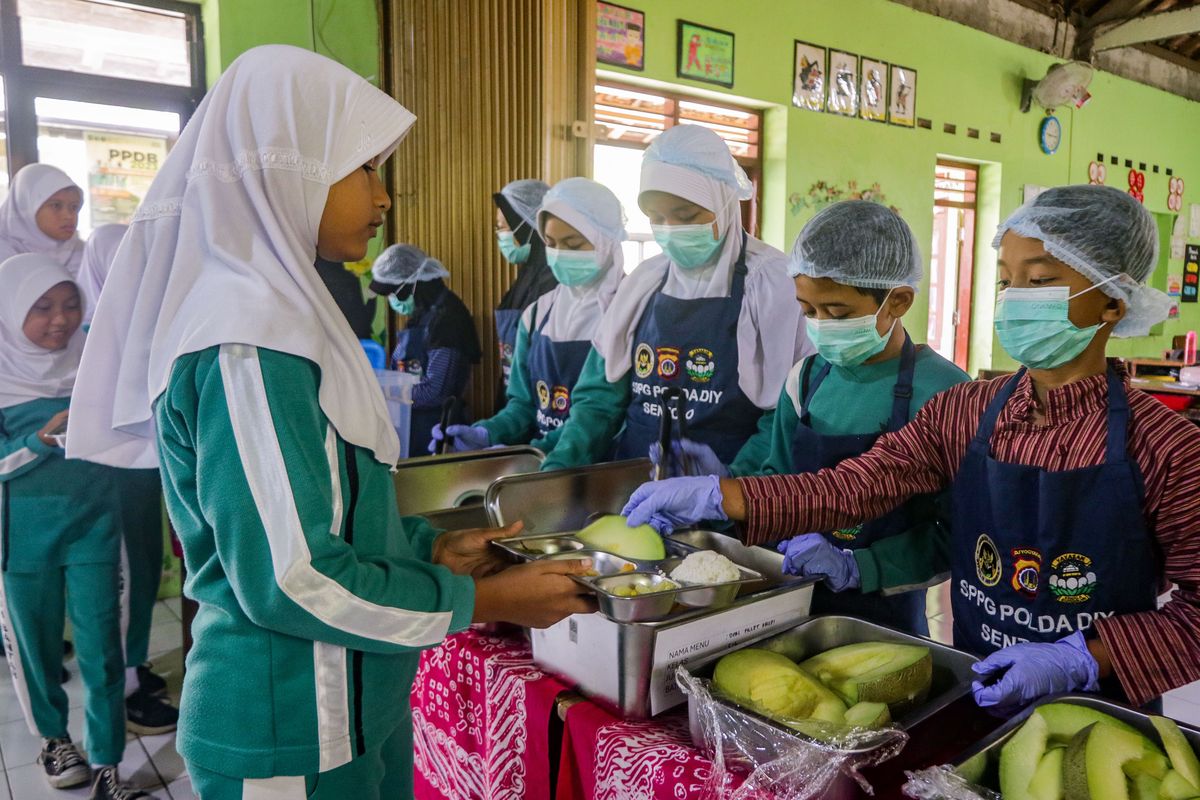
In addition to monitoring through CCTV, BGN is preparing changes in food serving methods through a buffet system.
Sudaryono targets this method to be implemented in 5,000 to 10,000 kitchens by the end of 2026.
Previously, trials were conducted in 66 kitchens and will be expanded to approximately 230 additional kitchens.
According to Sudaryono, the buffet method allows food to be served warm directly in classrooms, thus eliminating the need for reheating.
Food is brought from the kitchen to each classroom according to the number of students.
Food temperatures are also maintained at a minimum of 60 degrees Celsius.
"If there are 30 people in a class, 30 servings of rice, vegetables, and side dishes are brought to the class, served, eaten, cleaned up, and finished. So, it stays warm; no need to reheat because it's brought warm, kept at a minimum of 60 degrees," Sudaryono explained.
This method also allows students to take extra food if still hungry, as long as it adheres to portion guidelines and nutritional needs.