


Deputy Chairman of DPD Urges Local Governments to be More Independent, Avoid Reliance on Central Funds
-
News
-
16 minutes ago
This article was translated by AI. Read the original article on Kompas.com. See Original
THERE is something more important than debating whether the cancellation of Gibran Rakabuming Raka's Educational Equivalence Certificate can undermine his position as Vice President.
It is how the state is held accountable for administrative decisions that have been utilized in the most critical political process when those decisions are annulled by the court.
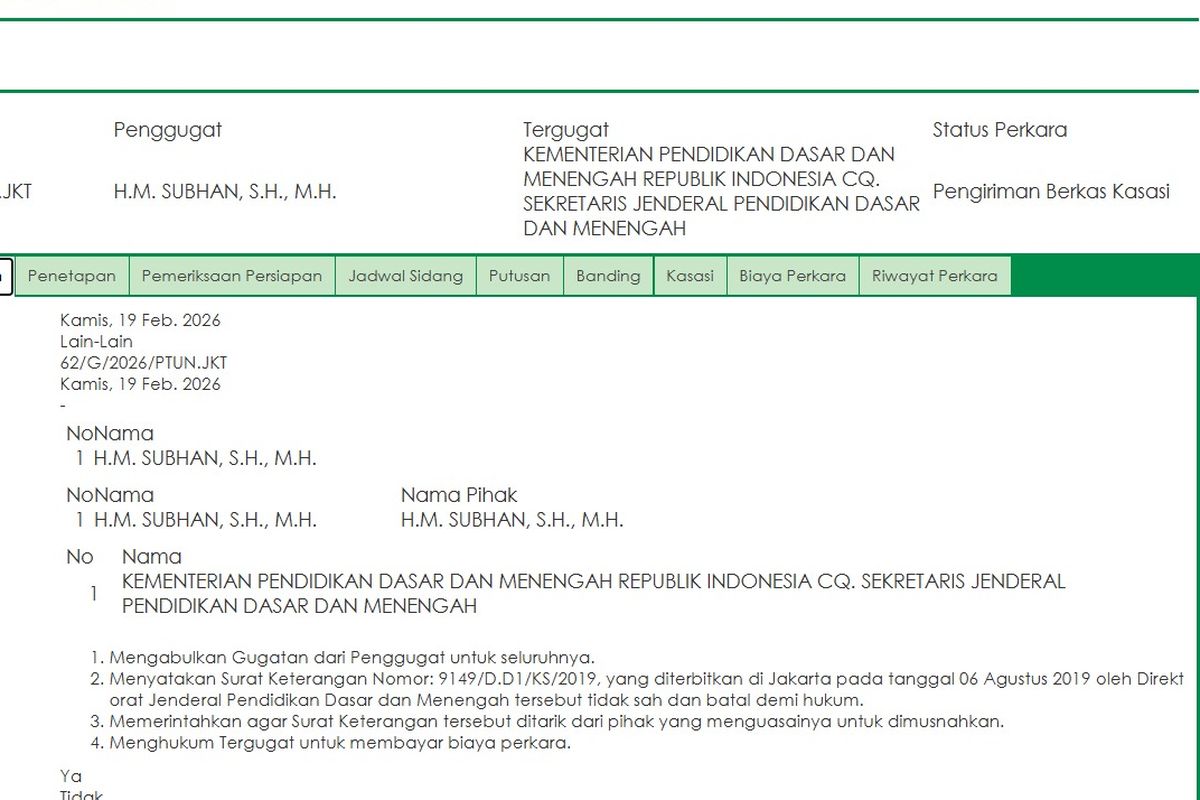
The Supreme Court's cassation ruling in case number 742 K/TUN/2026 has brought this issue into the public domain.
According to circulating information about the ruling, the Supreme Court granted the cassation, annulled the previous court ruling, and ruled on the matter by granting the complaint in its entirety.
However, the complete copy of the ruling is not yet available for inspection.
As a result, the basis for the judges' consideration and the details of the obligations imposed in the ruling cannot yet be fully confirmed.
In the midst of this limited information, a disciplined legal thought process is necessary. The annulment of administrative decisions must not be viewed as without consequence.
Conversely, such consequences cannot simply be extended to other decisions that have their own authority and testing mechanisms.
The issue of Gibran's Educational Certificate is not just about the validity of a document.
It also tests the state's capability to trace, correct, and account for administrative decisions that have been employed in the electoral process.
The object of dispute in this case is the Certificate Number 9149/D.D1/KS/2019 dated August 6, 2019, related to Gibran's educational equivalence.
In administrative law, a government decision can be reviewed based on authority, procedure, and substance.
However, not necessarily all three aspects will serve as the basis for the judges' considerations in every case.
Without reading the complete considerations, it is inaccurate to conclude that the Supreme Court found defects of authority, procedural errors, or certain substantive mistakes.
Likewise, the plaintiff's demands should not be directly equated with court rulings.
The petitum refers to the requests of the parties in the case, while the ruling determines what the judges decide.
This distinction is crucial because the execution of the ruling depends on the obligations explicitly laid down by the court.
In state administrative cases, Article 116 of the Administrative Judicial Review Law, as amended, outlines the mechanism for implementing legally binding rulings.
Its execution depends on the type of obligations placed on the defendant.
Therefore, respect for the Supreme Court's decision must begin with clarifying who is bound, what actions are required, and how these obligations are to be fulfilled.
Respecting court rulings does not mean extending their meanings according to political will.
On the contrary, limiting the consequences of a ruling should not be used as an excuse to evade legal obligations.
Article 30 of Law Number 30 of 2014 concerning Government Administration distinguishes between unlawful decisions and decisions that can be annulled.
Articles 70 and 71 regulate different legal consequences, including the validity of the decision and its resulting implications.
This distinction shows that annulment does not always have identical consequences.
Its determination must consider the basis for invalidity, the character of the decision, and the applicable legal provisions.
Articles 67 and 68 are also relevant because they outline follow-up measures for annulments, including issues related to documents and the issuance of new decisions under circumstances prescribed by law.
Thus, the annulment of an administrative decision is not merely a declaration that the government has made a mistake.
In certain circumstances, annulment necessitates further action to restore administrative order.
However, not every annulment automatically requires the destruction of documents, issuance of replacement decisions, or annulment of all decisions that were ever associated with it.