
Cabinet Lawsuit: Are Our Civil Servants Ready for Change?
-
News
-
2 minutes ago
Editor
This article was translated by AI. Read the original article on Kompas.com. See Original

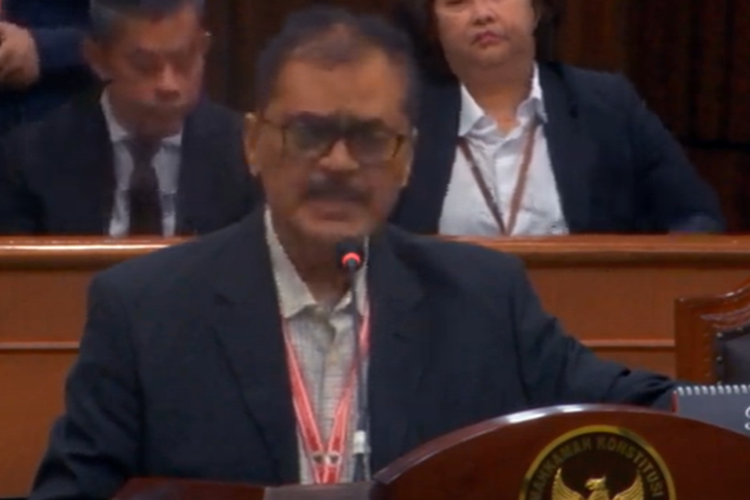
JAKARTA, KOMPAS.com - The Judicial Commission (KY) believes that the restructuring of laws pertaining to the judiciary through the Omnibus Law method is essential to strengthen ethical oversight of judges and harmonize the judicial system in Indonesia.
KY member Andi Muhammad Asrun argues that this step is urgent to resolve the issue of dual oversight, where internal oversight is conducted by the Supreme Court’s Supervisory Body (Bawas MA), while external oversight is managed by KY over the same subject and behavioral scope.
“Many laws in the judiciary need to be reorganized through the Omnibus Law method to incorporate everything and establish KY as the ethical overseer,” Asrun stated in a confirmation on Saturday (31/10/2026) in Jakarta.
This push was expressed by Asrun while serving as a speaker in a public discussion titled “Repositioning KY as a Completer of Judicial Power: Strengthening Authority, Institutions, and Judicial Integrity” in Palembang on Thursday (29/10).
Asrun explained that ethical oversight has a strong philosophical foundation as a moral guide in law enforcement. Judges who uphold ethics are expected to adjudicate cases fairly and with integrity.
He also emphasized the fundamental differences between legal violations and ethical violations.
If flawed decisions can be corrected through legal appeals ranging from appeals, cassation, to judicial reviews (PK), ethical violations require a separate corrective mechanism by an independent institution.
“For ethical violations, there should be another institution that performs the correction,” he said.
According to him, violations of the Code of Ethics and Guidelines for Judge Behavior (KEPPH) cannot always be uncovered solely through legal procedural examinations.
Court proceedings that formally seem to follow procedures do not necessarily guarantee that judges act fairly and impartially.
“Such matters cannot be proven through procedural law, but must undergo ethical examinations,” he asserted.
Asrun emphasized that KY's existence is not intended to hunt for mistakes or punish judges, but to uphold the honor and integrity of the judicial corps through objective and proportional oversight mechanisms.
“KY must be balanced and seek positive aspects. If KY and MA synergize, the results will be positive,” said Asrun.