

BRIN Researcher Warns Against Hasty Relocation of Javan Rhinoceros
-
News
-
33 minutes ago
This article was translated by AI. Read the original article on Kompas.com. See Original
JAKARTA, KOMPAS.com - The Chairperson of the Indonesian Consumers' Foundation (YLKI), Niti Emiliana, has expressed concerns regarding the imposition of Value Added Tax (VAT) on feminine hygiene products.
She stated that the tax burden on basic necessities, which are not luxury items, could exacerbate economic disparities.
"The VAT on sanitary pads has the potential to widen economic inequality. The tax burden is not evenly felt by all consumers; women from low-income families and vulnerable groups are likely to face greater difficulties in meeting their menstrual needs," Niti explained in her statement on Thursday (30/10/2026).
"This policy should be viewed from the perspective of consumer protection and gender equality to avoid reinforcing structural economic discrimination," she added.
For this reason, she urged the government to creatively explore tax sources, rather than relying on taxing basic necessities that women require.
"We must not allow basic community needs to become tax targets simply because the government lacks breakthroughs in finding fairer and more progressive revenue sources," she cautioned.
Consequently, YLKI is urging the government to eliminate VAT on feminine hygiene products through adjustments to applicable policies and tax regulations.
They also called for an evaluation of the taxation on other menstrual products, taking into account health, affordability, consumer protection, and gender equality.
"We need to formulate a creative, progressive, and equitable tax revenue strategy by optimizing tax potential and enhancing compliance, without burdening vulnerable groups in meeting their basic needs," she said.
YLKI emphasizes that tax policies should favor justice and community welfare.
"The state must be present to protect consumers, not to add burdens on unavoidable biological needs," Niti concluded.
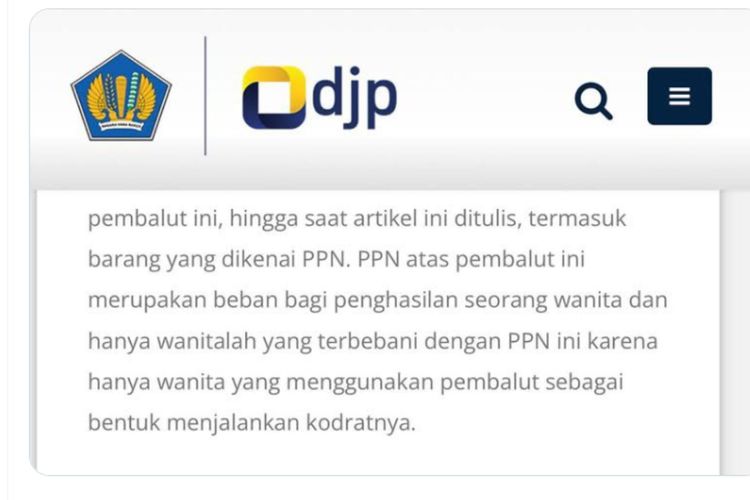
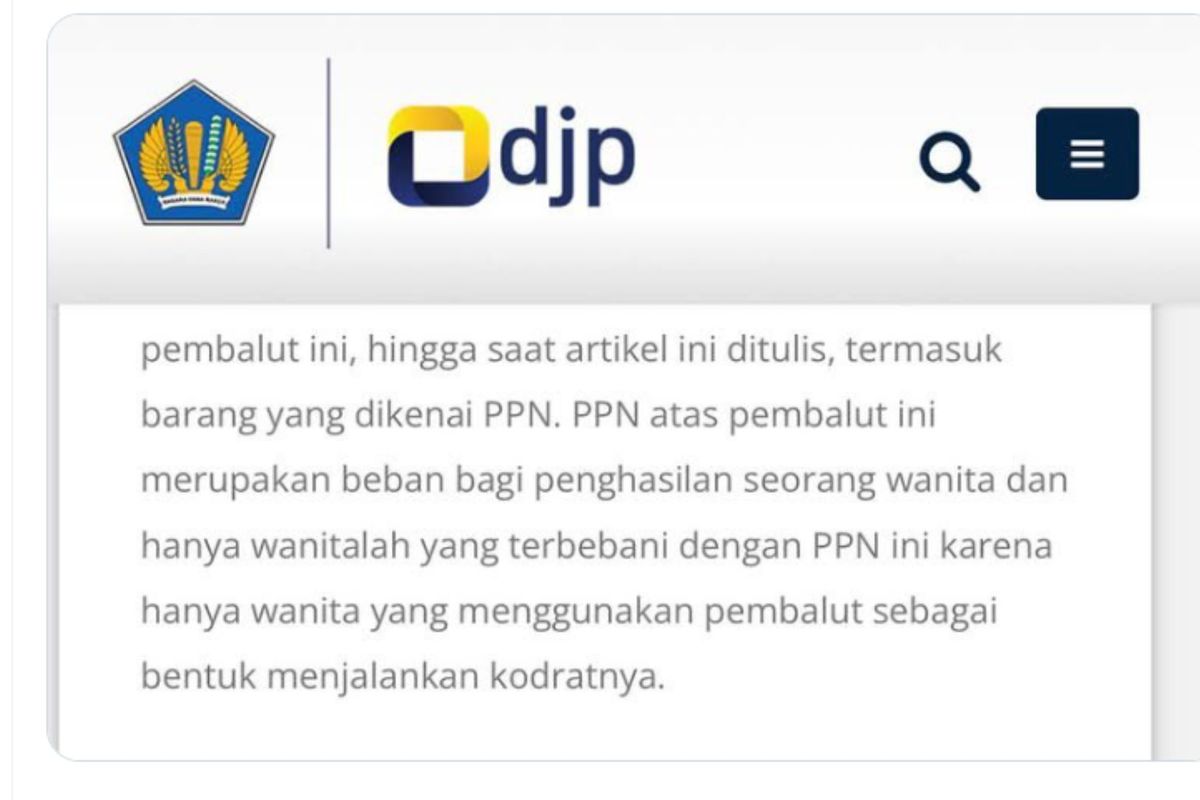
Previously, the Directorate General of Taxes (DJP) clarified that the imposition of VAT on sanitary pads is not a tax specifically targeting women or menstruation.
This tax is a part of the consumption tax system that applies in Indonesia.
The Director of Counseling, Services, and Community Relations at DJP, Inge Diana Rismawanti, explained that, in principle, goods consumed by the public are subject to Value Added Tax (BKP), except for certain goods that are granted exemption facilities based on regulatory provisions.
Sanitary pads sold in Indonesia are included as items subject to VAT as long as their delivery meets the applicable tax regulations.
"Sanitary pads are currently not included in the category of goods eligible for such exemption facilities," Diana stated in a conversation with Kompas.com on Thursday (29/10/2026).
As such, sanitary pads are still subject to an 11 percent VAT rate.