
Indonesia-China Signs MoU Worth Rp 1,300 Trillion on Smart Cities and Job Creation
-
News
-
5 minutes ago
This article was translated by AI. Read the original article on Kompas.com. See Original
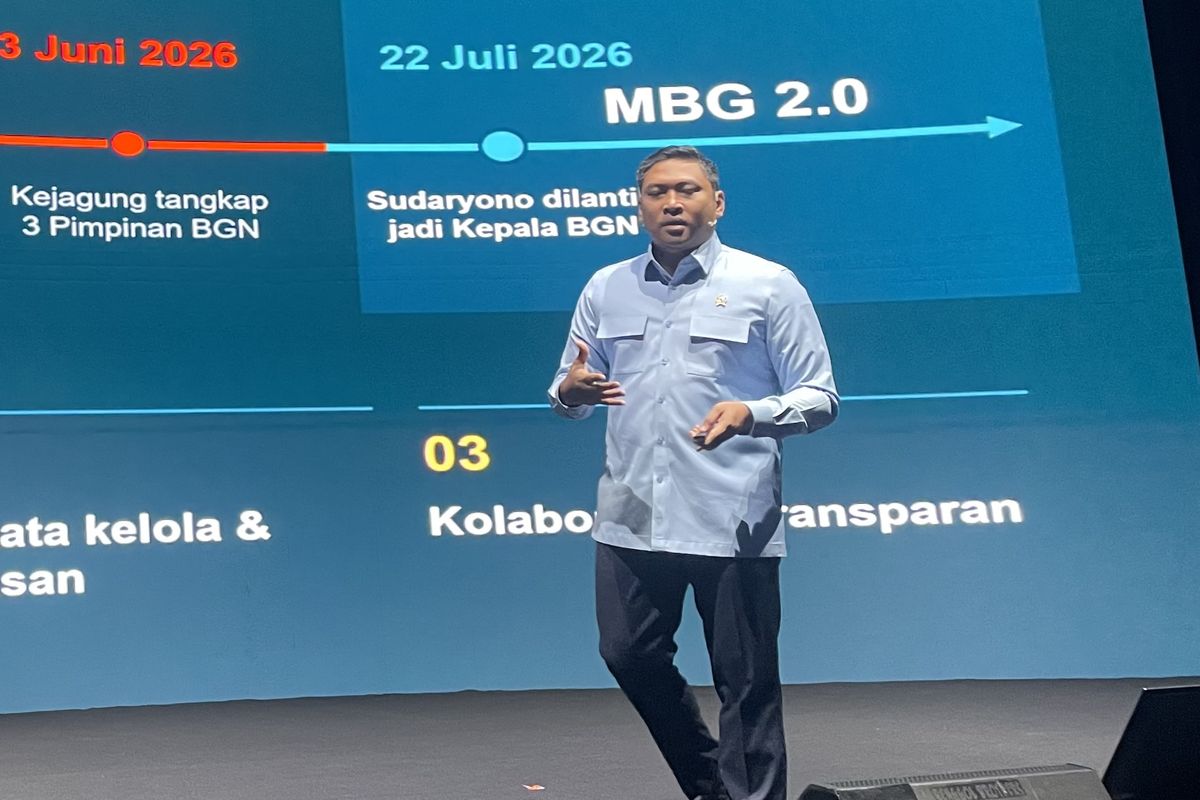
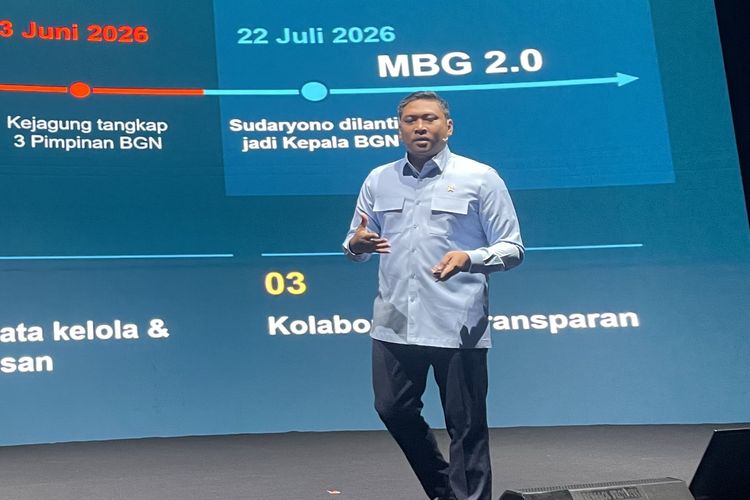
JAKARTA, KOMPAS.com - Head of the National Nutritional Agency (BGN) Sudaryono outlined his accomplishments during the first 100 days in office since his appointment on July 22, 2026. He presented several important notes, ranging from the system failures of BGN under previous leadership to budget efficiency measures that saved Rp 44 trillion, as well as cleaning up the practices of intermediary foundations.
Before detailing his achievements, Sudaryono emphasized that BGN does not ignore the issues affecting the Free Nutritious Meals (MBG) program. He asserted that BGN is ready to receive complaints and concerns raised by the public.
Sudaryono revealed allegations of the sale of MBG kitchen points valued at up to Rp 300 million to Rp 350 million.
He discovered the practice of selling SPPG after being entrusted to lead BGN, replacing Dadan Hindayana, who was embroiled in a corruption case. “Kitchen points were being sold. Before I became Head of BGN, I often heard about prices like Rp 350 million and Rp 300 million. Additionally, there were many intermediary foundations. I found this out after I took over at BGN,” he stated.
Sudaryono explained that the SPPG kitchens should ideally be established by partners or investors, who must have a foundation to channel the MBG.
From the Rp 268 trillion allocated for the MBG budget, Sudaryono calculated that the actual program needs are only Rp 229 trillion.
Approximately Rp 38 trillion has already been returned to the state treasury by BGN. “After our calculations, we determined that Rp 229 trillion suffices, allowing us to return Rp 38 trillion to the state treasury,” he remarked.
Further efficiency was achieved by revising the incentives received by the Nutritional Fulfillment Service Units (SPPG) from Rp 6 million to Rp 2,000 per portion. “The savings from this measure are estimated between Rp 2.5 trillion to Rp 3 trillion by the end of the year, helping us safeguard the national budget,” he added.
Sudaryono also made cost-saving adjustments to the operational funds of MBG kitchens, reducing them to a maximum of Rp 3,000 from an average of Rp 4,500. “The difference, multiplied by the remaining days until the end of the year and the number of meals we provide, enables us to save approximately another Rp 3 trillion,” he explained.
The final efficiency relates to fictitious balances. Sudaryono noted that previous leaders had maintained fictitious kitchen accounts.
According to new regulations, BGN mandates that all CCTVs installed in MBG kitchens must connect to the central system. “It is mandatory that all kitchens must have CCTVs that are connected to the BGN system for monitoring,” Sudaryono stated. The former Deputy Minister of Agriculture indicated that the plan for connected CCTVs had also been reported to President Prabowo Subianto.
“In line with the President's instructions, we informed him about reports related to several poisoning cases. This has become mandatory,” he noted. Despite the requirement, Sudaryono revealed that some SPPG were reluctant about CCTV installations. However, BGN remains steadfast in its position. By the end of 2026, they aim for 10,000 MBG kitchens to be equipped with CCTV.
All SPPG are also required to create daily fund usage reports (LPDH) before replenishing or topping up budgets as a means of ensuring transparency in the use of state funds for the MBG program. “Before the funds run out and more money is sent, the SPPG must account for the expenditures made,” he clarified.
The mandatory LPDH mechanism must be adhered to before any virtual kitchen account can be topped up. “So, if there are social media announcements that a kitchen isn't operational due to a lack of operational funds, it doesn't mean the state lacks funds. The funds are available, but they cannot provide a proper report,” he stated.
The MBG program is entering a new chapter with the development of MBG 2.0, focusing on enhancing service quality, food security, and program governance.
The MBG 2.0 concept is built upon three main priorities: eradicating corruption, strengthening management and supervision, and ensuring transparency and collaboration.