

Menkomdigi Urges Religious Leaders to Prevent Disinformation in the Digital Space
-
News
-
3 minutes ago
This article was translated by AI. Read the original article on Kompas.com. See Original
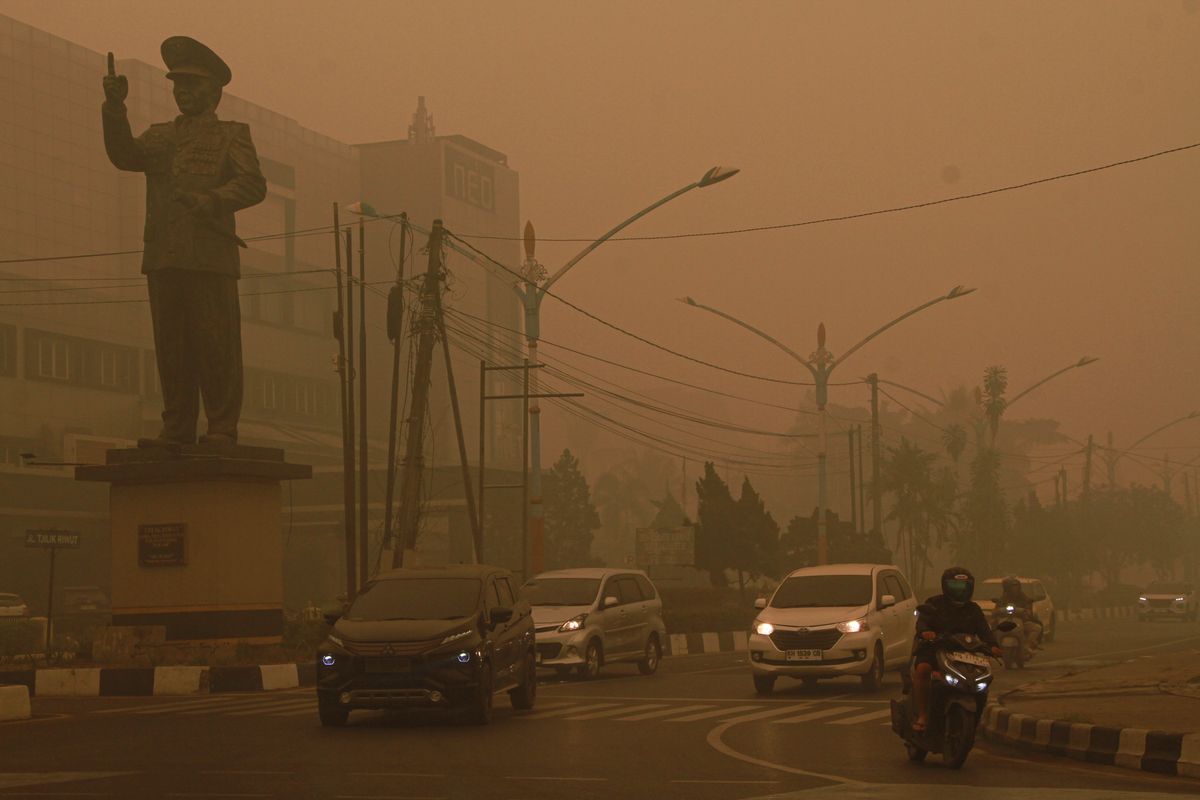
ON a morning shrouded in thick smog, on October 12, 2026, an elementary school student asked their teacher: “Ma'am, why is the sky no longer blue, why is it full of smoke, and why are many plants drying up and dying?”
The teacher did not respond to these questions with scientific theories about atmospheric physics.
Instead, she explained about forest and land fires, the oxygen mixed with toxic chemicals that formed, the countless animals and plants that were burned, and she invited all the students to pray for rain to come down from God.
On the same morning at the State Palace, a minister answered questions from reporters about whether the forest fire crisis had become a national disaster.
The minister confidently replied, “We are still able to manage.”
Between the now non-blue sky and that confident statement lies a deep logical chasm where the state hides behind definitions.
Head of the National Disaster Mitigation Agency (BNPB), Lieutenant General Kristomei Sianturi, emphasized that the criteria for declaring a national disaster must be evaluated. He stated, “The determination of the status of a national disaster, whether it is a national or regional disaster, has its indicators.” (Kompas.com, October 15, 2025)
These indicators include the affected area, number of victims, and a declaration of incapacity by local governments.
This framework was reinforced by Constitutional Court Decision Number 261/PUU-XXIII/2025 dated August 28, 2026, which requires at least three out of five indicators to be met, with the number of victims being the primary indicator.
Philosophically, this represents a form of administrative idealism that separates maps from territory.
The legal map states that a disaster has not yet occurred, while the territory is filled with thousands of hot spots.
On October 26, 2026, the SiPongi system recorded 3,022 hot spots in the last 24 hours, although the high-confidence figures had drastically declined thanks to rain and intensive operations.
The area burned from January to July 2026 reached 202,004 hectares, with independent data suggesting that the accumulative total by August far exceeded that figure.
As of October 25-26, thousands of hectares remain under active management in Kalimantan and Sumatra.
The state creates definitions of disaster, then uses those definitions to delay recognition of disasters.
Coordinating Minister for Political, Legal and Security Affairs, Dudung Abdurachman, asserted, “Not yet, not yet. We can still manage.”
This phrase was echoed again on October 19, 2026: “Regarding the declaration of national disaster. For now, we are still able. Our country is still capable.”
Here, the logic of capacity is not measured by a blue sky returning but by the state's ability to refrain from declaring itself incapable.
Even after the inauguration of the new head of BNPB on October 15, 2026, who emphasized rapid response measures, the national status remained unrecognized.
The government's second argument is much more candid, yet equally problematic.
Dudung pointed out that the fires are not only related to community activities, but there are indications of corporations and specific external parties deliberately creating conditions, and if declared a national disaster, certain parties would likely exploit the situation.
Chief of Police General Suyudi Ario Seto confirmed that hundreds of individuals and 13 corporations have been designated as suspects related to the forest fires, with burned land in concessions and private ownership totaling 35,390 hectares.